
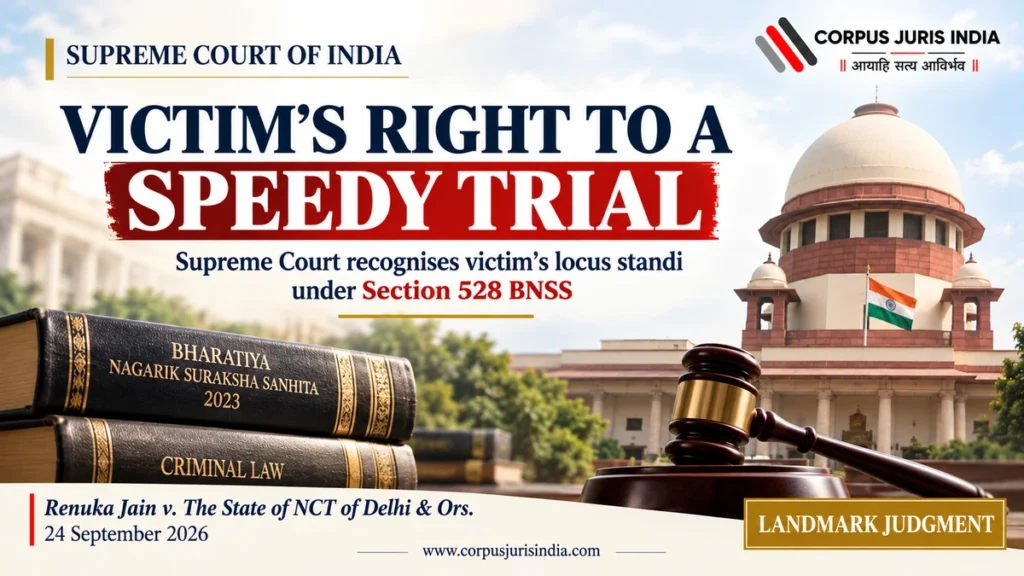
Can a Victim Approach the High Court for a Speedy Trial?
Can a victim or complainant independently approach the High Court when a criminal trial continues to face delays? Or is the right to seek expeditious disposal available only to the accused or the State?
In Renuka Jain v. The State of NCT of Delhi & Ors., 2026 INSC 1100, decided on 24 September 2026, the Supreme Court of India examined a victim’s right to speedy trial under Section 528 of the Bharatiya Nagarik Suraksha Sanhita, 2023 (BNSS). The Court held that a victim has the legal standing to approach the High Court seeking expeditious completion of criminal proceedings.
The decision addresses an important question concerning victims’ rights, criminal procedure and the High Court’s inherent jurisdiction. It clarifies that the State’s conduct of a prosecution does not, by itself, reduce the victim to the role of a witness for the purpose of seeking a speedy trial.
Case Snapshot
| Particulars | Details |
|---|---|
| Case Title | Renuka Jain v. The State of NCT of Delhi & Ors. |
| Court | Supreme Court of India |
| Neutral Citation | 2026 INSC 1100 |
| Reported Citation | 2026 LiveLaw (SC) 1033 |
| Date of Order | 24 September 2026 |
| Bench | Justice Ujjal Bhuyan and Justice Atul S. Chandurkar |
| Proceeding | Criminal Appeal arising from SLP (Criminal) No. 13468/2026 |
| Key Provision | Section 528, BNSS, 2023 |
| Principal Issue | Victim’s locus standi to seek expeditious completion of a criminal trial |
| Outcome | Appeal allowed; Delhi High Court order set aside |
Read the Supreme Court Order
The original order records the facts, statutory provisions, earlier judicial decisions and the Supreme Court’s final directions.
[Read Supreme Court Order (PDF)]
Background of the Case
The proceedings arose from FIR No. 211/2017, registered at Farsh Bazar Police Station, Delhi, on the appellant’s complaint alleging an offence under Section 420 of the Indian Penal Code, 1860.
Following investigation, a charge sheet was filed and the case was registered as C.R. No. 7850/2019 before the Judicial Magistrate First Class at Shahdara District Courts, Karkardooma, Delhi.
The complainant had previously approached the Delhi High Court concerning the delay in the trial. By an order dated 7 February 2023, the High Court directed the trial court to conclude the proceedings within two years after the framing of charges.
The trial nevertheless continued. When the matter came before the Supreme Court, the prosecution had cited 22 witnesses, one of whom had been deleted. The remaining list comprised 21 prosecution witnesses, and PW-1 was undergoing cross-examination.
The complainant subsequently approached the Delhi High Court under Section 528 BNSS, seeking a direction for expeditious disposal of the trial.
The prosecution questioned her locus standi, contending that in a State-prosecuted case, the complainant’s role was limited to being a witness and that only the State or the accused could institute such proceedings.
The High Court accepted this objection. By its order dated 6 January 2026 in CRL.M.C. No. 44/2026, it dismissed the petition, characterised it as frivolous and imposed costs of ₹10,000 on the complainant.
The complainant challenged that decision before the Supreme Court.
The Legal Question Before the Supreme Court
The principal question was whether a victim or complainant in a criminal case prosecuted by the State can independently approach the High Court under Section 528 BNSS to seek expeditious completion of the trial.
The question required consideration of the victim’s recognised position in criminal proceedings and the scope of the High Court’s inherent jurisdiction.
The issue was not whether the complainant could take over the State’s prosecution. It was whether she could seek judicial intervention to address prolonged trial delays.
What Did the Supreme Court Decide?
The Supreme Court rejected the proposition that a victim’s role is necessarily confined to appearing as a witness.
It recognised that a victim, or the victim’s legal guardian where applicable, has a legitimate stake in criminal proceedings because the alleged offence has caused the loss or injury that triggered the criminal process.
The Court held that the right to insist on a speedy and fair trial is not exclusively a concern of the accused. A victim also has locus standi to approach the High Court under Section 528 BNSS seeking a direction for expeditious completion of the trial.
The decision is significant because it addresses a procedural barrier that may arise when a complainant seeks judicial intervention in a case prosecuted by the State.
The Court’s reasoning does not transfer control of the prosecution to the complainant. It recognises the complainant’s standing to seek appropriate judicial directions while the prosecution continues within the applicable legal framework.
Section 528 BNSS: The High Court’s Inherent Powers
Section 528 of the Bharatiya Nagarik Suraksha Sanhita, 2023, preserves the inherent powers of the High Court. It corresponds to Section 482 of the Code of Criminal Procedure, 1973.
The provision enables the High Court to make orders necessary to give effect to orders under the Sanhita, prevent abuse of the process of a court, or otherwise secure the ends of justice.
In Renuka Jain, the Supreme Court examined the statutory provisions concerning the conduct of prosecution, the victim’s ability to assist the prosecution and the legal definition of a victim.
The Court noted that the corresponding provisions under the BNSS recognise the victim’s position in the criminal justice system. The statutory framework did not support the view that a victim becomes legally irrelevant once the State takes over the prosecution.
Accordingly, the Court held that a victim may invoke the High Court’s inherent jurisdiction to seek expeditious disposal of a criminal trial.
This recognition of locus standi does not mean that every application must automatically succeed. The High Court must still consider the request under the applicable law and in light of the circumstances of the case.
Earlier Supreme Court Decisions Considered
The Court placed its reasoning within the established jurisprudence on speedy trials and victims’ rights.
1. Mangal Singh v. Kishan Singh
In Mangal Singh v. Kishan Singh, (2009) 17 SCC 303, the Supreme Court recognised that delays in criminal trials can cause serious suffering to victims. The consequences of delay are not confined to the accused; victims may also experience substantial prejudice and distress.
2. Rattiram v. State of Madhya Pradesh
In Rattiram v. State of Madhya Pradesh, (2012) 4 SCC 516, the Supreme Court discussed the importance of speedy trial and explained that the right cannot be treated as an exclusive entitlement of the accused.
3. Amir Hamza Shaikh v. State of Maharashtra
In Amir Hamza Shaikh v. State of Maharashtra, (2019) 8 SCC 387, the Court considered the victim’s position and ability to participate in criminal proceedings, referring to the statutory framework and earlier decisions.
4. J.K. International v. State (NCT of Delhi)
In J.K. International v. State (NCT of Delhi), (2001) 3 SCC 462, the Court recognised that an aggrieved person is not altogether excluded from criminal proceedings merely because the investigation and prosecution are undertaken by the police and the State.
5. Keshvendra Singh v. Shankar Singh
The Court also referred to Keshvendra Singh v. Shankar Singh, cited in the order as 2026 SCC OnLine SC 1588, which recognised the victim’s interest in a speedy trial alongside that of the accused.
Taken together, these authorities informed the Supreme Court’s conclusion that a victim’s interest in timely justice cannot be disregarded merely because the State conducts the prosecution.
Why Was the Delhi High Court’s Order Set Aside?
The Supreme Court disagreed with the High Court’s treatment of the complainant’s petition as frivolous and as an unnecessary burden on the court’s docket.
The Supreme Court found that the impugned order proceeded on an incorrect understanding of the relevant legal and constitutional provisions. The complainant could not be denied standing simply because the case was being prosecuted by the State.
The Court therefore set aside the Delhi High Court’s order dated 6 January 2026. The order imposing costs of ₹10,000 on the complainant was also set aside.
The ruling is confined to the legal issue before the Court. It does not determine the truth of the allegations underlying the criminal case.
Final Directions of the Supreme Court
The Supreme Court allowed the appeal and directed the trial court to conclude the proceedings in C.R. Case No. 7850/2019 expeditiously, within an outer limit of one year from 24 September 2026.
The Court expressly clarified that it had not expressed any opinion on the merits of the underlying case and that all contentions remained open.
The direction is therefore concerned with the timely completion of the trial, not with determining the guilt or innocence of any accused person.
Key Legal Takeaways
- A victim is not merely a witness: The victim has a recognised stake in the criminal justice system.
- A victim may seek a speedy trial: Section 528 BNSS can be invoked to approach the High Court for expeditious completion of criminal proceedings.
- State prosecution does not automatically exclude the victim: The State’s role in conducting the prosecution does not, by itself, eliminate the victim’s standing to seek a speedy trial.
- Delay affects both sides: Prolonged criminal proceedings may prejudice victims as well as accused persons.
- Relief is not automatic: The judgment recognises standing to seek a direction; it does not guarantee that every application will be allowed.
- The merits remain open: The Supreme Court set aside the High Court’s order without deciding the underlying criminal allegations.
Conclusion
Renuka Jain v. The State of NCT of Delhi & Ors., 2026 INSC 1100, clarifies an important aspect of criminal procedure: a victim may approach the High Court under Section 528 BNSS to seek expeditious completion of a criminal trial.
By rejecting the view that a complainant in a State-prosecuted case is merely a witness for this purpose, the Supreme Court recognised the victim’s legitimate interest in the timely and fair administration of criminal justice.
The judgment does not make speedy-trial relief automatic or determine the merits of the underlying prosecution. Its significance lies in confirming that the victim has standing to seek appropriate judicial intervention when criminal proceedings are delayed.
Disclaimer
This content is published solely for legal information, legal education and reporting of judicial or legal developments. It does not constitute legal advice, create a lawyer-client relationship, or amount to solicitation or advertisement under the applicable Bar Council of India Rules.