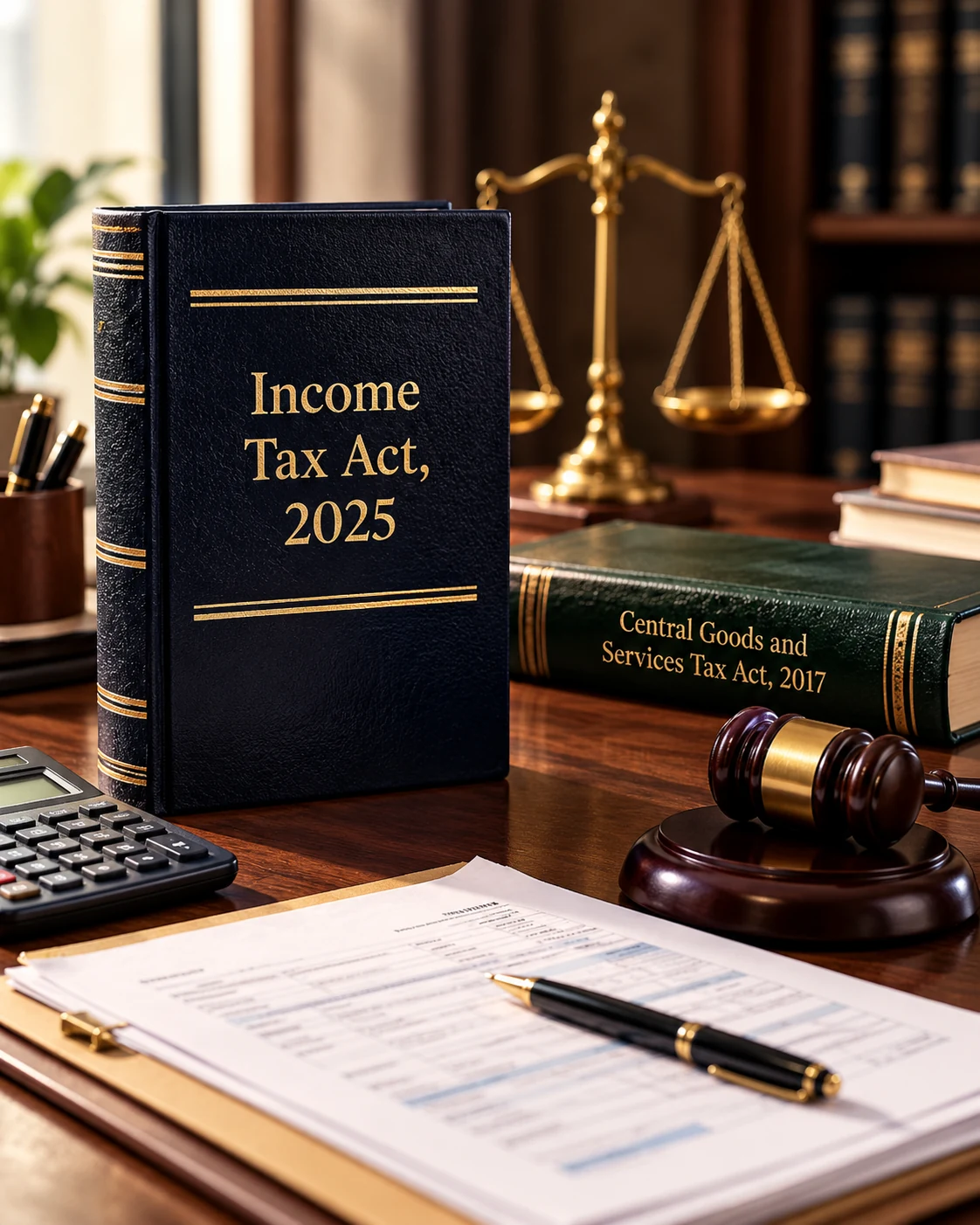
Taxation law in India governs the assessment, levy, collection and administration of direct and indirect taxes. The principal statutory framework includes the
Income-tax Act, 2025 for direct taxes, and the
Central Goods and Services Tax Act, 2017, the
Integrated Goods and Services Tax Act, 2017, and the
State Goods and Services Tax Acts, 2017 for goods and services tax, together with the
Customs Act, 1962 for customs duties. The
Income-tax Act, 1961 continues to apply to certain earlier tax years and pending or transitional matters in accordance with the applicable savings and transitional provisions. Appellate authorities and tribunals, including the
Income Tax Appellate Tribunal (ITAT), the
GST Appellate Tribunal (GSTAT) and the
Customs, Excise and Service Tax Appellate Tribunal (CESTAT), exercise jurisdiction over specified categories of tax disputes.
The nature and procedure of a tax matter depend on the
facts of the case, the applicable statute and the
forum or authority having jurisdiction. Disputes may arise in diverse contexts, including assessment, reassessment, appeals, rectification, recovery, penalty proceedings, and issues relating to input tax credit, classification, valuation, exemptions and refunds under the goods and services tax framework. Remedies and procedures vary according to the applicable legal framework and the nature of the matter.
Key Areas of Taxation & GST Law
An overview of the principal categories of direct and indirect tax matters, disputes and related legal issues arising under the current statutory framework in India.
01. Income Tax Assessment & Reassessment
Matters relating to the assessment of income, scrutiny, reassessment and related proceedings under the applicable direct tax framework.
Common Matters: Scrutiny assessments, reassessment notices, best judgment assessments and related proceedings.
Key Issues: Validity of notices, jurisdiction, limitation, and scope of assessment or reassessment.
Legal Focus: Income-tax Act, 2025 and applicable rules, subject to transitional provisions for earlier tax years.
02. Income Tax Appeals & Dispute Resolution
Matters relating to appeals and dispute resolution mechanisms available against orders passed under the direct tax framework.
Common Matters: Appeals before the Joint Commissioner (Appeals) / Commissioner (Appeals), Income Tax Appellate Tribunal (ITAT), High Court and related proceedings.
Key Issues: Maintainability, limitation, grounds of appeal and procedural requirements.
Legal Focus: Income-tax Act, 2025 and applicable appellate procedures.
03. TDS, TCS & Withholding Compliance
Matters relating to tax deducted at source (TDS), tax collected at source (TCS), and related compliance and dispute issues.
Common Matters: TDS/TCS defaults, lower deduction certificates, refunds and related disputes.
Key Issues: Applicability, rates, timelines, default proceedings and remedies.
Legal Focus: Income-tax Act, 2025 and applicable rules and regulations on withholding.
04. GST Registration & Compliance
Matters relating to registration, cancellation, revocation and ongoing compliance obligations under the goods and services tax framework.
Common Matters: Registration disputes, cancellation, revocation, returns and compliance.
Key Issues: Eligibility, procedural compliance and consequences of non-compliance.
Legal Focus: CGST Act, 2017, IGST Act, 2017 and applicable State GST Acts, rules and regulations.
05. GST Assessment & Demands
Matters relating to assessment, scrutiny, demand notices and recovery proceedings under the goods and services tax framework.
Common Matters: Show cause notices, demand orders, recovery proceedings and related disputes.
Key Issues: Validity of notices, jurisdiction, limitation, and grounds for challenging demands.
Legal Focus: CGST Act, 2017 and applicable rules on assessment and recovery.
06. Input Tax Credit & Refunds
Matters relating to input tax credit (ITC), its eligibility, availment, utilisation, reversal, and refunds under the goods and services tax framework.
Common Matters: ITC eligibility disputes, blocked credit, ITC mismatch, and refund claims.
Key Issues: Conditions for eligibility, procedural requirements, and remedies for denial.
Legal Focus: CGST Act, 2017 and applicable rules on ITC and refunds.
07. GST Appeals & Appellate Tribunal
Matters relating to appeals and remedies available against orders passed under the goods and services tax framework.
Common Matters: Appeals before the Appellate Authority, GST Appellate Tribunal (GSTAT), High Court and related proceedings.
Key Issues: Maintainability, limitation, pre-deposit, grounds of appeal and procedural requirements.
Legal Focus: CGST Act, 2017, applicable appellate provisions and rules.
08. Customs & Indirect Tax Matters
Matters relating to customs duties and other indirect tax issues arising under the applicable customs framework.
Common Matters: Classification, valuation, duty drawback, customs seizures and related disputes under the applicable customs framework.
Key Issues: Applicability of provisions, procedural compliance and remedies.
Legal Focus: Customs Act, 1962 and applicable rules, with appeals before CESTAT and higher courts where applicable.
09. Tax Litigation & Constitutional Remedies
Matters relating to writ proceedings and constitutional remedies in tax disputes, where such remedies are available in accordance with the applicable constitutional and judicial framework.
Common Matters: Writ petitions challenging tax notices or orders, and constitutional remedies in tax matters.
Key Issues: Maintainability, availability of alternative remedies, jurisdiction and grounds for constitutional challenge.
Legal Focus: Constitution of India, Articles 226 and 227, and Supreme Court remedies under Article 136, where applicable.
Legal Assistance in Taxation & GST Law
An overview of the legal assistance that may be relevant in direct and indirect tax matters, depending on the facts, the applicable statute and the forum having jurisdiction.
01
Pre-Filing Assessment & Advisory
Understanding the nature of the tax dispute, relevant facts and documents, applicable provisions of the Income-tax Act, 2025, the CGST Act, 2017 and other relevant laws, and the appropriate forum — including the Joint Commissioner (Appeals) / Commissioner (Appeals), ITAT, GSTAT, CESTAT or High Court — before proceedings are initiated, where applicable.
02
Drafting & Filing of Appeals / Petitions
Assistance relating to the drafting and filing of appeals, writ petitions, replies to show cause notices, rectification applications and other appropriate pleadings before the competent authority, tribunal or court, in accordance with the applicable statutory and procedural framework.
03
Interim Relief & Stay Applications
Assistance in matters involving interim relief, stay of demand or recovery proceedings, or other protective measures that may be sought during the pendency of proceedings before the appropriate court, tribunal or authority, in accordance with the applicable law and procedural framework.
04
Representation before Authorities & Tribunals
Representation and assistance in proceedings before the Assessing Officer, Joint Commissioner (Appeals) / Commissioner (Appeals), Income Tax Appellate Tribunal (ITAT), GST Appellate Tribunal (GSTAT), Customs, Excise and Service Tax Appellate Tribunal (CESTAT), High Courts and other forums having jurisdiction over the matter, including hearings, submissions and related procedural steps, subject to the nature of the matter.
05
Pleadings, Evidence & Arguments
Assistance in the preparation and filing of pleadings, written submissions, counter-affidavits and rejoinders, presentation of documentary evidence, and advancing of arguments before the appropriate forum, in accordance with the applicable procedural law and the requirements of the matter.
06
Appeals & Further Remedies
Assistance concerning statutory appeals, challenges and other remedies available under the applicable law, including appeals against orders of tax authorities and tribunals, and further proceedings before the High Courts and, where applicable, the Supreme Court, subject to the applicable statutory conditions, limitation and procedure.
Stages in a Tax Matter
An illustrative sequence of how a direct or indirect tax matter may progress under the applicable statutory framework, including the Income-tax Act, 2025, the CGST Act, 2017 and the Customs Act, 1962, depending on the nature of the proceedings and the forum having jurisdiction.
01
Pre-Filing Assessment & Advisory
The nature of the tax dispute, relevant facts and documents, and applicable provisions of the relevant statute are assessed, together with the appropriate forum and procedural framework — including the Joint Commissioner (Appeals) / Commissioner (Appeals), ITAT, GSTAT, CESTAT, High Court or other appropriate forum, where applicable — before proceedings are initiated.
02
Notice, Assessment / Reassessment & Demand Stage
Where applicable, proceedings before the tax authority may include issuance of notices, assessment or reassessment, determination of tax liability and consequential demand proceedings, in accordance with the applicable statutory provisions and procedural rules.
03
Filing of Appeal / Petition
An appeal, writ petition or other appropriate proceeding may, where legally available, be filed before the competent appellate authority, tribunal or court in accordance with the applicable statutory and procedural framework and the nature of the forum concerned.
04
Interim Relief & Stay Applications
Where applicable, the appropriate authority, tribunal or court may consider applications for interim relief, stay of demand or recovery proceedings, or other protective measures during the pendency of proceedings, in accordance with the applicable law and procedural framework.
05
Pleadings, Hearing & Evidence
The appropriate forum may consider pleadings, written submissions, replies, documentary evidence and submissions placed on record, in accordance with the applicable procedure and the nature of the matter.
06
Order / Judgment
After considering the material on record and the submissions made, the appropriate forum may pass an order, direction or judgment, as applicable to the nature of the proceedings and the statutory framework governing them.
07
Appeals, Challenges & Further Remedies
Where available under the applicable law, an appeal, statutory challenge or other further remedy may be pursued against an order or judgment, subject to the applicable statutory conditions, limitation and procedure.
08
Compliance, Recovery & Implementation
Where applicable, steps may be taken for compliance with or implementation of an order or judgment, including recovery proceedings, payment or adjustment of tax liabilities, or processing of refunds, in accordance with the applicable statutory provisions and procedural framework.
The sequence illustrated is indicative. Depending on the nature of the matter,
some stages may occur in a different order, concurrently or may not arise at all.
Interim relief or other measures may be sought at an appropriate stage during
proceedings. The information provided is a general overview and should not be
treated as legal advice for any particular matter.
How a Tax Matter May Progress
An overview of how a direct or indirect tax matter may proceed through different authorities and forums, depending on the applicable statutory framework, including the Income-tax Act, 2025, the CGST Act, 2017 and the Customs Act, 1962, and the nature of the proceedings.
01
Assessing / Adjudicating Authority or Other Forum
02
First Appeal / Statutory Appeal
03
Tribunal / High Court, Where Applicable
04
Supreme Court or Other Statutory / Constitutional Remedies
01
Commencement before the Assessing / Adjudicating Authority
A tax matter may be initiated or pursued before the
Assessing Officer, the adjudicating authority under the goods and services tax framework,
the Customs Authority or other appropriate authority, depending on the nature of the matter,
the applicable statutory framework and the forum having jurisdiction.
In Simple Terms
The matter begins before the tax authority having jurisdiction, depending on whether it relates to income tax, GST or customs.
02
First Appeal before the Appellate Authority
An aggrieved party may, where applicable, pursue a first appeal before the
Joint Commissioner (Appeals) / Commissioner (Appeals) under the income-tax framework,
the Appellate Authority under the GST framework,
the Commissioner (Appeals) under the customs framework,
or another prescribed appellate authority, subject to the applicable statutory conditions,
limitation and procedure.
In Simple Terms
If a party is not satisfied with the order, a first appeal may be available before the designated appellate authority, depending on the applicable tax framework.
03
Further Appeal / Challenge before Tribunal or High Court
Where the applicable law permits, a further appeal or other statutory challenge may be pursued before the
Income Tax Appellate Tribunal (ITAT),
the GST Appellate Tribunal (GSTAT),
the Customs, Excise and Service Tax Appellate Tribunal (CESTAT) or the
High Court, depending on the nature of the dispute, the applicable statutory framework
and the jurisdiction of the forum.
In Simple Terms
The matter may then be heard by the appropriate tribunal or the High Court, depending on the applicable statute and the nature of the order.
04
Supreme Court or Other Further Remedies
Where available under the applicable law, a further appeal or other remedy may be pursued before the
Supreme Court or another competent forum, subject to the applicable statutory conditions,
jurisdiction, limitation and procedure. Other statutory or constitutional remedies may also be available
in appropriate cases. Not every tax matter ultimately reaches the Supreme Court.
In Simple Terms
In appropriate cases, a matter may reach the Supreme Court or invoke other remedies, but the availability of these options depends on the applicable law and the nature of the decision.
Please note: The stages illustrated are indicative. Depending on the nature of the matter,
some stages may not arise, may occur concurrently or may not apply at all. The applicable statutory framework,
forum and available remedies determine the actual course of proceedings. The information provided is a general
overview and should not be treated as legal advice for any particular matter.
Documents & Information That May Be Relevant
The documents and information relevant to a tax matter depend on the nature of the dispute, the applicable statutory framework — including the Income-tax Act, 2025, the CGST Act, 2017 and the Customs Act, 1962 — and the relief sought.
01
Identity & Tax Registration Records
PAN, TAN, GST registration certificate, and other identity and registration documents establishing the assessee's tax status and jurisdiction, where applicable.
02
Returns, Statements & Filings
Income tax returns, GST returns, TDS/TCS statements, and other statutory filings made under the applicable tax framework, as relevant to the matter.
03
Notices, Assessment & Demand Orders
Notices, show cause notices, assessment or reassessment orders, demand orders, penalty orders and other orders passed by the tax authority, where applicable.
04
Books of Account & Financial Records
Books of account, financial statements, invoices, ledgers, input tax credit records, e-way bills and other supporting records relevant to the tax dispute, where applicable.
05
Correspondence & Submissions
Replies to notices, submissions, representations, and other communications exchanged with the tax authority relevant to the tax dispute.
06
Appeal & Tribunal Proceedings Records
Appeals, writ petitions, pleadings, orders and judgments of appellate authorities, the Joint Commissioner (Appeals) / Commissioner (Appeals), Income Tax Appellate Tribunal (ITAT), GST Appellate Tribunal (GSTAT), Customs, Excise and Service Tax Appellate Tribunal (CESTAT), High Courts and other forums having jurisdiction over the matter, where applicable.
Please Note: The documents relevant to a tax matter vary according to the nature of the dispute, the applicable statute, the forum involved and the relief sought. Not every document listed above will be relevant to every matter. The information provided is a general overview and should not be treated as legal advice for any particular matter.
Frequently Asked Questions
Common questions about taxation law in India, the Income-tax Act, 2025, the goods and services tax framework, customs law, and related legal remedies.
Taxation law in India governs the assessment, levy, collection and administration of direct and indirect taxes. The principal statutory framework includes the Income-tax Act, 2025 for direct taxes, and the Central Goods and Services Tax Act, 2017, the Integrated Goods and Services Tax Act, 2017 and the respective State Goods and Services Tax Acts, 2017 for goods and services tax, together with the Customs Act, 1962 for customs duties. The Income-tax Act, 1961 continues to apply to certain earlier tax years and pending or transitional matters in accordance with the applicable savings and transitional provisions. Appellate authorities and tribunals, including the Income Tax Appellate Tribunal (ITAT), the GST Appellate Tribunal (GSTAT) and the Customs, Excise and Service Tax Appellate Tribunal (CESTAT), exercise jurisdiction over specified categories of tax disputes.
Direct taxes are levied on the income or profits of a person and are borne directly by the person on whom they are imposed; income tax under the Income-tax Act, 2025 is the principal example. Indirect taxes are levied on the supply of goods or services or on the import or export of goods, and are generally collected by an intermediary and passed on to the ultimate consumer; the goods and services tax under the CGST, IGST and State GST Acts, 2017, and customs duties under the Customs Act, 1962, are principal examples. The two categories differ in their levy, collection, incidence and the statutory framework governing them.
The goods and services tax (GST) framework in India is governed by the Central Goods and Services Tax Act, 2017, the Integrated Goods and Services Tax Act, 2017 and the respective State Goods and Services Tax Acts, 2017, together with the rules and regulations made thereunder. GST is a destination-based tax levied on the supply of goods or services or both. The framework provides for registration, returns and compliance, input tax credit, assessment, demand and recovery, refunds, and appellate remedies before the Appellate Authority and the GST Appellate Tribunal (GSTAT). The specific provisions applicable depend on the nature of the transaction, the place of supply and the applicable statutory provisions and rules.
The appellate structure under the Income-tax Act, 2025 generally provides for a first appeal before the Joint Commissioner (Appeals) or Commissioner (Appeals), as applicable, followed by an appeal before the Income Tax Appellate Tribunal (ITAT). Further remedies may include appeals before the High Court and, in appropriate cases, the Supreme Court, subject to the applicable statutory conditions, limitation and procedure. The availability, scope and procedure of each remedy depend on the nature of the order, the applicable provisions and the forum having jurisdiction. Not every order follows the same appellate route.
Assessment refers to the process by which the tax authority determines the income, turnover or tax liability of a person for a given tax period, in accordance with the applicable statutory provisions. Reassessment refers to a subsequent proceeding through which the tax authority may reopen or revise an earlier assessment, subject to the conditions, procedural requirements and limitation periods prescribed by the applicable statute. The grounds, procedure and limitation for assessment and reassessment differ under the applicable tax framework, and the validity of such proceedings may be subject to judicial review where the statutory conditions are not satisfied.
Input tax credit (ITC) under the goods and services tax framework refers to the credit that a registered person may be entitled to claim in respect of tax paid on inputs, input services or capital goods used or intended to be used in the course or furtherance of business, subject to the conditions and restrictions prescribed under the applicable provisions. The eligibility, availment, utilisation and reversal of ITC are governed by the CGST Act, 2017 and the rules made thereunder. Disputes relating to ITC eligibility, blocked credit, mismatch or denial of credit may be pursued through the available statutory remedies, subject to the applicable conditions and procedure.
The Income Tax Appellate Tribunal (ITAT) is a statutory tribunal that exercises appellate jurisdiction over specified categories of direct tax matters. The GST Appellate Tribunal (GSTAT) exercises appellate jurisdiction over specified categories of goods and services tax matters. The Customs, Excise and Service Tax Appellate Tribunal (CESTAT) exercises appellate jurisdiction over specified customs, central excise and service tax matters. Each tribunal operates under its own statutory framework, and the remedies against their orders depend on the applicable statutory framework and may include proceedings before the High Court or the Supreme Court, where available.
The limitation period for filing a tax appeal depends on the applicable statute, the nature of the order and the forum before which the appeal is filed. The Income-tax Act, 2025, the CGST Act, 2017 and the Customs Act, 1962 prescribe specific limitation periods for different categories of appeals, subject to provisions relating to condonation of delay, where applicable. For example, the first appeal under the income-tax framework is generally subject to a prescribed limitation period, while GST and customs appeals are governed by their respective statutory periods. The computation of limitation and availability of condonation depend on the applicable statutory provisions and the facts of the matter. The specific limitation applicable to a matter should therefore be verified with reference to the applicable statute and order concerned.
A tax notice or order may, in appropriate cases, be challenged before the High Court under Article 226 of the Constitution of India, and supervisory jurisdiction under Article 227 may be relevant where applicable. The maintainability of such proceedings may depend on factors including the availability of an alternative statutory remedy, the nature of the challenge and the stage of the proceedings. Further remedy before the Supreme Court may be available under Article 136 in appropriate cases, subject to the applicable constitutional and legal framework. The specific position should be verified with reference to the applicable law and facts of the matter.
Legal representation is not uniformly mandatory in every tax matter, and the position depends on the forum and the applicable rules. Before tax authorities, an assessee may appear personally or through an authorised representative, subject to the applicable statutory provisions and circumstances requiring personal appearance. In proceedings before the Income Tax Appellate Tribunal (ITAT), the GST Appellate Tribunal (GSTAT) and the Customs, Excise and Service Tax Appellate Tribunal (CESTAT), representation by an authorised representative may be permitted in accordance with the applicable rules. Proceedings before the High Court and the Supreme Court are ordinarily conducted through advocates, subject to the applicable procedural rules and permissions. The specific position should be verified with reference to the applicable rules and the forum concerned.
Further Reading
Related Legal Areas
Explore related legal information and resources relevant to taxation and GST matters and related legal issues.
For information regarding a taxation or GST matter, or our areas
of practice, you may contact Corpus Juris India through
the available contact channels.
Please read the following information before accessing this website.
The Rules of the Bar Council of India prohibit advocates and law firms from soliciting work or advertising in any manner. By clicking on "Proceed to Website", you acknowledge and confirm that:
You wish to obtain information about Corpus Juris India (CJI), its practice areas, advocates, and legal services for your own information and use.
The information available is provided solely upon your specific request. Your access does not create an advocate-client relationship.
The content is for legal awareness only. Nothing herein is legal advice, opinion, solicitation, or advertisement.
CJI shall not be liable for reliance on this information. Users are advised to seek independent legal counsel before acting.
By continuing, you consent to cookies per our Privacy Policy.