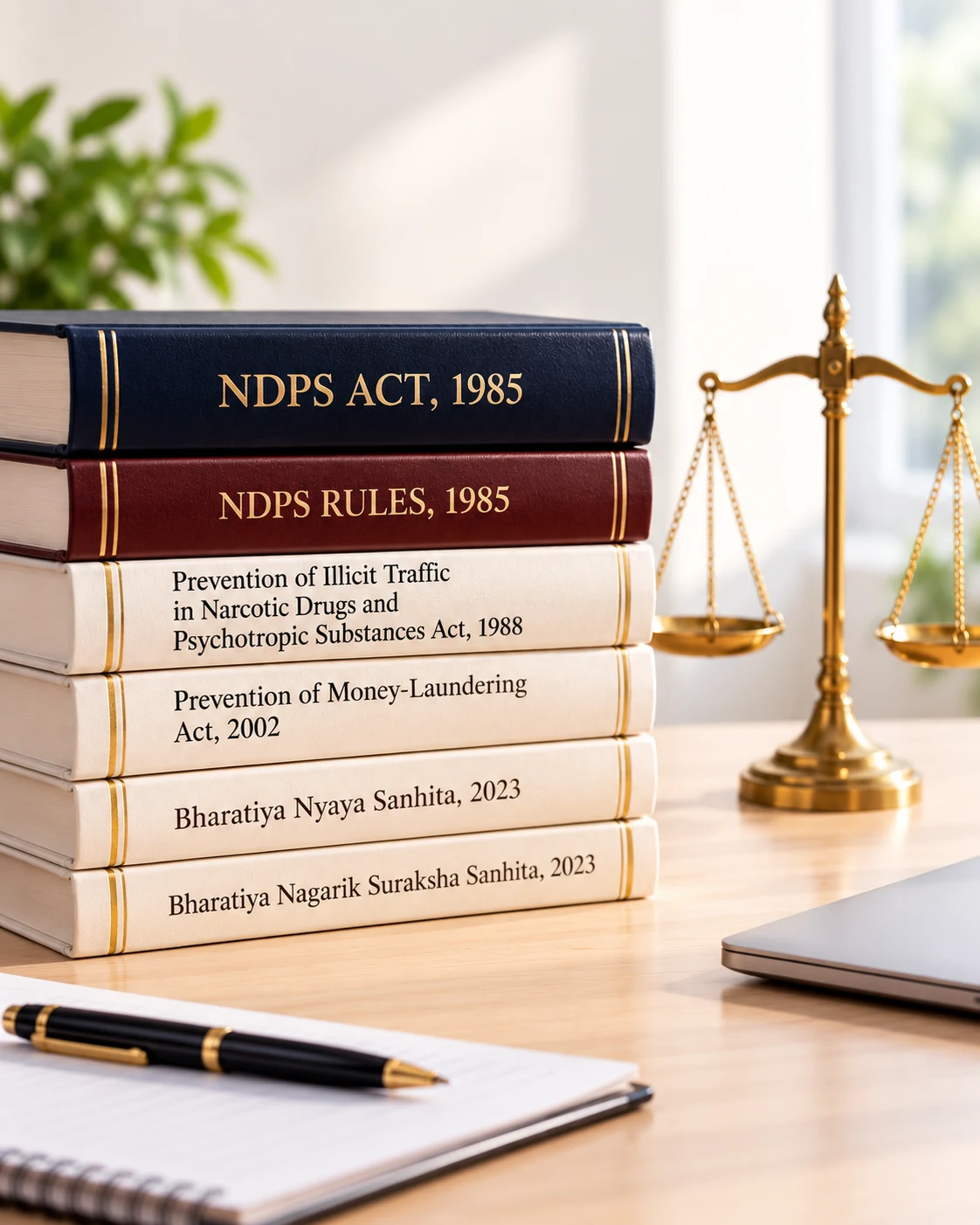
The Narcotic Drugs and Psychotropic Substances Act, 1985 (NDPS Act) is the principal statute governing offences relating to narcotic drugs and psychotropic substances in India. The Act regulates and prohibits, subject to its statutory framework, various activities involving narcotic drugs and psychotropic substances, including production, possession, manufacture, transport, purchase, sale and consumption, and provides for
offences, penalties and related enforcement measures. The Act is supplemented by the
NDPS Rules, 1985 and related notifications. Preventive detention in specified cases is governed by the
Prevention of Illicit Traffic in Narcotic Drugs and Psychotropic Substances Act, 1988. Depending on the nature of the matter, other laws such as the
Bharatiya Nyaya Sanhita, 2023, the
Prevention of Money-Laundering Act, 2002, where issues relating to proceeds of crime and money-laundering arise, the
Customs Act, 1962 and the
Bharatiya Nagarik Suraksha Sanhita, 2023 may also be relevant.
The nature and procedure of an NDPS matter depend on the
facts of the case, the quantity and nature of the substance involved, the applicable statute, and the
investigating agency or forum having jurisdiction. Matters may involve authorities such as the Narcotics Control Bureau, the Directorate of Revenue Intelligence, State Police authorities or specialised anti-narcotics units, depending on the nature of the matter, and may arise in contexts such as
seizure or recovery of substances, alleged contraventions of the Act, or related proceedings. The Act also contains specific procedural provisions concerning search, seizure, sampling and other safeguards applicable at different stages of the proceedings, while applicable law also governs arrest and related procedural requirements, along with
statutory presumptions applicable in specified circumstances under the Act. The procedure, remedies and defences depend on the applicable statutory framework and the stage of the proceedings.
Key Areas of NDPS / Drug Offences
An overview of the principal categories of offences and procedural matters under the Narcotic Drugs and Psychotropic Substances Act, 1985, and related legal issues.
01. Possession & Recovery
Matters relating to the alleged possession of narcotic drugs or psychotropic substances.
Common Matters: Complaints and proceedings relating to alleged possession of substances, and recovery during search or seizure.
Key Issues: Quantity and nature of the substance, compliance with search and seizure procedure, and evidentiary considerations.
Legal Focus: NDPS Act, 1985 — Section 8 and applicable offence provisions under Sections 20, 21 and 22; related procedural provisions where applicable.
02. Manufacture & Production
Matters relating to the alleged manufacture, production or cultivation of narcotic drugs or psychotropic substances.
Common Matters: Complaints relating to manufacture, production, cultivation or processing of substances.
Key Issues: Nature of the alleged activity, applicable statutory provisions, and evidentiary considerations.
Legal Focus: NDPS Act, 1985 — Sections 15 to 18, 20 to 22, as applicable to the substance and nature of the alleged contravention.
03. Trafficking & Transport
Matters relating to the alleged transport, sale, purchase or trafficking of narcotic drugs or psychotropic substances.
Common Matters: Complaints and proceedings relating to transport, sale, purchase or distribution of substances.
Key Issues: Nature of the alleged transaction, quantity and classification of the substance, and evidentiary considerations.
Legal Focus: NDPS Act, 1985 — Section 8 and applicable offence provisions under Sections 20 to 22; Section 23 where import, export or transhipment is involved.
04. Import, Export & Cross-Border
Matters relating to the alleged import, export or cross-border movement of narcotic drugs or psychotropic substances.
Common Matters: Complaints and proceedings relating to import, export, transhipment or cross-border movement of substances.
Key Issues: Nature of the alleged activity, jurisdictional considerations, and evidentiary framework.
Legal Focus: NDPS Act, 1985 — Sections 23 and 24; Customs Act, 1962, where applicable.
05. Consumption & Related Offences
Matters relating to the alleged consumption of narcotic drugs or psychotropic substances, and related offences.
Common Matters: Complaints and proceedings relating to alleged consumption, and related offences under the Act.
Key Issues: Nature of the alleged consumption, applicable provisions, and evidentiary considerations.
Legal Focus: NDPS Act, 1985 — Section 27 and related provisions.
06. Financing, Abetment & Conspiracy
Matters relating to the alleged financing of illicit traffic, abetment or conspiracy in relation to offences under the Act.
Common Matters: Complaints and proceedings relating to financing, harbouring offenders, abetment, criminal conspiracy or attempt.
Key Issues: Nature of the alleged role, evidentiary considerations, and applicable statutory provisions.
Legal Focus: NDPS Act, 1985 — Sections 27A, 28 and 29; Section 30 where preparation to commit an offence is relevant.
07. Bail, Remand & Custody
Matters relating to bail, remand and custody in NDPS proceedings, which are subject to specific statutory considerations under the Act.
Common Matters: Bail applications, anticipatory bail and related custody matters, where applicable.
Key Issues: Applicability of the specific bail framework under the Act, nature of the alleged offence, and evidentiary considerations.
Legal Focus: NDPS Act, 1985 — Sections 36A and 37; Bharatiya Nagarik Suraksha Sanhita, 2023, where applicable.
08. Search, Seizure & Procedure
Matters relating to the procedural framework for search, seizure, sampling and disposal of substances under the Act.
Common Matters: Questions relating to compliance with procedural safeguards during search, seizure, sampling and disposal.
Key Issues: Compliance with the prescribed procedure, including provisions relating to personal search, and evidentiary consequences.
Legal Focus: NDPS Act, 1985 — Sections 41 to 50 and Section 52A; related notifications and standing orders.
09. Appeals & Further Remedies
Remedies against orders or decisions in NDPS matters, including statutory appeals, bail applications and further proceedings.
Common Matters: Statutory appeals, bail applications, quashing petitions and further remedies available under the applicable law.
Key Issues: Availability of the remedy, limitation, jurisdiction, and grounds of challenge.
Legal Focus: NDPS Act, 1985 — Section 36B and other applicable appellate provisions; Bharatiya Nagarik Suraksha Sanhita, 2023; and constitutional or other statutory remedies where available.
Stages in an NDPS Matter
A procedural overview of how an NDPS matter may progress, in accordance with the applicable provisions of the Narcotic Drugs and Psychotropic Substances Act, 1985 and the related procedural framework.
01
Information / Complaint / FIR
A matter may commence with information, a complaint or a first information report, depending on the applicable framework. Certain matters may also arise from intelligence inputs, interception or investigation by specialised agencies.
02
Search, Seizure & Recovery
Search, seizure and recovery of substances may be conducted in accordance with the procedural safeguards under the Act, including provisions relating to authorisation, search of persons, and sampling, where applicable.
03
Arrest, Remand & Custody
Where applicable, arrest, remand and custody may arise in accordance with the applicable procedural framework, including the Bharatiya Nagarik Suraksha Sanhita, 2023, read with the specific provisions of the Act.
04
Bail & Custody Considerations
Where applicable, applications for bail or anticipatory bail may be sought before the appropriate court, subject to the specific bail framework under Section 37 of the Act and the applicable procedural law.
05
Investigation & Sampling
Investigation may be conducted by the appropriate agency, and sampling and disposal of substances may be carried out in accordance with the prescribed procedure, notifications and standing orders, where applicable.
06
Complaint / Charge Sheet
Upon completion of investigation, a complaint or charge sheet may be filed or presented before the appropriate court, in accordance with the applicable statutory and procedural framework.
07
Trial before the Special Court
The matter may proceed to trial before the Special Court, in accordance with the applicable procedural and evidentiary framework, including the Bharatiya Sakshya Adhiniyam, 2023, where applicable.
08
Judgment / Order & Appeals
After considering the evidence and submissions, the court may pass a judgment or order. Where the applicable law permits, an aggrieved party may pursue a statutory appeal or revision or other available remedy, subject to the statutory conditions, limitation and procedural requirements.
The sequence illustrated is indicative. Depending on the nature of the matter, the applicable provisions and the forum involved, some stages may occur in a different order, concurrently or may not arise at all. Not every matter proceeds through every stage. The information provided is a general overview and should not be treated as legal advice for any particular matter.
Stages in an NDPS Matter
A procedural overview of how an NDPS matter may progress, in accordance with the applicable provisions of the Narcotic Drugs and Psychotropic Substances Act, 1985 and the related procedural framework.
01
Information / Complaint / FIR
A matter may commence with information, a complaint or a first information report, depending on the applicable framework. Certain matters may also arise from intelligence inputs, interception or investigation by specialised agencies.
02
Search, Seizure & Recovery
Search, seizure and recovery of substances may be conducted in accordance with the procedural safeguards under the Act, including provisions relating to authorisation, search of persons, and sampling, where applicable.
03
Arrest, Remand & Custody
Where applicable, arrest, remand and custody may arise in accordance with the applicable procedural framework, including the Bharatiya Nagarik Suraksha Sanhita, 2023, read with the specific provisions of the NDPS Act, 1985.
04
Bail & Custody Considerations
Where applicable, applications for bail, including anticipatory bail where legally maintainable, may be sought before the appropriate court, subject to the specific bail framework under Section 37 of the NDPS Act, 1985 and the applicable procedural law.
05
Investigation & Sampling
Investigation may be conducted by the appropriate agency, and sampling and disposal of seized substances may be carried out in accordance with the applicable statutory procedure, notifications and standing orders, where applicable.
06
Police Report / Complaint
Upon completion of investigation, a police report or complaint may be filed or presented before the appropriate court, as applicable, in accordance with the applicable statutory and procedural framework.
07
Trial before the Special Court
The matter may proceed to trial before the Special Court, in accordance with the applicable procedural and evidentiary framework, including the Bharatiya Sakshya Adhiniyam, 2023, where applicable.
08
Judgment / Order & Appeals
After considering the evidence and submissions, the court may pass a judgment or order. Where the applicable law permits, an aggrieved party may pursue an appeal, revision or other available remedy, including remedies under Section 36B of the NDPS Act, 1985, subject to the applicable statutory conditions, limitation and procedural requirements.
The sequence illustrated is indicative. Depending on the nature of the matter, the applicable provisions and the forum involved, some stages may occur in a different order, concurrently or may not arise at all. Not every matter proceeds through every stage. The information provided is a general overview and should not be treated as legal advice for any particular matter.
How an NDPS Matter May Progress
An overview of how an NDPS matter may proceed through information, investigation, bail, trial and appellate forums, in accordance with the applicable provisions of the Narcotic Drugs and Psychotropic Substances Act, 1985 and the related procedural framework.
01
Information / Investigation
02
Bail / Custody
03
Trial before Appropriate Court
04
Appeal / Revision
01
Information, Search, Seizure and Investigation
An NDPS matter may commence with information, a complaint or a first information report,
depending on the applicable framework. Search, seizure or recovery may be conducted in accordance with
the procedural safeguards under the Act, including provisions relating to authorisation, search of persons
and sampling, where applicable. Investigation may be conducted by the appropriate agency, and sampling and
disposal of seized substances may be carried out in accordance with the applicable statutory procedure,
notifications and standing orders, where applicable.
In Simple Terms
The matter begins with information or a complaint, followed by investigation with specific procedural safeguards under the Act.
02
Arrest, Custody and Bail Considerations
Where applicable, arrest, remand and custody may arise in accordance with the applicable
procedural framework, including the Bharatiya Nagarik Suraksha Sanhita, 2023, read with the specific
provisions of the NDPS Act, 1985. Applications for bail, including anticipatory bail where legally
maintainable, may be sought before the appropriate court, subject to the specific bail requirements
under Section 37 of the NDPS Act, 1985 and the applicable procedural law.
In Simple Terms
Where applicable, bail may be sought before the appropriate court, subject to the specific bail requirements under the Act.
03
Police Report / Complaint & Trial
Upon completion of investigation, a police report or complaint may be filed or presented
before the appropriate court, as applicable, in accordance with the applicable statutory and procedural
framework. Where the matter is triable by a Special Court, the case may proceed before the designated
Special Court in accordance with the applicable procedural and evidentiary framework,
including the Bharatiya Sakshya Adhiniyam, 2023, where applicable.
In Simple Terms
The matter goes before the appropriate court, and where triable by a Special Court, the case proceeds before the designated Special Court.
04
Judgment, Appeal and Revision
After considering the evidence and submissions, the court may pass a judgment or order.
Where the applicable law permits, an aggrieved party may pursue an appeal, revision or other
available remedy, including remedies under Section 36B of the NDPS Act, 1985, subject to the
applicable statutory conditions, limitation and procedural requirements. Further remedies before the
High Court or the Supreme Court may be available where permitted by law.
In Simple Terms
In appropriate cases, an appeal, revision or other legal remedy may be available, subject to the applicable law.
Please note: The path followed by an NDPS matter depends on the applicable provisions,
the quantity and nature of the substance involved, the investigating agency and the forum involved.
Every matter does not necessarily proceed through every stage shown above, and some stages may occur
in a different order or not arise at all. The information provided is a general overview and should
not be treated as legal advice for any particular matter.
Documents & Information That May Be Relevant
The documents and information relevant to an NDPS matter depend on the nature of the alleged offence, the quantity and nature of the substance involved, the applicable provisions and the forum or authority involved.
01
Identity & Related Records
Identity and address-related records of the person concerned, along with any documents relevant to establishing identity, custody history or the context of the matter, where applicable.
02
Complaint / FIR & Statements
Complaint, first information report or other initiating record, and statements recorded in the course of the proceedings, in accordance with the applicable procedural framework.
03
Search, Seizure & Recovery Records
Records relating to search, seizure and recovery, including authorisation, search memos, seizure lists and related documentation prepared in accordance with the procedural safeguards under the Act.
04
Sampling & Forensic Reports
Records relating to sampling, inventory and forensic analysis of seized substances, including reports of the Forensic Science Laboratory or other notified laboratories, where applicable.
05
Bail, Custody & Court Records
Records relating to bail, remand and custody, and records of proceedings before the appropriate court, including the Special Court where applicable, such as orders, applications and related documentation.
06
Evidence & Supporting Material
Documents, records, electronic evidence or other material relevant to the facts of the matter, subject to the applicable evidentiary framework, including the Bharatiya Sakshya Adhiniyam, 2023, where applicable.
Please Note: The documents relevant to an NDPS matter vary according to the nature of the alleged offence, the quantity and nature of the substance involved, the applicable provisions and the forum or authority involved. Not every document listed above will be relevant to every matter. The information provided is a general overview and should not be treated as legal advice for any particular matter.
Frequently Asked Questions
Common questions about the Narcotic Drugs and Psychotropic Substances Act, 1985, the applicable procedural framework, bail considerations and related legal remedies.
The Narcotic Drugs and Psychotropic Substances Act, 1985 (NDPS Act) is the principal statute governing offences relating to narcotic drugs and psychotropic substances in India. The Act regulates and prohibits, subject to its statutory framework, various activities involving such substances, including production, possession, manufacture, transport, purchase, sale and consumption, and provides for offences, penalties and related enforcement measures. It is supplemented by the NDPS Rules, 1985 and related notifications. Preventive detention in specified cases is governed by the Prevention of Illicit Traffic in Narcotic Drugs and Psychotropic Substances Act, 1988.
NDPS matters in India may involve investigation by different authorities depending on the nature of the alleged offence and the applicable framework. These may include the Narcotics Control Bureau, the Directorate of Revenue Intelligence, State Police authorities or specialised anti-narcotics units, and, where applicable, customs authorities. The applicable agency and the procedure followed depend on the nature of the matter and the relevant statutory framework.
The NDPS Act categorises quantities of narcotic drugs and psychotropic substances into small quantity, commercial quantity and quantities that fall between the two, and the applicable punishment provisions may vary accordingly. The determination of quantity is therefore relevant to the classification of the alleged offence and to the applicable statutory framework. The specific quantity, its classification, and its legal consequences depend on the applicable provisions and the facts of the matter, as may be determined in accordance with the applicable law.
Bail may be sought in NDPS matters in accordance with the applicable law. The offences under the NDPS Act are cognizable, and Section 37 provides specific restrictions on the grant of bail in specified categories of cases, including offences under Sections 19, 24 and 27A and offences involving commercial quantity. Where Section 37(1)(b) applies, the statutory conditions prescribed therein must be satisfied. Applications for bail, including anticipatory bail where legally maintainable, may be considered by the appropriate court, subject to the applicable statutory requirements and the facts of the matter. Whether bail is granted is a matter for the competent court to determine in accordance with law.
The NDPS Act contains specific procedural provisions concerning search, seizure, arrest and related matters, including provisions relating to authorisation, search of persons, sampling and disposal of seized substances. These provisions are intended to ensure compliance with the prescribed procedure and to safeguard the rights of the person concerned. The applicability and scope of these safeguards depend on the nature of the search or seizure, the applicable provisions and the facts of the matter.
The NDPS Act provides for the constitution of Special Courts for the trial of offences under the Act. Section 36A of the Act specifies which offences are triable by a Special Court, generally those punishable with imprisonment for a term of more than three years. Not every NDPS matter is necessarily tried by a Special Court; whether a particular matter is triable by a Special Court depends on the nature of the alleged offence and the applicable statutory provisions. The procedure before the Special Court is governed by the applicable procedural and evidentiary framework.
Yes. The NDPS Act contains statutory presumptions applicable in specified circumstances, including the presumption of culpable mental state under Section 35 and the presumption from possession of illicit articles under Section 54. These presumptions operate subject to the conditions and requirements set out in the Act, and their applicability and scope depend on the specific provision, the nature of the offence and the facts of the matter.
The NDPS Act does not provide a general mechanism for compounding offences under the Act. A settlement between parties does not, by itself, amount to compounding of an NDPS offence or bring criminal proceedings to an end. In an appropriate case, a party may pursue a separate statutory or judicial remedy, such as an application for quashing where legally maintainable, but the availability of such a remedy depends on the applicable law, the nature of the proceedings and the facts of the matter.
Remedies available in an NDPS matter depend on the applicable provisions and the nature of the order under challenge. Section 36B of the NDPS Act provides for appeal and revision by the High Court, so far as applicable, in relation to orders of a Special Court. Other statutory or constitutional remedies may also be available where permitted by law, including appropriate proceedings before the High Court or the Supreme Court. The availability, forum, limitation and grounds of a particular remedy depend on the applicable law and the nature of the order under challenge.
Whether legal representation is required or permitted in an NDPS matter depends on the stage and nature of the proceedings, the forum involved and the applicable procedural law. Proceedings before courts, including Special Courts where applicable, are governed by the applicable procedural framework, while interactions with investigating or other authorities may be subject to their respective statutory and procedural requirements. The nature of the relief sought and the stage of the matter may also affect the role of legal representation. The information provided is a general overview and should not be treated as legal advice for any particular matter.
Further Reading
Related Legal Areas
Explore related legal information and resources relevant to NDPS matters and related legal issues.
Please read the following information before accessing this website.
The Rules of the Bar Council of India prohibit advocates and law firms from soliciting work or advertising in any manner. By clicking on "Proceed to Website", you acknowledge and confirm that:
You wish to obtain information about Corpus Juris India (CJI), its practice areas, advocates, and legal services for your own information and use.
The information available is provided solely upon your specific request. Your access does not create an advocate-client relationship.
The content is for legal awareness only. Nothing herein is legal advice, opinion, solicitation, or advertisement.
CJI shall not be liable for reliance on this information. Users are advised to seek independent legal counsel before acting.
By continuing, you consent to cookies per our Privacy Policy.