Personal Injury & MACT

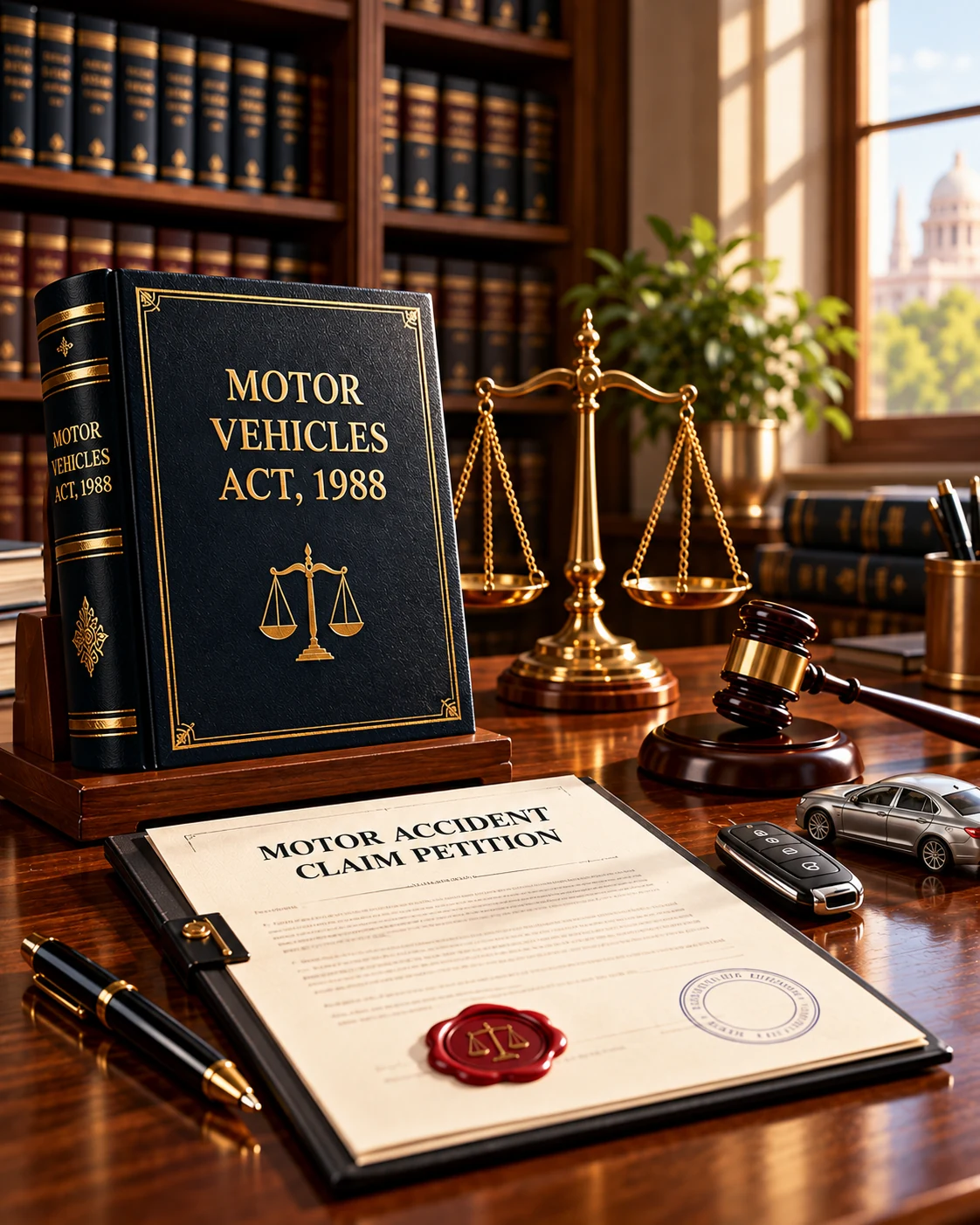
Motor Vehicles Act, 1988 legal volume with motor accident claim petition, gavel, scales of justice and a model car

Personal Injury & MACT

Personal injury law concerns legal remedies for injuries caused by negligence or wrongful acts, including road accidents, workplace injuries and other matters. In the context of motor accidents, the principal framework is the Motor Vehicles Act, 1988, and claims are generally adjudicated by the Motor Accident Claims Tribunal (MACT) having jurisdiction, as provided under the Act.

The nature and procedure of a personal injury matter depend on the facts of the case, the applicable statute and the forum or authority having jurisdiction. In road accident matters, provisions of the Bharatiya Nyaya Sanhita, 2023 relating to rash or negligent driving may also become relevant, depending on the facts. Claims may involve compensation for injury, medical expenses, loss of income and related heads, as applicable.

Key Areas of Personal Injury & MACT

An overview of the principal categories of claims, proceedings and related issues arising in personal injury and motor accident matters.

01. Motor Accident Claims

Claims arising out of motor vehicle accidents, including injury, death and related matters.

  • Common Matters: Claims relating to bodily injury, death, disability and related loss arising from road accidents.
  • Key Issues: Negligence, contributory negligence, quantum of compensation and liability of parties.
  • Legal Focus: Motor Vehicles Act, 1988 — Sections 166 and 168 (claims before the Motor Accident Claims Tribunal).

02. No-Fault Compensation & Statutory Claims

Statutory compensation frameworks under the Motor Vehicles Act, including compensation payable in specified circumstances without requiring proof of wrongful act, neglect or default.

  • Common Matters: Claims involving statutory compensation, including compensation under Section 164 and hit-and-run compensation under Section 161.
  • Key Issues: Applicability, eligibility, statutory conditions and computation of compensation.
  • Legal Focus: Motor Vehicles Act, 1988 — Sections 161 and 164, and related provisions.

03. Third-Party Insurance Claims

Claims against insurers relating to third-party liability arising from motor vehicle use.

  • Common Matters: Claims against insurance companies concerning third-party liability and related matters.
  • Key Issues: Statutory coverage, policy terms, defences available to insurers and enforcement of awards.
  • Legal Focus: Motor Vehicles Act, 1988 — Sections 146, 147, 149 and 150, and related provisions.

04. Negligence & Tort Claims

Civil claims arising from negligence and other recognised civil wrongs resulting in actionable harm.

  • Common Matters: Claims relating to negligence, nuisance, occupier's liability and related torts.
  • Key Issues: Duty of care, breach, causation, contributory negligence and quantum of damages.
  • Legal Focus: Principles of tort law, the applicable law of limitation and civil procedure, as relevant to the matter.

05. Workplace & Occupational Injuries

Claims concerning injuries arising in the course of employment.

  • Common Matters: Claims relating to injuries sustained in the course of employment and related statutory benefits.
  • Key Issues: Applicability of the statutory framework, employer liability and computation of compensation.
  • Legal Focus: Employees' Compensation Act, 1923, where applicable, and related statutory provisions.

06. Medical Negligence

Claims relating to alleged negligence in the provision of medical treatment or services.

  • Common Matters: Claims relating to medical treatment, diagnosis and related matters, where negligence is alleged.
  • Key Issues: Standard of care, causation, expert evidence and the applicable forum.
  • Legal Focus: Consumer Protection Act, 2019 and applicable civil law, depending on the nature of the matter.

07. Rash & Negligent Driving — Criminal Proceedings

Criminal proceedings that may arise in relation to motor vehicle accidents, depending on the facts.

  • Common Matters: Criminal proceedings relating to rash or negligent driving and related offences.
  • Key Issues: Nature of the alleged conduct, evidence and applicable statutory provisions.
  • Legal Focus: Bharatiya Nyaya Sanhita, 2023 — Sections 106 and 281, and applicable provisions of the Motor Vehicles Act, 1988.

08. Interim Relief & Compensation

Interim measures and compensation-related relief in personal injury proceedings.

  • Common Matters: Applications for interim compensation and related measures during the pendency of proceedings.
  • Key Issues: Applicability, computation and procedural requirements of interim relief.
  • Legal Focus: Motor Vehicles Act, 1988 — Sections 164, 164A, 166, 168 and 171, where applicable.

09. Appeals & Further Remedies

Remedies against awards of the Claims Tribunal, including statutory appeals and other remedies available under applicable law.

  • Common Matters: Appeals against awards or orders passed in motor accident claims, as provided by statute.
  • Key Issues: Availability of the appellate remedy, limitation and procedural requirements.
  • Legal Focus: Motor Vehicles Act, 1988 — Section 173 and applicable procedural provisions.
Motor Vehicles Act, 1988 legal volume with motor accident claim petition, gavel and scales of justice in a wide legal setting

Stages in a Personal Injury & MACT Matter

A procedural overview of how a motor accident claim may progress before the Motor Accident Claims Tribunal under the Motor Vehicles Act, 1988.

Pre-Filing Assessment

The nature of the matter, relevant facts, applicable provisions of the Motor Vehicles Act, 1988 and the appropriate forum — including the Motor Accident Claims Tribunal having jurisdiction — are considered before proceedings are initiated, where applicable.

Filing of Claim Petition

An application for compensation may be presented before the Claims Tribunal under Section 166 of the Act, by the injured person, the legal heirs or other persons as provided under the Act, seeking compensation for injury, death or related loss.

Preliminary Consideration

The Claims Tribunal considers the application at the preliminary stage and may take such procedural steps as are required under the Act and the applicable rules, depending on the nature of the matter.

Notice & Response

Notice may be issued to the concerned parties, including the insurer where applicable, in accordance with the procedure under the Act. The respondents may file their response as permitted under the applicable procedural framework.

Interim Relief & Statutory Compensation

Where applicable, interim relief may be available under schemes or provisions made under the Act, while compensation under Section 164 may apply in cases falling within its statutory requirements.

Inquiry & Evidence

The Tribunal conducts an inquiry in accordance with the procedure and powers provided under Section 169 of the Act, and considers the evidence, documents and submissions placed on record, as applicable to the matter.

Hearing & Award

After considering the material on record and the submissions made, the Tribunal may pass an award under Section 168 of the Act, determining the compensation payable, where applicable, in accordance with the applicable statutory framework.

Appeals & Further Remedies

Where the applicable law permits, an aggrieved party may prefer an appeal under Section 173 of the Act against an award of the Claims Tribunal, subject to the statutory requirements, limitation and procedure prescribed under the Act.

The sequence illustrated is indicative. Depending on the nature of the matter, some stages may occur in a different order, concurrently or may not arise at all. Interim relief or statutory compensation may be sought at an appropriate stage during proceedings. The information provided is a general overview and should not be treated as legal advice for any particular matter.

How a Personal Injury & MACT Matter May Progress

An overview of where a motor accident claim may be instituted and how it may proceed through awards, appeals and further remedies, depending on the applicable statute.

Motor Accident
Claims Tribunal
Award of
Compensation
Appeal under
Section 173
High Court /
Further Remedies

Motor Accident Claims Tribunal

A motor accident claim is generally instituted before the Motor Accident Claims Tribunal having jurisdiction, as provided under the Motor Vehicles Act, 1988. Jurisdiction is determined in accordance with the applicable provisions of the Act, including Section 166.

In Simple Terms The claim may be filed before a Claims Tribunal having jurisdiction as permitted under Section 166(2) of the Act, including the place of accident, the claimant's place of residence or business, or the place where the defendant resides.

Award of Compensation

After inquiry and hearing, the Tribunal may pass an award under Section 168 of the Act, determining the compensation payable, where applicable, in accordance with the applicable statutory framework and the evidence on record.

In Simple Terms The Tribunal decides the amount of compensation to be paid to the claimant, based on the facts and evidence.

Appeal under Section 173

Where the applicable law permits, an aggrieved party may prefer an appeal against an award of the Claims Tribunal under Section 173 of the Act, subject to the statutory requirements, limitation and procedure prescribed under the Act.

In Simple Terms If a party is not satisfied with the Tribunal's award, they may appeal to the High Court within the time allowed by law.

High Court / Further Remedies

Where legally maintainable, a matter may come before the High Court under its applicable constitutional or supervisory jurisdiction, including Articles 226 and 227 of the Constitution, depending on the nature of the order or proceeding and the remedy available in law. Not every matter reaches this stage.

In Simple Terms In appropriate cases, a matter may be brought before the High Court, but the available remedy depends on the nature of the order and the applicable law.
Please note: The path followed by a personal injury or motor accident matter depends on the applicable statute and the forum having jurisdiction. Every matter does not necessarily proceed through every stage shown above, and not all forums share the same appellate or revisional route. The information provided is a general overview and should not be treated as legal advice for any particular matter.

Documents & Information That May Be Relevant

The documents and information relevant to a personal injury or motor accident matter depend on the nature of the proceeding, the applicable provisions of the Act and the relief sought.

Identity & Address Documentation

Identity documents and address-related records of the claimant, the respondent and other relevant parties, along with documents relevant to establishing jurisdiction under Section 166(2) of the Act, where applicable.

Accident & Incident Records

Records relating to the accident, including the First Information Report, site or spot records, photographs, witness statements, and other available records relevant to the claim.

Medical Records & Treatment Documents

Medical records, treatment papers, discharge summaries, prescriptions, bills and other documents relating to the injury, treatment and related aspects, where relevant to the claim.

Financial & Income Records

Income records, employment documents, tax returns and other financial documents relevant to claims of loss of income, loss of earning capacity or related heads of compensation, where applicable.

Insurance & Vehicle Documents

Insurance policy documents, registration certificate, driving licence and other vehicle-related records relevant to the matter, where applicable to the claim against the insurer or owner.

Court Records & Legal Documents

Claim petitions, orders, awards, notices and other legal documents connected with the matter, where applicable, including records before the Motor Accident Claims Tribunal.

Please Note: The documents relevant to a personal injury or motor accident matter vary according to the nature of the matter, the applicable law, the proceedings involved and the relief sought. Not every document listed above will be relevant to every matter. The information provided is a general overview and should not be treated as legal advice for any particular matter.

Frequently Asked Questions

Common questions about personal injury and motor accident claims, the Motor Accident Claims Tribunal and related legal remedies.

The Motor Accident Claims Tribunal (MACT) is a statutory tribunal constituted under the Motor Vehicles Act, 1988, to adjudicate claims for compensation arising out of motor vehicle accidents. It deals with matters relating to injury, death and related loss, as provided under the Act.

Under Section 166 of the Motor Vehicles Act, 1988, an application for compensation may be made by the injured person, the owner of the property, the legal representatives of the deceased, or an authorised agent, as provided under the Act. The specific eligibility depends on the nature of the claim.

The Motor Vehicles Act, 1988, as amended, contains specific provisions relating to the time within which an application for compensation may be made. Section 166(3), brought into force from 1 April 2022, provides that an application shall not be entertained unless made within six months of the occurrence of the accident. The application of this provision has been the subject of litigation before courts, and the legal position continues to evolve. Given the statutory framework and the evolving judicial position, it is advisable to seek appropriate legal guidance and to file the claim promptly, rather than relying on any general assumption.

Compensation may be claimed under various heads depending on the nature of the case, including medical expenses, loss of income, loss of earning capacity, pain and suffering, and other related heads. In case of death, compensation may include loss of dependency and related matters. The specific heads and quantum depend on the facts and the applicable law.

Section 166 provides for an application for compensation before the Claims Tribunal, where the claimant is required to establish negligence or fault. Section 164 provides for compensation in specified circumstances without requiring proof of wrongful act, neglect or default, as provided under the Act. The two provisions operate in different contexts and have different requirements.

The insurance company is generally a party to the proceedings, and its liability to satisfy the award depends on the statutory provisions and the policy terms. The insurer may contest the claim on grounds available under the law, including defences relating to the policy, negligence or quantum. Its role is governed by the applicable provisions of the Motor Vehicles Act, 1988.

Yes, subject to the applicable provisions of the Act. An appeal against an award of the Claims Tribunal may lie to the High Court under Section 173 of the Motor Vehicles Act, 1988, within the time provided under the Act. The availability of the remedy and the applicable period depend on the statutory framework.

A MACT claim is primarily civil in nature and is intended to provide compensation to the claimant. Criminal proceedings arising from the same accident concern penal liability for offences, such as rash or negligent driving, and are governed by the applicable criminal law and procedure, including, where relevant, provisions under the Bharatiya Nyaya Sanhita, 2023. The two proceedings are distinct, though they may arise from the same incident.

The Act does not make legal representation mandatory for filing or pursuing a claim before the Motor Accident Claims Tribunal. A claimant may appear in person or through authorised legal representation, in accordance with the applicable procedure and rules. A party may choose to engage legal assistance depending on the nature of the matter, the complexity of the issues involved and the relief sought.

There is no fixed or universal timeline applicable to every MACT matter. The duration may depend on a range of factors, including the nature of the matter and the issues involved, the evidence and documents, the parties and the insurer, the pendency and workload before the Tribunal, and any appeal or further proceedings that may follow. The Act provides for a summary procedure to facilitate timely disposal, but the actual duration varies from case to case.

Discuss Your Legal Matter

For information regarding a personal injury or motor accident matter, or our areas of practice, you may contact Corpus Juris India through the available contact channels.

Contact Us
Scroll to Top

Legal Disclaimer

Please read the following information before accessing this website.

The Rules of the Bar Council of India prohibit advocates and law firms from soliciting work or advertising in any manner. By clicking on "Proceed to Website", you acknowledge and confirm that:

  • You wish to obtain information about Corpus Juris India (CJI), its practice areas, advocates, and legal services for your own information and use.
  • The information available is provided solely upon your specific request. Your access does not create an advocate-client relationship.
  • The content is for legal awareness only. Nothing herein is legal advice, opinion, solicitation, or advertisement.

CJI shall not be liable for reliance on this information. Users are advised to seek independent legal counsel before acting.

By continuing, you consent to cookies per our Privacy Policy.