
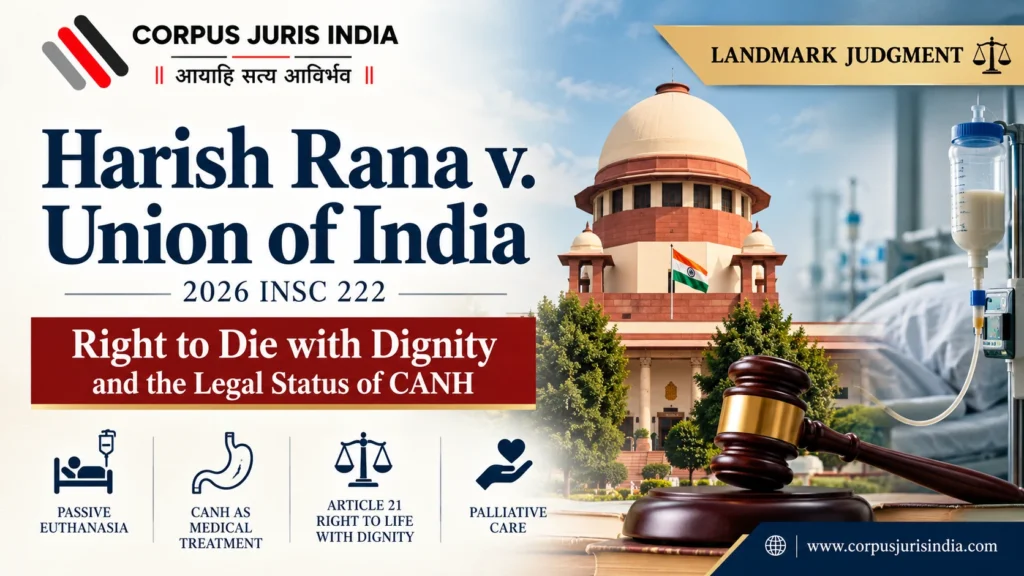
The Supreme Court of India, in Harish Rana v. Union of India & Others (2026 INSC 222), examined important questions concerning the right to die with dignity under Article 21 of the Constitution of India, passive euthanasia and the withdrawal of life-sustaining medical treatment. The judgment addresses the legal status of Clinically Assisted Nutrition and Hydration (CANH), the assessment of a patient’s best interests and the safeguards to be followed before withdrawing medical treatment.
Central issue: Whether clinically assisted nutrition and hydration can be treated as medical treatment and, where its continuation is no longer in a patient’s best interests, whether it may be withdrawn in accordance with the applicable legal and medical safeguards.
Case Snapshot
| Case Title | Harish Rana v. Union of India & Others |
|---|---|
| Citation | 2026 INSC 222 |
| Case Number | Miscellaneous Application No. 2238 of 2025 in SLP (C) No. 18225 of 2024 |
| Court | Supreme Court of India |
| Bench | Justice J.B. Pardiwala and Justice K.V. Viswanathan |
| Date of Judgment | 11 March 2026 |
| Constitutional Provision | Article 21 of the Constitution of India |
| Principal Legal Area | Right to die with dignity, passive euthanasia and withdrawal of life-sustaining medical treatment |
Background of the Case
Harish Rana suffered a severe brain injury following a fall in 2013. His condition resulted in prolonged dependence on medical support and an extended period in a state of severe neurological impairment.
Over the years, his family faced difficult questions concerning his medical condition, the continuation of life-sustaining treatment and his dignity. The matter eventually reached the Supreme Court, requiring the Court to consider the applicable legal framework governing the withdrawal of medical treatment in such circumstances.
The case brought into focus the distinction between actively causing death and allowing the natural course of an illness or condition to take place through the lawful withdrawal of medical treatment.
What Is Passive Euthanasia?
Passive euthanasia, in the legal context, refers to the withdrawal or withholding of life-sustaining medical treatment in circumstances where continuing such treatment is no longer considered to be in the patient’s best interests, subject to prescribed safeguards.
It does not mean actively causing a person’s death. The focus is on a medically and legally regulated decision concerning treatment, while ensuring that the patient continues to receive appropriate care, including palliative care and relief from pain and suffering.
Important distinction: Withdrawal of life-sustaining treatment is not the same as abandoning a patient. Appropriate medical care, comfort and dignity must continue.
What Is CANH? Understanding Clinically Assisted Nutrition and Hydration
CANH stands for Clinically Assisted Nutrition and Hydration. It refers to the provision of nutrition and fluids through clinical methods when a person is unable to eat or drink normally.
For example, a patient may receive nutrition through a feeding tube or other medically assisted methods. Such treatment may be necessary when the patient’s medical condition prevents normal oral intake.
The legal significance of CANH in this case lies in whether it should be regarded as medical treatment rather than simply as the ordinary provision of food and water.
Why Was This Question Important?
If CANH is recognised as medical treatment, its continuation or withdrawal can be examined within the legal framework governing medical treatment decisions and the patient’s best interests.
The Supreme Court’s consideration of CANH is therefore significant for decisions involving patients who are unable to communicate their wishes or independently make decisions about their treatment.
Best Interests of the Patient: The Central Consideration
One of the important aspects of the judgment is the emphasis on assessing the best interests of the patient. Such an assessment must be patient-centric and should not be based merely on the preferences, convenience or emotional position of family members.
The patient’s medical condition, prospects of recovery, treatment options, suffering, dignity and overall circumstances are relevant to a proper assessment.
Factors Relevant to the Best Interests Assessment
The best interests assessment requires a careful examination of the patient’s individual circumstances. Relevant considerations include:
- The patient’s present medical condition and clinical diagnosis.
- The nature, purpose and effectiveness of the proposed medical treatment.
- The likely benefits and burdens associated with continuing treatment.
- The patient’s prospects of recovery or improvement.
- The patient’s known wishes, values and previously expressed preferences, where ascertainable.
- The patient’s dignity, comfort and quality of life.
- The availability of appropriate alternatives, including palliative care.
- The patient’s overall circumstances, assessed objectively and in accordance with the applicable medical and legal safeguards.
These considerations underline the importance of an individualised assessment rather than a mechanical or purely family-driven decision.
Medical Boards and the Safeguards for Withdrawal of Treatment
Decisions concerning the withdrawal of life-sustaining treatment require appropriate medical assessment. The safeguards laid down by the Supreme Court in its earlier decisions, including the framework in Common Cause v. Union of India, are important in this context.
Medical boards play a significant role in examining the patient’s condition, assessing the treatment being provided and considering whether its continuation remains in the patient’s best interests.
The purpose of these safeguards is to ensure that such decisions are not taken arbitrarily or without proper medical scrutiny. They also help protect the interests and dignity of patients who may not be capable of expressing their wishes.
Why Are Medical Safeguards Necessary?
- To ensure that decisions are based on proper medical evaluation.
- To protect vulnerable patients from arbitrary decisions.
- To assess whether continued treatment serves the patient’s best interests.
- To ensure that the prescribed legal procedure is followed.
- To maintain appropriate care and palliative support for the patient.
Application of the Legal Principles in Harish Rana’s Case
The Supreme Court considered the particular medical circumstances of Harish Rana and the questions surrounding the continuation of clinically assisted nutrition and hydration.
The case required the Court to examine the medical assessment, the applicable safeguards and the patient’s best interests. It also highlighted the importance of ensuring that any decision concerning withdrawal of treatment is accompanied by appropriate medical care and attention to the patient’s comfort.
The matter is significant because it demonstrates how the principles governing passive euthanasia and the right to die with dignity operate in a real and deeply sensitive medical situation.
Right to Die with Dignity Under Article 21
Article 21 of the Constitution of India guarantees the right to life and personal liberty. Judicial interpretation has recognised that the right to life includes the right to live with dignity.
In the context of end-of-life medical decisions, the right to die with dignity does not create an unrestricted right to end one’s life. Rather, it concerns the legal and medical safeguards applicable to the withholding or withdrawal of life-sustaining treatment in appropriate circumstances.
The judgment in Harish Rana v. Union of India contributes to the continuing development of this area of constitutional and medical law.
Importance of Palliative Care
An important aspect of end-of-life care is that withdrawal of life-sustaining treatment must not be confused with withdrawal of all medical attention.
Palliative care focuses on improving the quality of life of patients facing serious illness. It includes the management of pain and other distressing symptoms, as well as psychological, social and supportive care.
The emphasis on palliative care reinforces the principle that a patient’s dignity and comfort remain important even when curative treatment is no longer appropriate.
Need for a Clear Legal Framework
Decisions involving passive euthanasia, advance medical directives and withdrawal of life-sustaining treatment raise complex medical, ethical and legal questions.
A clear and practical legal framework is important to guide patients, families, doctors and hospitals. It can help ensure consistency in medical decision-making, provide safeguards against misuse and reduce uncertainty in sensitive end-of-life situations.
The judgment also brings renewed attention to the need for clarity in the law and effective implementation of the safeguards governing such decisions.
Key Legal Takeaways
- Right to dignity: The right to live with dignity under Article 21 is relevant to end-of-life medical decisions.
- CANH: Clinically Assisted Nutrition and Hydration is an important part of the legal examination of medical treatment and its withdrawal.
- Best interests: The patient’s best interests must remain central to the decision-making process.
- Medical assessment: Proper medical evaluation and prescribed safeguards are essential.
- Patient-centric approach: Decisions must focus on the patient’s circumstances and interests.
- Palliative care: Appropriate care and relief from suffering remain important even when life-sustaining treatment is withdrawn.
Why This Judgment Matters
Harish Rana v. Union of India is an important judgment in the evolving field of constitutional law, medical ethics and end-of-life care in India.
It brings attention to the difficult decisions that arise when a patient is unable to communicate, remains dependent on medical intervention and faces a prolonged medical condition. It also highlights the need to balance medical evidence, patient dignity, individual interests and legal safeguards.
For legal professionals, medical practitioners, students and researchers, the judgment provides an important opportunity to understand the relationship between Article 21, passive euthanasia and the legal regulation of life-sustaining medical treatment.
Conclusion
The decision in Harish Rana v. Union of India & Others adds to the jurisprudence on the right to die with dignity and the withdrawal of life-sustaining medical treatment in India.
Its significance lies in the attention given to the legal status of CANH, the importance of a patient-centric best interests assessment and the role of medical safeguards. Above all, the case reinforces that dignity, appropriate medical care and respect for the patient’s interests must remain central to end-of-life decisions.
Case Details
Case: Harish Rana v. Union of India & Others
Citation: 2026 INSC 222
Case Number: Miscellaneous Application No. 2238 of 2025 in SLP (C) No. 18225 of 2024
Court: Supreme Court of India
Bench: Justice J.B. Pardiwala and Justice K.V. Viswanathan
Decision Date: 11 March 2026
Disclaimer
This content is published solely for legal information, legal education, and reporting of judicial or legal developments. It does not constitute legal advice, create a lawyer-client relationship, or amount to solicitation or advertisement under the applicable Bar Council of India Rules.