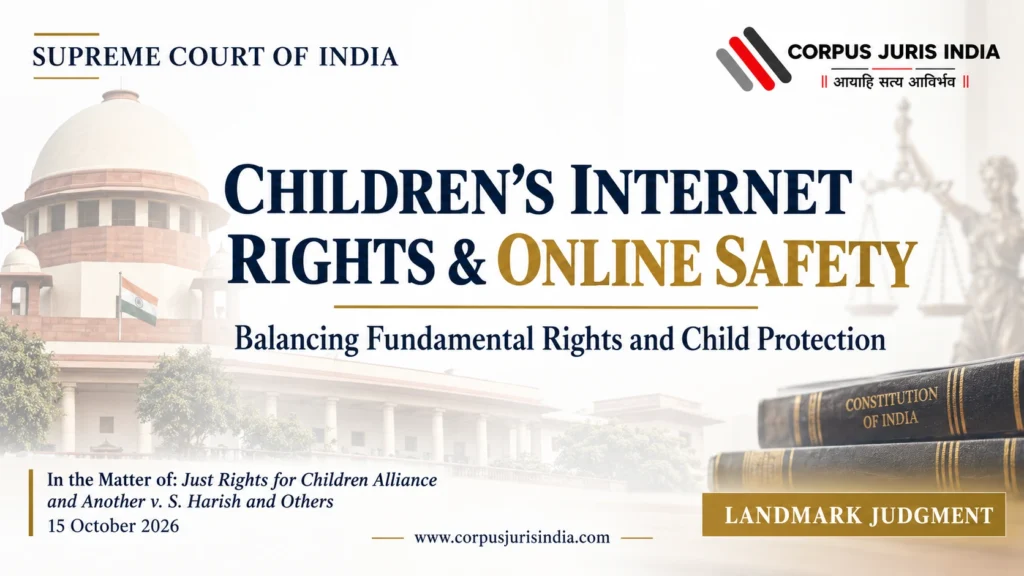
Just Rights for Children Alliance v. S. Harish (2026) is an important Supreme Court of India case concerning children’s internet access, online safety and protection from child sexual exploitation and abuse material (CSEAM). In its order dated 15 October 2026, the Supreme Court examined the relationship between the fundamental right to access the internet, child protection and the responsibilities of online intermediaries.
The internet has become an essential part of education, communication and access to information. But how should the law protect children from online sexual exploitation and abuse without treating a blanket restriction on internet access as the default solution? The Supreme Court of India addressed this important question in its order dated 15 October 2026 in In the Matter of: Just Rights for Children Alliance and Another v. S. Harish and Others, reported as 2026 INSC 1149.
The order examines the relationship between the fundamental right to access and use the internet, child safety in digital spaces, the responsibilities of online intermediaries, and mechanisms for identifying, removing and reporting child sexual exploitation and abuse material (CSEAM).
Its significance lies in the Court’s consideration of two connected objectives: recognising the importance of internet access, including for children, and strengthening safeguards against online exploitation through appropriate technological, procedural and regulatory measures.
Case Details
Case Name: In the Matter of: Just Rights for Children Alliance and Another v. S. Harish and Others
Court: Supreme Court of India
Date of Order: 15 October 2026
Neutral Citation: 2026 INSC 1149
Proceedings: M.A. Nos. 2553–2554 of 2026 in Criminal Appeal Nos. 2161–2162 of 2024
Bench: Justice J.B. Pardiwala and Justice K.V. Chandran
Key Legal Areas: Constitutional law, fundamental rights, child protection, cyber law, intermediary liability, online content regulation and digital governance.
1. Background: The Challenge of Protecting Children Online
Online platforms offer children access to educational material, communication tools and information. At the same time, digital services may be misused to create, circulate, access or monetise material involving the sexual exploitation or abuse of children.
Removing individual posts may not be sufficient when harmful material continues to circulate through repeated uploads, links or multiple platforms. Effective protection can require reliable detection, verification, prompt removal, reporting to appropriate authorities and accountable grievance mechanisms.
The legal challenge is to develop effective child-protection systems without disregarding fundamental rights or allowing inaccurate content identification and unjustified restrictions.
The Supreme Court’s order addresses these concerns in the context of continuing proceedings concerning compliance with child-protection obligations by online intermediaries.
2. Internet Access as a Fundamental Right
An important constitutional observation appears in paragraph 292 of the order. The Court states that the right to access and use the internet is a fundamental right of every individual under Article 21 read with Article 19(1)(a) of the Constitution of India. Its discussion recognises that children share this right.
The observation is significant because internet access can facilitate education, access to information, communication and participation in modern society.
However, the right must be understood in its proper legal context. Recognition of internet access as a fundamental right does not mean that every website, online service or category of content must remain unrestricted. Restrictions may still be possible where supported by applicable law and constitutional requirements.
The central question is therefore not simply whether children should have internet access, but how their access can be made safer through proportionate and effective safeguards.
3. Why Blanket Restrictions Are Not the Complete Answer
The Court questions the assumption that blanket restrictions on children’s internet access necessarily provide an effective or proportionate solution to online risks.
Its discussion considers alternatives such as age-appropriate safeguards, parental guidance, dedicated child modes and appropriate platform-level protections.
The order does not, however, suggest that age-based restrictions have no place. It expressly recognises that the Union Government may restrict specific categories of content inherently harmful to children, including adult-content websites.
The distinction is important. Protecting children from harmful material is not the same as treating all internet access as harmful. A more targeted approach considers the type of risk, the effectiveness of the safeguard and its effect on children’s access to legitimate information and educational resources.
For constitutional and digital-policy research, this raises questions about proportionality, the design of online services and the relationship between safety and access.
4. National Hash and URL List Database for CSEAM
A major aspect of the order concerns the creation of a National Hash and URL List Database dedicated to child sexual exploitation and abuse material.
A hash is a digital identifier generated from data. Hash-matching technology can assist in identifying known material when the same material appears again. URL lists can help identify online locations associated with reported material.
The order directs the Union Government to create a national database for CSEAM and considers whether it should form part of the existing Sahyog Portal or operate separately.
The proposed system is intended to improve the detection and removal of known harmful material, including where it is repeatedly circulated across platforms.
The order also addresses verification safeguards. Database entries should pass through a multi-tier verification process, with final determination by at least three trained human analysts.
These safeguards are important because automated matching can improve detection, but inaccurate identification may result in material being wrongly classified or removed. A reliable system therefore requires appropriate verification and accountability.
The database discussed in the order is specifically directed towards CSEAM. It should not be described as a general authorisation for unrestricted removal of unrelated online content.
5. Detection, Removal and Verification
The order distinguishes between known-origin material and material whose origin is not yet established.
For known-origin material matched to the database, the directions contemplate immediate removal. For unknown-origin material, the order provides for verification, due diligence and reporting in the circumstances specified.
It also addresses the use of hash and URL matching across platforms to help identify repeated circulation.
These mechanisms illustrate the different stages involved in responsible content moderation:
- Detecting potentially harmful material.
- Verifying whether it falls within the relevant category.
- Removing material where required.
- Reporting to appropriate authorities when applicable.
- Providing suitable notices and grievance mechanisms.
The distinction between detection and final determination is particularly important. Technology can assist in identifying material, but the legal consequences of a match depend on the applicable procedure and safeguards.
6. Reporting Duties and Timelines
The order addresses reporting to appropriate authorities, including Special Juvenile Police Units (SJPUs), local police and/or the cybercrime reporting portal under the applicable framework.
It specifies a two-hour reporting timeline for certain unknown-origin CSEAM cases and provides for weekly reporting in relation to known-origin removals, in the circumstances set out in the directions.
Removal and reporting serve different purposes. Removing material can limit further circulation, while reporting may enable investigation and action under the applicable law.
The timelines should be read carefully. The order’s two-hour requirement should not be generalised into a rule that every online content complaint must be reported within two hours.
7. Intermediary Accountability and Grievance Redressal
The order considers the responsibilities of online intermediaries in relation to detection, removal, notices, reporting and grievance redressal.
It discusses mechanisms for notifying users when material is removed, appropriate grievance procedures, monthly compliance reports and the extension of grievance mechanisms to intermediaries through possible amendments to the Information Technology Rules.
The Court also asks the Union Government to consider exemplary monetary fines. In addition, it addresses the forfeiture or disgorgement of revenue generated when CSEAM is circulated through paywalls or subscription-based arrangements.
These aspects highlight that platform accountability is not limited to removing a single item of content. It can also involve repeat circulation, compliance systems, reporting procedures and the financial incentives associated with harmful material.
It is essential to distinguish between operative directions and measures that require further guidelines, government consideration or amendments. A direction to consider an amendment does not by itself establish that the amendment has already become law.
8. Parental Guidance and Age-Appropriate Safeguards
The order discusses several possible safeguards for children using online platforms, including parental consent or guidance, dedicated child modes, privacy settings, restrictions on contact or messages from unknown adults, and moderation of advertisements and content.
These measures reflect an approach that seeks to make digital environments safer rather than relying solely on excluding children from online spaces.
The effectiveness of a safeguard depends on how it is designed and implemented. Its legal status also matters: a measure discussed as a recommendation or proposed safeguard should not be presented as a universally applicable statutory duty unless the relevant law or operative direction establishes that obligation.
The order is therefore useful for understanding the relationship between constitutional reasoning, judicial directions and future policy implementation.
9. Practical Implications for Online Platforms
The order has implications for platforms that host user-generated content or facilitate the circulation of digital material.
Its principal themes include:
- More systematic detection and removal of known CSEAM.
- Verification before material is included in the national database.
- Cross-platform identification of repeated circulation.
- Reporting to appropriate authorities in specified circumstances.
- Notices and grievance mechanisms concerning content removal.
- Compliance reporting and consideration of financial penalties.
- Further government work on guidelines, standard operating procedures and possible amendments.
The broader regulatory lesson is that intermediary accountability requires more than a published content policy. It also raises questions about technical systems, verification standards, reporting channels and review mechanisms.
The exact obligations applicable to a platform must be assessed against the operative directions, the Information Technology Act, applicable rules and any subsequent valid amendments.
10. Constitutional and International Research Significance
The order is relevant to several areas of legal and policy research.
Constitutional law: The relationship between internet access, Article 21 and Article 19(1)(a).
Child rights: The balance between children’s access to information and protection from online exploitation.
Cyber law: Detection, removal and reporting of CSEAM.
Intermediary regulation: Compliance, grievance redressal and potential financial consequences.
Technology governance: Hash matching, URL databases, human verification and cross-platform content moderation.
For international comparative research, the order can be considered alongside debates about age assurance, child-safety-by-design, online privacy, intermediary responsibility and proportionate content restrictions. Such comparisons must account for differences between national constitutions and regulatory frameworks.
The order is particularly useful as a research starting point because it brings together constitutional rights, child protection and the practical design of online safety systems.
11. Important Legal Limits
The order should not be interpreted as giving children an unlimited right to access every category of online content. It discusses age-appropriate safeguards and recognises the possibility of restricting categories inherently harmful to children.
Similarly, measures that require further guidelines or amendments should not be described as already enacted law. Their implementation status must be checked against subsequent government action, amendments and later judicial orders.
Finally, the national database discussed in the order is directed towards CSEAM. Its purpose should not be expanded in summaries to imply a general power to block unrelated categories of content.
These distinctions are essential for accurately understanding the order’s constitutional and regulatory significance.
Conclusion
The Supreme Court’s order dated 15 October 2026 in Just Rights for Children Alliance v. S. Harish addresses a central issue in digital governance: how to protect children from online sexual exploitation and abuse while recognising the importance of internet access and fundamental rights.
Its discussion of internet access under Articles 21 and 19(1)(a), alongside directions concerning CSEAM detection, verification, removal, reporting and intermediary accountability, makes it relevant to constitutional law, child rights, cyber law and digital-policy research.
The long-term impact will depend not only on the Court’s directions but also on how the Union Government and relevant intermediaries implement them, and on any subsequent rules, guidelines or amendments.
Frequently Asked Questions (FAQs)
1. What did the Supreme Court say about internet access as a fundamental right?
In its order dated 15 October 2026, the Supreme Court stated that the right to access and use the internet is a fundamental right under Article 21 read with Article 19(1)(a) of the Constitution of India. The order’s discussion recognises that children share this right.
2. Does the right to internet access mean children can access all online content?
No. The right does not create an unrestricted entitlement to every website or category of content. The order discusses age-appropriate safeguards and recognises the possibility of restrictions on specific categories of content inherently harmful to children.
3. What does CSEAM stand for?
CSEAM stands for Child Sexual Exploitation and Abuse Material. The term is used in the order’s discussion of the detection, removal and reporting of material involving the sexual exploitation or abuse of children.
4. What is the National Hash and URL List Database?
It is a national database directed towards CSEAM. Hashes and URLs can help identify known material and associated online locations, supporting detection and removal. The order also provides for verification safeguards before entries are finalised.
5. Why does the order provide for human verification?
Human verification can help reduce the risk of incorrectly identifying material as prohibited. The order provides for a multi-tier verification process, including final determination by at least three trained human analysts.
6. What reporting timelines does the order discuss?
The order specifies a two-hour reporting timeline for certain unknown-origin CSEAM cases and weekly reporting for known-origin removals in the circumstances described in its directions. The two-hour timeline should not be treated as a universal deadline for every online content complaint.
7. What responsibilities of online intermediaries are addressed?
The order discusses detection and removal of CSEAM, reporting to authorities, notices, grievance redressal, compliance reports and possible financial consequences. Specific obligations depend on the operative directions and applicable law.
8. Does the order automatically amend the Information Technology Rules?
No. Some measures require the Union Government to formulate guidelines, consider amendments or take further implementation steps. The status of any amendment must be verified separately.
9. Why is this order important for constitutional law and cyber law?
It brings together fundamental rights, children’s digital access, online safety, intermediary accountability and technology-assisted content moderation. It is relevant to research on constitutional law, child protection, cyber law and digital governance.
10. Where can I read the original Supreme Court order?
Consult the official Supreme Court of India order dated 15 October 2026 in In the Matter of: Just Rights for Children Alliance and Another v. S. Harish and Others, neutral citation 2026 INSC 1149. The official PDF link appears at the end of this article.
Legal Disclaimer
This article is intended solely for legal education, information and research. It is a general discussion of the judicial order and does not constitute legal advice or a substitute for reading the original judicial text. It does not create a lawyer-client relationship and is not intended to solicit legal work or advertise legal services. Readers should consult the original order and applicable law before relying on any legal proposition.
Source and Further Reading
Primary source: Supreme Court of India, order dated 15 October 2026, In the Matter of: Just Rights for Children Alliance and Another v. S. Harish and Others, 2026 INSC 1149.
Official Supreme Court PDF: Provided in the Download Judgment section below.
Research note: This article distinguishes the Court’s stated legal position and operative directions from measures requiring further government guidelines, consideration or amendments. For formal legal citation or procedural reliance, consult the original order and verify subsequent developments.
Download the Judgment
Read the original judicial order for the complete reasoning, directions and procedural context.