
Service Matters
Service Matters
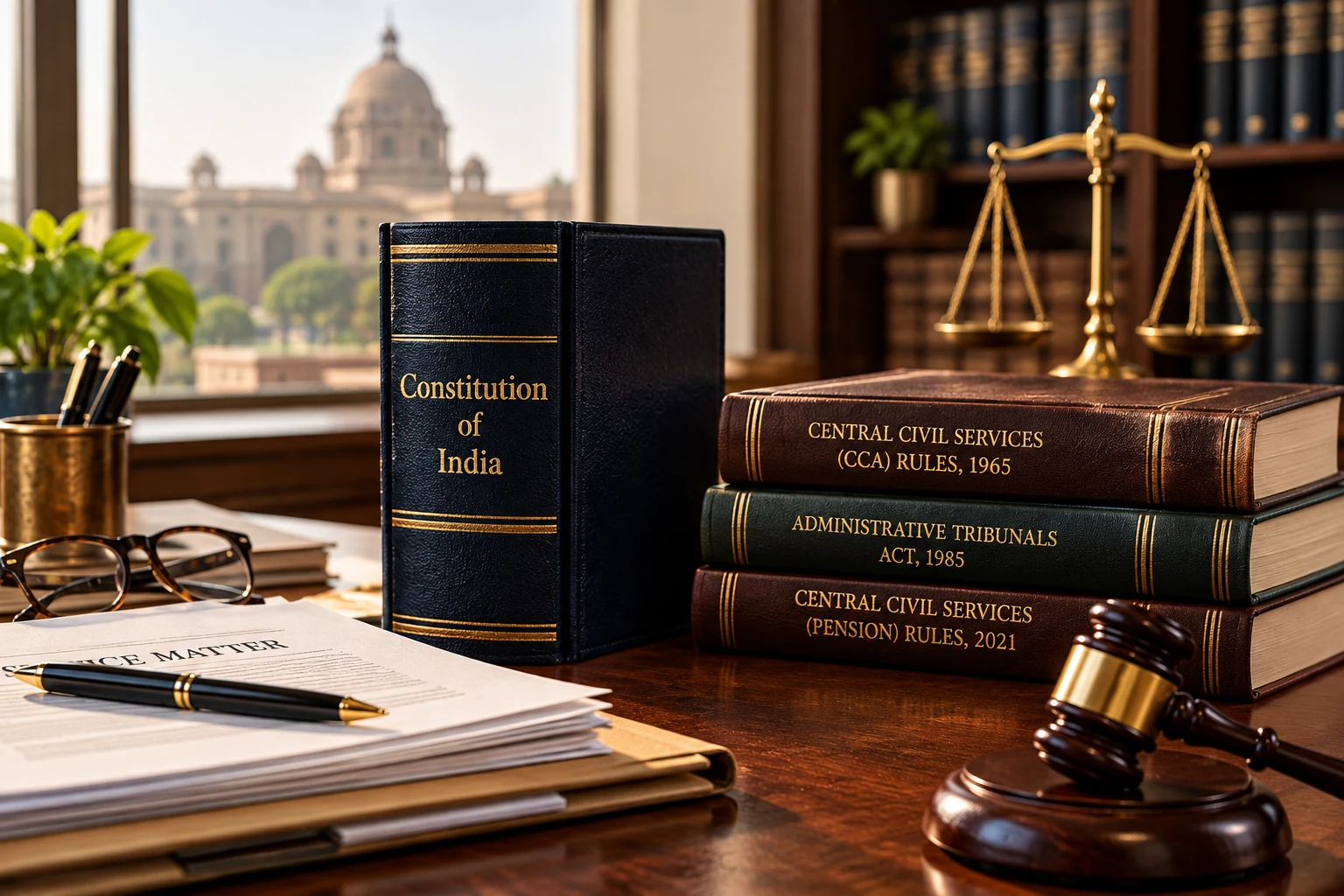
Service law in India governs the relationship between the State and persons holding civil posts, including matters relating to recruitment, conditions of service, disciplinary proceedings, and retirement benefits. The principal constitutional framework includes Article 309, Article 310, and Article 311 of the Constitution of India, together with the applicable Central Civil Services (Classification, Control and Appeal) Rules, 1965 and corresponding State service rules. Statutory tribunals, including the Central Administrative Tribunal and State Administrative Tribunals, exercise jurisdiction over specified categories of service disputes. Other applicable enactments, including the Administrative Tribunals Act, 1985 and the Central Civil Services (Pension) Rules, 2021, may also be relevant depending on the nature of the matter.
The nature and procedure of a service matter depend on the facts of the case, the applicable rules and the forum or authority having jurisdiction. Disputes may arise in diverse contexts, including suspension, departmental enquiry, disciplinary action, promotion, seniority, transfer, pay and allowances, pension and gratuity, and issues relating to regularisation and termination. Remedies and procedures vary according to the applicable legal framework and the nature of the matter.
Key Areas of Service Matters
An overview of the principal categories of service matters, disputes and related legal issues arising under the constitutional and statutory framework governing public employment in India.
01. Constitutional Framework of Service Law
Matters relating to the constitutional foundation of public employment, including the framework governing recruitment, conditions of service and safeguards against dismissal or removal.
- Common Matters: Applicability of constitutional safeguards, scope of the pleasure doctrine, and related issues.
- Key Issues: Interpretation of Articles 309, 310 and 311, and their application to different categories of service.
- Legal Focus: Constitution of India — Articles 309, 310 and 311.
02. Recruitment & Appointment
Matters relating to recruitment processes, eligibility, selection, appointment and related procedural issues in public employment.
- Common Matters: Selection disputes, eligibility criteria, reservation, and irregularities in recruitment.
- Key Issues: Validity of selection, procedural compliance and scope of judicial review.
- Legal Focus: Applicable recruitment rules, service rules and constitutional principles governing public employment.
03. Suspension & Departmental Enquiry
Matters relating to suspension pending disciplinary proceedings and the conduct of departmental enquiries, including procedural safeguards and related interim issues.
- Common Matters: Suspension, charge-sheet, enquiry proceedings and related interlocutory applications.
- Key Issues: Validity of suspension, procedural compliance and principles of natural justice.
- Legal Focus: Central Civil Services (Classification, Control and Appeal) Rules, 1965 and corresponding State service rules.
04. Disciplinary Action & Penalties
Matters relating to disciplinary proceedings and imposition of penalties, including procedural requirements and remedies against such orders.
- Common Matters: Major and minor penalties, removal, dismissal, compulsory retirement and related orders.
- Key Issues: Validity of penalty, proportionality, procedural lapses and appellate remedies.
- Legal Focus: Applicable service rules and constitutional safeguards under Article 311.
05. Promotion, Seniority & Transfer
Matters relating to promotion, seniority, transfer and posting, including related disputes and procedural issues in service matters.
- Common Matters: Denial of promotion, seniority disputes, transfer and posting orders.
- Key Issues: Eligibility, criteria, scope of judicial review and administrative discretion.
- Legal Focus: Applicable service rules, promotion policies and administrative instructions.
06. Pay, Allowances & Service Benefits
Matters relating to pay, allowances and other service benefits, including disputes regarding entitlement, computation and recovery.
- Common Matters: Pay fixation, arrears, allowances and related service benefits.
- Key Issues: Entitlement, computation and procedural requirements for claims.
- Legal Focus: Applicable pay rules, government orders and service regulations.
07. Pension, Gratuity & Retirement Benefits
Matters relating to pension, gratuity and other retirement benefits payable to government servants and their families.
- Common Matters: Pension, family pension, gratuity, commutation and related benefits.
- Key Issues: Eligibility, computation, procedural requirements and remedies for non-payment.
- Legal Focus: Applicable pension rules, including the Central Civil Services (Pension) Rules, 2021 and corresponding State pension rules, where applicable.
08. Administrative Tribunals
Matters relating to adjudication of service disputes before Administrative Tribunals, including jurisdiction, procedure and related issues.
- Common Matters: Original applications, jurisdiction disputes, interim relief and related proceedings.
- Key Issues: Scope of jurisdiction, maintainability and procedural requirements.
- Legal Focus: Administrative Tribunals Act, 1985 and applicable rules governing the Central Administrative Tribunal and, where constituted, State Administrative Tribunals.
09. Appeals & Further Remedies
Remedies against orders or decisions in service matters, including departmental appeals, statutory appeals and further proceedings before the appropriate forum, where available.
- Common Matters: Review, appeal and further proceedings against orders in service matters.
- Key Issues: Availability of appellate or other remedies, limitation, grounds and procedural requirements.
- Legal Focus: Applicable service rules, tribunal procedures and constitutional or statutory remedies.
Legal Assistance in Service Matters
An overview of the legal assistance that may be relevant in service matters, depending on the facts, the applicable service rules and the forum having jurisdiction.
Pre-Filing Assessment & Advisory
Understanding the nature of the service matter, relevant facts and documents, applicable service rules and constitutional provisions, and the appropriate forum, including the Central Administrative Tribunal, State Administrative Tribunal where constituted, High Court or other appropriate forum, depending on the nature of the matter — before proceedings are initiated, where applicable.
Drafting & Filing of Applications / Petitions
Assistance relating to the drafting and filing of original applications, writ petitions, appeals, representations and other pleadings before the appropriate authority, tribunal or court, in accordance with the applicable statutory and procedural framework.
Interim Relief & Stay Applications
Assistance in matters involving interim relief, stay of impugned orders or other protective measures that may be sought during the pendency of proceedings before the appropriate court, tribunal or authority, in accordance with the applicable law and procedural framework.
Representation before Authorities & Tribunals
Representation and assistance in proceedings before the Central Administrative Tribunal, State Administrative Tribunal where constituted, High Courts and other appropriate forums, including hearings, submissions and related procedural steps, subject to the nature of the matter.
Pleadings, Evidence & Arguments
Assistance in the preparation and filing of pleadings, counter-affidavits and rejoinders, presentation of documentary evidence, and advancing of arguments before the appropriate forum, in accordance with the applicable procedural law and the requirements of the matter.
Appeals & Further Remedies
Assistance concerning appeals and other remedies available under the applicable laws, including departmental appeals, challenges to or appeals against orders of tribunals and authorities, and further proceedings before higher forums, subject to the applicable statutory conditions, limitation and procedure.
Stages in a Service Matter
An illustrative sequence of how a service matter may progress under the applicable constitutional and statutory framework, including the service rules, the Administrative Tribunals Act, 1985 and related provisions, depending on the nature of the proceedings and the forum having jurisdiction.
Pre-Filing Assessment & Advisory
The nature of the service matter, relevant facts and documents, applicable service rules and constitutional provisions, and the appropriate forum — including the Central Administrative Tribunal, State Administrative Tribunal where constituted, or other appropriate forum — are considered before proceedings are initiated, where applicable.
Departmental Proceedings & Representation
Where applicable, proceedings before the departmental authority — including disciplinary proceedings, enquiries or statutory representations under the applicable service rules — may be conducted in accordance with the prescribed procedure and principles of natural justice.
Filing of Original Application / Petition
An original application, writ petition or other appropriate proceeding may, where applicable, be filed before the appropriate tribunal or court in accordance with the applicable statutory and procedural framework and the nature of the forum concerned.
Interim Relief & Stay Applications
Where applicable, the appropriate tribunal or court may consider applications for interim relief, stay of the impugned order or other protective measures during the pendency of proceedings, in accordance with the applicable law and procedural framework.
Pleadings, Hearing & Evidence
The appropriate forum may consider pleadings, counter-affidavits, rejoinders, documentary evidence and submissions placed on record, in accordance with the applicable procedure and the nature of the matter.
Order / Judgment
After considering the material on record and the submissions made, the appropriate forum may pass an order or judgment, as applicable to the nature of the proceedings and the statutory framework governing them.
Appeals & Further Remedies
Where the applicable law permits, an aggrieved party may pursue a departmental appeal, statutory appeal, review or other available remedy against an order or judgment, subject to the applicable statutory conditions, limitation and procedure.
Compliance & Implementation
Where applicable, steps may be taken for the compliance, enforcement or implementation of the order or judgment in accordance with the applicable provisions of the relevant statute and procedural framework, subject to the nature of the matter.
The sequence illustrated is indicative. Depending on the nature of the matter, some stages may occur in a different order, concurrently or may not arise at all. Interim relief or other measures may be sought at an appropriate stage during proceedings. The information provided is a general overview and should not be treated as legal advice for any particular matter.
How a Service Matter May Progress
An overview of how a service matter may proceed through different forums, depending on the applicable constitutional and statutory framework, including the service rules, the Administrative Tribunals Act, 1985 and related provisions, and the nature of the proceedings.
(CAT / SAT where constituted / High Court or Other Appropriate Forum)
(Departmental / Statutory / Judicial, where applicable)
Supreme Court Remedy
Other Remedies
Commencement before the Appropriate Forum
A service matter may be initiated or pursued before the appropriate Central Administrative Tribunal, State Administrative Tribunal where constituted, High Court or other appropriate forum, depending on the nature of the dispute, the category of service and the applicable statutory framework.
Appeal, Challenge or Other Statutory Remedy
An aggrieved party may, where applicable, pursue a departmental appeal, statutory appeal or other statutory remedy against an order or decision, before the competent appellate authority, tribunal or court, including the High Court in appropriate cases, as provided under the relevant service rules or statute.
Further Appeal or Supreme Court Remedy
Where the applicable law permits, a further appeal or other Supreme Court remedy may be available against a judgment or order of the High Court or other appellate forum, subject to the applicable statutory or constitutional requirements and prescribed procedure. Not every matter reaches the Supreme Court.
Review, Curative or Other Available Remedies
Where legally permissible, a party may pursue further remedies such as review or, in limited circumstances, curative jurisdiction, subject to the applicable law, statutory or procedural requirements and the nature of the decision. These remedies are not available in every matter.
Documents & Information That May Be Relevant
The documents and information relevant to a service matter depend on the nature of the dispute, the applicable service rules, the constitutional framework and the relief sought.
Identity & Service Records
Identity documents, appointment letter, service book, seniority list, and other records establishing the service history, cadre, and category of the government servant, where applicable.
Service Rules & Government Orders
Applicable service rules, government orders, circulars, office memoranda, and administrative instructions governing the conditions of service, where relevant to the matter.
Departmental Proceedings Records
Charge sheet, suspension order, show cause notice, enquiry report, findings of the enquiry officer, and other documents relating to departmental proceedings, where applicable.
Pay, Pension & Benefits Records
Pay slips, pay fixation orders, pension records, gratuity records, GPF statements, and other documents evidencing entitlement to pay, allowances, pension or other service benefits, as applicable.
Correspondence & Representations
Representations, notices, replies, reminders and other communications exchanged with the department or authority relevant to the service dispute.
Tribunal / Court Proceedings & Orders
Original applications, writ petitions, pleadings, orders, judgments and other records of proceedings before the Central Administrative Tribunal, State Administrative Tribunal where constituted, High Court or other appropriate forum, where applicable.
Please Note: The documents relevant to a service matter vary according to the nature of the dispute, the applicable service rules, the forum involved and the relief sought. Not every document listed above will be relevant to every matter. The information provided is a general overview and should not be treated as legal advice for any particular matter.
Frequently Asked Questions
Common questions about service law in India, the constitutional framework, service rules, the Administrative Tribunals Act, 1985, and related legal remedies.
Service law in India governs the relationship between the State and persons holding civil posts, including matters relating to recruitment, conditions of service, disciplinary proceedings, promotion, seniority, pay and allowances, pension and retirement benefits. The principal constitutional framework includes Articles 309, 310 and 311 of the Constitution of India, together with the applicable service rules such as the Central Civil Services (Classification, Control and Appeal) Rules, 1965 and corresponding State service rules. Statutory tribunals, including the Central Administrative Tribunal and State Administrative Tribunals where constituted, exercise jurisdiction over specified categories of service disputes under the Administrative Tribunals Act, 1985.
Article 309 empowers the appropriate legislature to regulate recruitment and conditions of service of persons appointed to public services and posts in connection with the affairs of the Union or a State. Article 310 embodies the doctrine of pleasure, under which members of the defence services and civil services of the Union or a State hold office during the pleasure of the President or the Governor, as applicable. Article 311 provides procedural safeguards in certain cases of dismissal, removal or reduction in rank, including the requirement of an inquiry and a reasonable opportunity of being heard, subject to the exceptions specified in the Article. The scope and application of these provisions depend on the category of service and the facts of the matter.
Suspension is generally an interim measure pending disciplinary proceedings or an enquiry, and does not by itself amount to a penalty. Dismissal, removal from service, or reduction in rank are substantive penalties that may be imposed under the applicable service rules, such as the Central Civil Services (Classification, Control and Appeal) Rules, 1965, and are subject to the procedural safeguards under Article 311 of the Constitution in cases to which the Article applies. The distinction is relevant to the nature of the proceedings, the rights available to the government servant and the remedies that may be pursued.
A departmental enquiry is generally governed by the applicable service rules, such as the Central Civil Services (Classification, Control and Appeal) Rules, 1965, and corresponding State service rules. The procedure may include framing of charges, communication of the charge sheet to the government servant, an opportunity to submit a written statement of defence, appointment of an inquiry authority where required, examination of witnesses and documents, and submission of a report of findings. The principles of natural justice, including a reasonable opportunity of being heard, apply subject to the applicable rules and circumstances. The specific procedure and the rights available to the government servant depend on the nature of the charges and the applicable rules.
The Central Administrative Tribunal (CAT) is a statutory tribunal constituted under the Administrative Tribunals Act, 1985, with jurisdiction over specified categories of service matters relating to recruitment and conditions of service of persons appointed to public services and posts in connection with the affairs of the Union or other authorities within its jurisdiction. State Administrative Tribunals, where constituted under the same Act, exercise comparable jurisdiction in relation to State services. The Act provides for the jurisdiction, powers and procedure of these tribunals, and their orders are subject to the remedies available under the applicable law.
A disciplinary order may, where the applicable law permits, be challenged through the remedies available under the relevant service rules or the applicable statute. These may include a departmental appeal before the prescribed appellate authority, a review or revision where provided, or proceedings before the Central Administrative Tribunal or a State Administrative Tribunal where constituted, or the High Court in appropriate cases. The availability, scope and procedure of each remedy depend on the nature of the order, the applicable service rules and the forum having jurisdiction.
The remedies available in a service matter depend on the nature of the order or decision and the applicable service rules. These may include a representation to the competent authority, a departmental appeal, a review or revision where provided, proceedings before the Central Administrative Tribunal or a State Administrative Tribunal where constituted, and writ or other constitutional proceedings before the High Court under the applicable constitutional jurisdiction, including Articles 226 and 227 where applicable. Further remedies before the Supreme Court may be available subject to the applicable constitutional and statutory requirements. Not every matter follows the same route, and the availability of a particular remedy depends on the facts and the applicable law.
Pension, gratuity and other retirement benefits are governed by the applicable pension rules, which may include the Central Civil Services (Pension) Rules, 2021 for covered Central Government services, and corresponding State pension rules for State Government services. The eligibility, computation and payment of pension and other retirement benefits depend on the applicable rules, the nature of service and the qualifying service of the government servant. Disputes relating to pension and retirement benefits may be pursued through the remedies available under the applicable service rules and before the appropriate forum.
The limitation period for filing a service matter depends on the applicable statute and the forum before which the proceeding is initiated. Under the Administrative Tribunals Act, 1985, the limitation applicable to an application before the Central Administrative Tribunal or a State Administrative Tribunal generally runs from the date of the final order where the prescribed departmental remedy has resulted in a final order. Where an appeal or representation has been made and no final order is passed within six months, the Act provides for limitation calculated from the expiry of that six-month period. The Act also permits condonation of delay where sufficient cause is shown. For writ proceedings before the High Court, the position depends on the applicable law and judicial principles governing delay and laches. The specific limitation applicable to a matter should be verified with reference to the applicable statute and facts of the case.
Legal representation is not uniformly mandatory in every service matter, and the position depends on the forum and applicable rules. Before the Central Administrative Tribunal and State Administrative Tribunals, an applicant may appear in person or take the assistance of a legal practitioner in accordance with the Administrative Tribunals Act, 1985 and applicable rules. In departmental proceedings, the applicable service rules may permit representation through a defence assistant in specified circumstances. Proceedings before the High Court and Supreme Court are ordinarily conducted through advocates, subject to the applicable procedural rules and permissions. The specific position should be verified with reference to the applicable rules and the forum concerned.
Related Legal Areas
Explore related legal information and resources relevant to service matters and related legal issues.
Our Practices
Explore other areas of legal practice that may be relevant to service matters and related legal issues.
Read More → 02Orders & Judgments
Read selected court orders and judgments published for legal information and awareness.
Read More → 03Legal Insights
Explore articles and explanatory content on legal issues, court decisions and developments.
Read More → 04Legal Resources
Access useful legal resources and reference material relating to courts, procedures and legal practice.
Read More →Discuss Your Legal Matter
For information regarding a service matter, or our areas of practice, you may contact Corpus Juris India through the available contact channels.