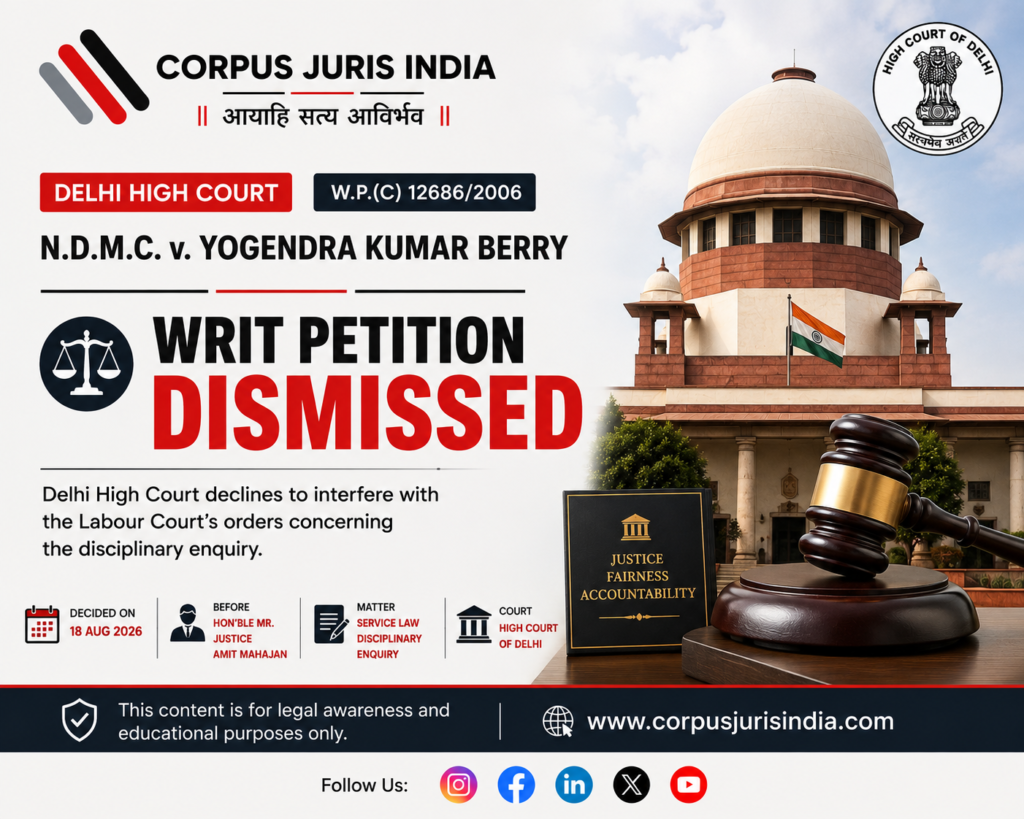
The Delhi High Court, in N.D.M.C. v. Yogendra Kumar Berry, W.P.(C) 12686/2006, decided on 18 August 2026, examined Labour Court interference with domestic enquiry findings in a disciplinary proceeding concerning an employee of the New Delhi Municipal Council (N.D.M.C.).
The judgment, delivered by Hon’ble Mr. Justice Amit Mahajan, examines the limits of judicial interference with domestic enquiry findings and explains that the fact that an enquiry has been conducted fairly does not, by itself, make its findings immune from scrutiny.
The Court ultimately dismissed the writ petition filed by N.D.M.C. and declined to interfere with the Labour Court’s orders.
Background of the Case
The respondent, Yogendra Kumar Berry, had been appointed as a compounder in 1964 and was subsequently assigned duties assisting the store-keeper.
In 1970, another pharmacist, M.C. Sharma, was appointed as store-keeper. The respondent was subsequently charge-sheeted in 1975 in relation to alleged shortages of medicines in the Central Medical Store and the alleged failure to hand over charge to his successor.
Two principal charges were framed against him.
The first charge concerned alleged shortages of medicines costing more than ₹60,000, said to have been discovered during an internal audit covering the period from 1 April 1970 to 31 March 1974.
The second charge alleged that after the respondent’s transfer from the Central Medical Store in May/June 1970, he had failed to hand over charge to his successor, M.C. Sharma.
The departmental enquiry continued for more than six years. The Enquiry Officer ultimately found the first charge partially proved and the second charge proved. The respondent was thereafter removed from service by an order dated 23 November 1982.
What Happened Before the Labour Court?
The Labour Court examined the findings of the Enquiry Officer and ultimately set aside the adverse findings.
In relation to Charge No. 1, the Labour Court found the charge and the findings to be vague and perverse.
In relation to Charge No. 2, the Labour Court concluded that there was no sufficient basis to hold the respondent liable.
The Labour Court subsequently considered the relief available to the respondent. Since he had already reached the age of superannuation, reinstatement could not practically be granted. The Labour Court therefore awarded 50% of the back wages from the date of termination until superannuation, along with retirement benefits.
N.D.M.C. challenged these orders before the Delhi High Court.
The Issue Before the Delhi High Court
The principal issue before the High Court was whether the Labour Court had improperly re-appreciated the evidence and interfered with the findings of a domestic enquiry which had otherwise been conducted in a fair manner.
N.D.M.C. argued that once the enquiry had been conducted fairly, the Labour Court should not have interfered with the Enquiry Officer’s findings.
The petitioner also relied upon the evidence of PW-7, a Senior Store-keeper, regarding the alleged absence of a record showing that the respondent had handed over charge to his successor.
What Did the Delhi High Court Hold?
The High Court recognised the established principle that ordinarily a Labour Court should not interfere with the findings of a domestic enquiry where the enquiry has been conducted fairly and in accordance with the principles of justice.
However, the Court made an important qualification.
A finding in a fair enquiry is not automatically protected from judicial scrutiny. Interference remains permissible where the conclusion is based on no evidence or where the findings are manifestly perverse.
This distinction was central to the Court’s decision.
Why Did the Court Uphold the Labour Court’s Intervention?
The High Court examined the reasoning contained in the Enquiry Officer’s report.
With respect to Charge No. 1, the Court noted that the Enquiry Officer had recorded the versions and contentions of the parties and referred to statements of witnesses, but had not adequately explained how the conclusion that the charge was partially proved had actually been reached.
The Court therefore found that the reasoning did not sufficiently establish the basis for the adverse conclusion.
The Court also found the reasoning concerning Charge No. 2 to be insufficient.
According to the Enquiry Officer’s reasoning, the charge was treated as proved because the respondent had not produced evidence showing his desire to hand over charge and had not sufficiently explained his inability to do so.
The High Court held that this approach incorrectly placed the burden upon the respondent to disprove the charge instead of examining how the petitioner had itself established the charge.
The Court therefore found that, in the absence of cogent reasoning explaining how the Enquiry Officer reached the conclusion, the Labour Court could not be faulted for setting aside the adverse findings.
The Question of the Timing of the Allegations
The High Court also considered the circumstances surrounding the alleged failure to hand over charge.
The Court noted that, even according to the petitioner’s case as recorded by the Enquiry Officer, M.C. Sharma had taken over the charge of the store on 11 June 1970, while the respondent remained in the store only until June 1970.
The Court further noted that the respondent subsequently worked intermittently for a short period when M.C. Sharma was on leave.
The Labour Court had therefore drawn a presumption that, since M.C. Sharma had joined on 10 February 1970, he had taken over charge at that time. The High Court found this assessment relevant to the question of whether responsibility for the subsequent shortage could properly be attributed to the respondent.
Delay in Initiating the Charge
Another significant factor considered by the Court was the delay.
Although the alleged failure to hand over charge related to the year 1970, disciplinary action in relation to that allegation was not initiated against the respondent at the relevant time.
The charge was subsequently levelled after purported discrepancies in the stock of medicines were noticed.
The High Court specifically noted that the enquiry proceedings themselves continued for around six years and that no satisfactory explanation was provided for why the charges had been levelled at such a belated stage.
In the circumstances of the case, the Court observed that the allegations appeared to be an afterthought.
Responsibility for the Shortage of Medicines
The Court also examined the period covered by Charge No. 1.
The alleged shortage related to the period from April 1970 to March 1974. However, M.C. Sharma had already joined in February 1970.
The High Court noted that the respondent could not be held responsible for the entire period merely on the basis of the allegations made against him, particularly when the Enquiry Officer’s report did not clearly identify the period for which the respondent was being held responsible.
The Court also noted the absence of clear-cut evidence fixing responsibility upon the respondent for the alleged shortage.
Accordingly, the High Court considered the Labour Court’s view to be plausible and reasonable.
Article 226 and Judicial Review
After considering the record and the reasoning adopted by the Labour Court, the Delhi High Court concluded that there was no sufficient basis for exercising its extraordinary jurisdiction under Article 226 of the Constitution of India.
The Court therefore declined to interfere with the Labour Court’s order dated 15 June 2005 and award dated 21 June 2005.
The writ petition filed by N.D.M.C. was accordingly dismissed.
Key Legal Takeaway
The judgment illustrates an important distinction in cases involving domestic enquiries.
A Labour Court does not ordinarily function as an appellate court over a domestic enquiry merely because another view of the evidence may be possible.
However, a fair procedure does not make the resulting findings completely immune from scrutiny.
Where the conclusion is unsupported by evidence, manifestly perverse, inadequately reasoned, or reached by incorrectly shifting the burden of proof upon the employee, judicial interference may remain permissible.
In the present case, the High Court found that the Enquiry Officer’s conclusions lacked sufficient reasoning and that the Labour Court was justified in setting aside the adverse findings.
Why This Judgment Matters
For employees facing disciplinary proceedings, the judgment demonstrates that the fairness of the enquiry procedure is only one part of the judicial examination.
The reasoning supporting the ultimate findings also matters.
An enquiry officer must explain how the evidence leads to the conclusion reached. Merely recording the versions of witnesses or the contentions of the parties is not necessarily sufficient where the final finding does not disclose the reasoning connecting the evidence with the charge.
The judgment also highlights the relevance of delay and the need for a clear evidentiary basis for fixing responsibility in disciplinary proceedings.
At the same time, the judgment does not establish that Labour Courts may routinely re-appreciate evidence in every domestic enquiry. The Court expressly recognised the general principle restricting interference with fair enquiries, while identifying circumstances in which interference may nevertheless be justified.
Case Details
Case: N.D.M.C. v. Yogendra Kumar Berry
Court: High Court of Delhi at New Delhi
Case Number: W.P.(C) 12686/2006
Date of Decision: 18 August 2026
Bench: Hon’ble Mr. Justice Amit Mahajan
Nature: Judgment (Oral)
Result: Writ petition dismissed
Relevant Provision: Article 226, Constitution of India
Rules Referred: Rule 3, CCS (Conduct) Rules, 1955
Broad Area: Service Law / Employment & Labour Law / Disciplinary Proceedings
The respondent was represented by Mr. Kamlesh Kumar Mishra, Ms. Samishti Soloman, Ms. Renu and Ms. Akanksha Priya, Advocates, as recorded in the judgment.
Frequently Asked Questions
Can a Labour Court interfere with findings of a domestic enquiry?
Ordinarily, a Labour Court should not interfere with findings of a fair domestic enquiry merely as an appellate court. However, interference may be permissible where the conclusion is based on no evidence or the findings are manifestly perverse.
Does a fair enquiry automatically make the Enquiry Officer’s findings final?
No. The Delhi High Court observed that findings in a fair enquiry are not automatically immune from interference where they are unsupported by evidence or manifestly perverse.
What was the problem with the Enquiry Officer’s reasoning in this case?
The High Court found that the report did not adequately explain how Charge No. 1 had been partially proved and that the reasoning concerning Charge No. 2 was insufficient. The Court also found that the burden had incorrectly been placed upon the respondent to disprove the charge.
Did the Delhi High Court interfere with the Labour Court’s orders?
No. The High Court declined to interfere with the Labour Court’s order and award and dismissed N.D.M.C.’s writ petition.
What was the final outcome for the respondent?
The High Court dismissed the writ petition and upheld the Labour Court’s position, including the Labour Court’s decision concerning the relief awarded after the respondent had reached superannuation.
Conclusion
The decision in N.D.M.C. v. Yogendra Kumar Berry demonstrates that while courts generally respect the findings of a properly conducted domestic enquiry, the findings must still have an adequate evidentiary and reasoning foundation.
Where an Enquiry Officer fails to sufficiently connect the evidence with the conclusions, incorrectly places the burden upon the employee, or reaches findings that are unsupported or manifestly perverse, the Labour Court may have grounds to interfere.
In the present case, the Delhi High Court found no error in the Labour Court’s approach and declined to exercise its jurisdiction under Article 226. The writ petition was therefore dismissed.
Standard Disclaimer
This content is published solely for legal information, legal education, and reporting of judicial or legal developments. It does not constitute legal advice, create a lawyer-client relationship, or amount to solicitation or advertisement under the applicable Bar Council of India Rules.
📄 Download Official Judgment (PDF)