
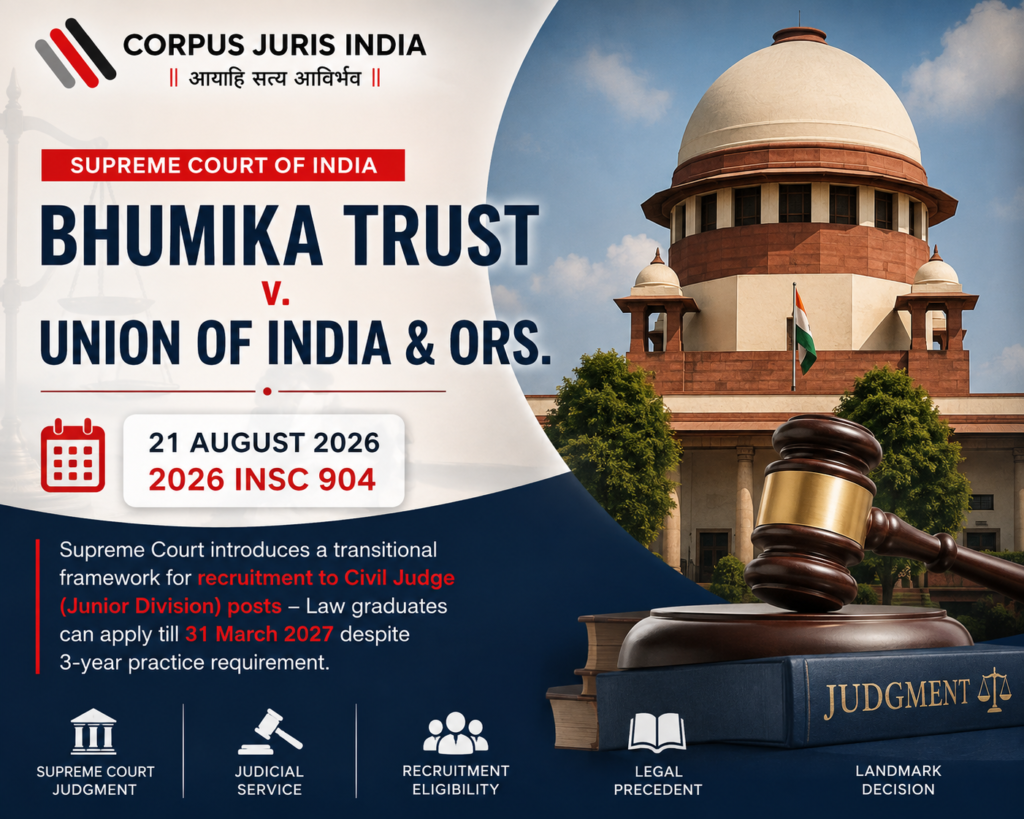
Supreme Court of India | 21 August 2026 | 2026 INSC 904
The Civil Judge practice rule has been modified by the The Supreme Court of India, in Bhumika Trust v. Union of India & Ors., has modified the framework governing the practice requirement for recruitment to the post of Civil Judge (Junior Division). The judgment introduces a transitional arrangement for recruitment notifications issued up to 31 March 2027 and prescribes a revised framework for recruitment notifications issued on or after 1 April 2027.
Case Details
Case Title: Bhumika Trust v. Union of India & Ors.
Court: Supreme Court of India
Date of Judgment: 21 August 2026
Citation: 2026 INSC 904
Case Number: Writ Petition (Civil) No. 1110/2025 and connected matters
Subject: Recruitment to the post of Civil Judge (Junior Division) and practice requirement
Decision: Earlier judgment modified
Download Official Judgment PDF
[📄 Download Official Judgment PDF]
Background
The present proceedings arose in the context of the Supreme Court’s earlier judgment dated 20 May 2025, which had mandated a minimum of three years’ practice at the Bar as an eligibility requirement for candidates seeking appointment to the post of Civil Judge (Junior Division).
The present batch comprised Writ Petition (Civil) No. 1110/2025 filed by Bhumika Trust, three Review Petitions challenging the mandatory three-year practice requirement, and applications concerning whether the period spent in higher legal education could be counted towards the practice requirement.
The Court considered submissions and material placed before it by High Courts, Law Universities, National Law Universities and the learned Amicus Curiae. The central question was not whether practical exposure to courts is desirable for a person entering judicial service, but whether such exposure necessarily had to take the form of three years of conventional practice at the Bar before a candidate could even appear for the examination.
What Has the Supreme Court Decided?
The Supreme Court has modified the earlier judgment and introduced a structured framework combining:
- prior practical exposure,
- judicial academy training,
- supervised Law Clerkship, and
- evaluation before regular appointment.
The new framework operates differently during the transition period up to 31 March 2027 and after 1 April 2027.
Transitional Framework: Recruitment Notifications Up to 31 March 2027
For recruitment notifications or advertisements issued after the earlier judgment and up to 31 March 2027, the Court has directed that all law graduates shall be eligible to apply notwithstanding the three-year practice requirement.
For the purpose of their applications, such candidates will be deemed to have completed one year of active practice. They will not be required to furnish a separate Certificate of Practice for this deemed period.
However, selected candidates will not immediately enter regular judicial service.
They will initially be designated as “Trainee Judicial Officers” and will be required to undergo one year of intensive training at the concerned State Judicial Academy. The Court has directed that this training period will be treated as equivalent to one year of practice at the Bar for purposes of the three-year requirement.
During the training period, Trainee Judicial Officers will receive a fixed emolument equivalent to one-half of the remuneration payable to a Judicial Magistrate First Class in the concerned State, together with the facilities and other benefits ordinarily made available to trainees at the concerned State Judicial Academy.
One Year of Structured Law Clerkship
After successful completion of the one-year Judicial Academy training, the Trainee Judicial Officers will undergo a further one-year structured Law Clerkship.
The first six months will be spent as a Law Clerk under the supervision of the Principal District/District and Sessions Judge or Members of the Higher Judicial Services.
The remaining six months will be spent under the supervision of a sitting Judge of the concerned High Court.
The Court has also directed that this one-year Law Clerkship will be treated as equivalent to one year of practice at the Bar for the purpose of satisfying the three-year practice requirement.
The Court observed that supervised Law Clerkship can provide exposure to the manner in which court proceedings are conducted, courtroom decorum, interaction with members of the Bar and litigants, preparation and analysis of cases, evaluation of submissions, application of procedural law and the discipline involved in preparing judicial orders.
Evaluation Before Regular Appointment
The Court has attached importance to the evaluation of a Trainee Judicial Officer after completion of the Law Clerkship.
The evaluation is required to consider matters including:
- conduct;
- diligence;
- analytical ability;
- understanding of procedure;
- capacity to deal with cases;
- quality of legal reasoning; and
- suitability for judicial office.
The Court also directed that the evaluation should remain objective and reasoned and should not become an additional or undefined barrier to appointment.
After satisfactory evaluation, the Trainee Judicial Officer will be appointed to the regular post and will become entitled to the regular pay scale and other service benefits attached to the post.
Framework From 1 April 2027
The Supreme Court has prescribed a different framework for recruitment notifications or advertisements issued on or after 1 April 2027.
Under this framework, every candidate seeking to appear for the examination for appointment as Civil Judge (Junior Division) must possess at least one year of actual practice.
The practice must be subject to verification through a Certificate of Practice. The Court has directed that such certification must be based upon the candidate’s presence and participation in effective judicial proceedings, in accordance with the mechanism to be prescribed by the High Courts.
The application for recruitment from this cycle will be entertained only upon submission of the requisite certificate evidencing completion of one year of actual practice in the District Courts.
Candidates selected under this framework will thereafter undergo:
- One year of intensive training at the State Judicial Academy;
- Six months of Law Clerkship under the Principal District/District and Sessions Judge or Members of the Higher Judicial Services; and
- Six months of Law Clerkship under a sitting Judge of the concerned High Court.
The Judgment Does Not Simply Abolish Practical Experience
The judgment should not be understood as simply removing the requirement of practical experience for entry into judicial service.
The Supreme Court expressly recognised the importance of exposure to the working of courts for candidates entering the judicial service. The Court’s focus was on whether three years of conventional practice at the Bar must necessarily be completed before appearing for the examination, and on whether practical experience could instead be supplemented through structured training and supervised judicial exposure.
The framework therefore combines different forms of professional and judicial exposure.
During the transitional period, law graduates can enter the selection process without completing three years of prior practice, subject to the deemed one-year practice arrangement and the prescribed training and clerkship after selection.
From 1 April 2027, candidates must possess one year of actual District Court practice before appearing for the examination, followed by the prescribed judicial training and clerkship after selection.
Changes to Recruitment Rules
The Court has directed the State Governments, in consultation with the respective jurisdictional High Courts, to undertake and officially notify the necessary amendments to the applicable service rules within three months from the date of the judgment.
The Court has further clarified that recruitment notifications and advertisements already issued after the judgment under review, as well as those issued subsequently, must conform to and be governed by the directions contained in the present judgment.
Persons with Disabilities
The judgment also considered the concerns raised in Writ Petition (Civil) No. 1110/2025 concerning persons with disabilities.
The Court observed that the directions issued in the judgment should adequately address the grievances raised by the petitioners, particularly concerning the need for appropriate accommodation for persons with disabilities.
Separate Opinion
Justice K. Vinod Chandran delivered a separate opinion.
He expressed his inability to agree that review of the earlier decision prescribing three years’ practice at the Bar before entering a judicial career was necessary. His opinion considered the review within the established limits applicable to review jurisdiction and disagreed with the majority’s approach.
Justice Chandran’s separate opinion is therefore an important part of the judgment and reflects a different view on the necessity of revisiting the three-year practice requirement.
Duration and Future Review of the Scheme
The Supreme Court has stated that the scheme should not be treated as immutable.
The Court observed that judicial recruitment is an evolving process and that the effect of the new arrangement can be properly assessed only after it has operated for a reasonable period.
The judgment provides that the scheme will remain in force for five years from the date of the judgment. After completion of that period, material concerning the quality of recruitment, training and clerkship, performance of officers recruited under the scheme and other relevant empirical material is to be placed before the Court for consideration. The scheme may thereafter be revisited, if necessary.
Key Takeaways
1. Transitional recruitment up to 31 March 2027
Law graduates will be eligible to apply notwithstanding the three-year practice requirement.
2. One year of deemed practice
For the transitional recruitment period, candidates will be deemed to have completed one year of active practice for the purpose of their applications.
3. One year of Judicial Academy training
Selected candidates will initially be designated as Trainee Judicial Officers and must undergo one year of intensive training at the State Judicial Academy.
4. One year of structured Law Clerkship
The transitional framework provides for one year of supervised Law Clerkship, divided equally between the District/Higher Judicial Services level and a sitting Judge of the concerned High Court.
5. One year of actual practice from 1 April 2027
Candidates applying under recruitment notifications issued on or after 1 April 2027 must possess at least one year of actual District Court practice.
6. Continued training after selection
Candidates recruited under the post-transition framework will continue to undergo one year of Judicial Academy training followed by the prescribed six-month and six-month Law Clerkship periods.
7. Evaluation before regular appointment
Trainees must undergo a reasoned evaluation, with regular appointment following satisfactory assessment.
8. Rules to be amended
State Governments and High Courts have been directed to make the necessary amendments to the applicable rules.
9. Five-year operation of the scheme
The framework will remain in force for five years and may thereafter be reviewed on the basis of empirical experience.
Conclusion
The Supreme Court’s decision in Bhumika Trust v. Union of India & Ors. represents an important development in the framework governing Civil Judge (Junior Division) recruitment.
Rather than treating courtroom practice, judicial training and supervised judicial exposure as mutually exclusive, the judgment combines these elements within a structured recruitment and training model.
For the transitional period ending 31 March 2027, law graduates can apply notwithstanding the earlier three-year practice requirement, subject to the deemed one-year practice arrangement and the prescribed post-selection training and clerkship.
For recruitment notifications issued from 1 April 2027, candidates must have at least one year of actual District Court practice before appearing for the examination, followed by the prescribed Judicial Academy training and Law Clerkship after selection.
The judgment is likely to have significant implications for law graduates, judicial service aspirants, High Courts, State Governments, State Judicial Academies and institutions involved in legal and judicial education.
The scheme will remain subject to institutional evaluation, with the Supreme Court retaining the possibility of revisiting the framework after the prescribed period on the basis of relevant empirical material.
Disclaimer
This content is published solely for legal information, legal education, and reporting of judicial or legal developments. It does not constitute legal advice, create a lawyer-client relationship, or amount to solicitation or advertisement under the applicable Bar Council of India Rules.