
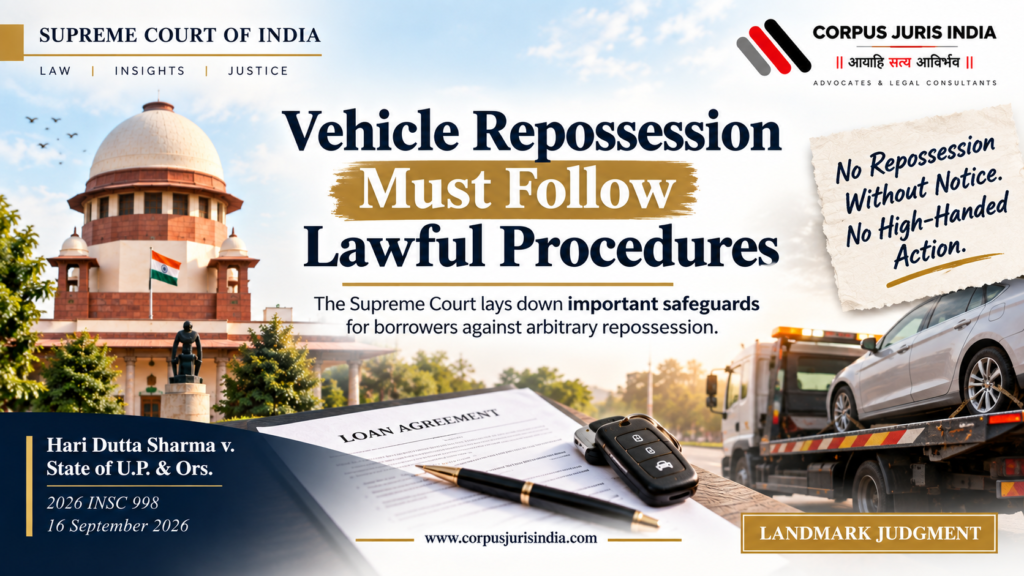
Hari Dutta Sharma v. State of U.P., 2026 INSC 998
The Supreme Court on vehicle repossession was examined in Hari Dutta Sharma v. State of U.P. & Ors., 2026 INSC 998, where the Court considered the manner in which a financier may exercise its contractual right to repossess a vehicle following a loan default. The judgment was delivered on 16 September 2026 by a Bench comprising Justice Pamidighantam Sri Narasimha and Justice Alok Aradhe.
The case concerns the balance between the right of a financier to recover a secured debt and the borrower’s right to have such recovery carried out in accordance with law and applicable procedural safeguards.
Case Details
Case Title: Hari Dutta Sharma v. State of U.P. & Ors.
Court: Supreme Court of India
Citation: 2026 INSC 998
Date of Judgment: 16 September 2026
Bench: Justice Pamidighantam Sri Narasimha and Justice Alok Aradhe
Case: Civil Appeal arising out of S.L.P. (C) Diary No. 10952 of 2026
Subject: Vehicle repossession, loan recovery, RBI guidelines and borrower rights.
Background of the Case
The appellant had obtained a commercial vehicle loan from Cholamandalam Investment and Finance Company Limited for a Tata SFC 407 truck bearing registration number UP-16-GT-0449.
The sanctioned loan amount was ₹10,40,080.75, out of which ₹9,36,000 was disbursed. The loan was repayable in 75 monthly instalments and was secured by hypothecation of the vehicle. A supplementary loan of ₹1,04,080.75 was subsequently extended.
The appellant defaulted on the repayment obligations. A recall-cum-demand notice dated 17 January 2022 was issued, followed by further defaults. The company repossessed the vehicle on an earlier occasion and subsequently released it after the appellant made a payment of ₹86,726 and assured regularisation of the loan account.
The appellant again defaulted. Notices dated 7 July 2022 and 22 December 2022 were issued, calling upon him to clear the outstanding dues or surrender the hypothecated vehicle. A pre-seizure notice was subsequently sent to the SHO, Police Station Ayodhya Cantt, on 9 April 2023.
According to the appellant, on 9 April 2023, while the vehicle was parked after delivery of goods at a consignor’s godown in Ayodhya, four unidentified persons broke the steering lock at about 1:00 a.m. and drove the vehicle away. The appellant stated that the vehicle was taken without notice. He lodged a lost article report and an e-FIR on the same day.
On 30 September 2023, the appellant received a legal notice from the company stating that possession of the vehicle had been taken and that it had been sold on 31 August 2023 for ₹4,50,000. The notice stated that ₹5,71,914 was payable as on 31 August 2023 and that a further amount remained due after adjustment of the sale proceeds.
The appellant subsequently approached the courts. His complaint under Section 156(3) of the Code of Criminal Procedure was dismissed, and the Allahabad High Court dismissed his writ petition by order dated 4 April 2025. The matter was thereafter considered by the Supreme Court.
Issues Before the Supreme Court
The Supreme Court considered the legality of the manner in which the vehicle had been repossessed.
The Court examined whether the financier’s contractual right to repossess the vehicle could be exercised through force, without following the notice requirement contained in the agreement and without complying with applicable RBI guidelines.
The Court also considered the consequences of the alleged unlawful repossession upon the appellant, who was dependent upon the vehicle for his livelihood.
Supreme Court on Vehicle Repossession
The Supreme Court recognised that a financier may have a contractual right to take possession of a financed vehicle where the agreement confers such a right.
The Court, however, made it clear that the existence of such a contractual right does not mean that the financier has an unrestricted authority to take possession in any manner it chooses.
The Court observed that contractual self-help repossession provisions are not inherently invalid. Such provisions can facilitate institutional financing, particularly where the financed asset itself constitutes the security. At the same time, because repossession may take place outside the immediate supervision of a court or tribunal, the right must be exercised with care.
Thus, the judgment distinguishes between the right to repossess and the lawful manner of exercising that right.
RBI Guidelines on Loan Recovery
The Supreme Court examined the regulatory framework developed by the Reserve Bank of India concerning recovery of loans.
The Court referred to the Fair Practices Code for Lenders issued by the RBI in 2003 and subsequent guidelines and circulars dealing with banks, NBFCs and recovery agents.
These guidelines addressed matters including fair recovery practices, customer rights, debt collection, recovery agents, repossession clauses, grievance redressal and procedures relating to sale or auction of repossessed assets.
The Court summarised the applicable safeguards. Among other things, lenders should not resort to undue harassment or the use of muscle power for recovery. Vehicle seizure must be undertaken through lawful means, and recovery agents must comply with applicable regulatory requirements.
The Court also noted that a repossession clause may contain safeguards concerning the notice period, the circumstances in which notice may be waived, the procedure for taking possession, a final opportunity to repay before sale or auction, and the procedure governing sale or auction.
Examination of the Repossession Clause
The Supreme Court examined Article 11 of the loan agreement between the parties.
The agreement provided for a seven-day notice in cases of default before repossession. It also contained provisions concerning post-repossession notice, repayment of the termination price and sale of the vehicle.
However, the agreement also gave the company extensive powers concerning repossession, including the ability to enter places where the vehicle might be located and a provision allowing the company to waive the notice requirement in certain circumstances.
After examining the agreement alongside the RBI Guidelines, the Supreme Court held that Article 11 was not in conformity with the RBI Guidelines or the Indian Contract Act, 1872.
The Court identified several concerns. These included the provision treating the borrower’s rights over the vehicle as determined without notice, the authority to enter places in search of the vehicle, the absence of a prescribed procedure for possession and sale, and the unilateral power to waive the notice requirement.
Repossession Without Following the Contractual Notice Requirement
The Supreme Court then considered the facts of the present case.
The Court found that the seven-day notice contemplated by Article 11(a)(i) had not been issued before the repossession.
The Court also considered the appellant’s specific and unrebutted case that possession was taken at approximately 1:00 a.m. on 9 April 2023 by breaking open the vehicle’s steering lock.
The Court observed that such a method was not a peaceful mode of taking possession. It also noted that the possession memorandum did not bear the appellant’s signature.
On this basis, the Court concluded that the repossession had been carried out without following the required legal process.
Delay Before Approaching the High Court
The Supreme Court also considered the High Court’s finding that the writ petition should be dismissed on the ground of delay.
The Court noted that the appellant had lodged an FIR on the very day of the incident and had subsequently filed a complaint under Section 156(3) of the Code of Criminal Procedure.
The Court further noted that traffic challans continued to be issued in relation to the vehicle even after the company stated that the vehicle had been sold on 31 August 2023. These circumstances, according to the Supreme Court, required consideration while examining the question of delay.
The Supreme Court therefore did not sustain the High Court’s finding that the writ petition should be dismissed solely on the ground of delay.
Right to Livelihood and Articles 14 and 21
The Court noted that the appellant was a person of modest means and was dependent upon the vehicle for his livelihood through his transportation business.
The Supreme Court held that the appellant had been deprived of his right to livelihood in an arbitrary and unfair manner in the circumstances of the case.
The Court consequently held that the impugned action of the company constituted a violation of Articles 14 and 21 of the Constitution of India.
Directions to the Reserve Bank of India
The Supreme Court also considered the implementation of RBI’s recovery-related guidelines.
The Court observed that the Guidelines, Master Circulars and Clarifications issued by the RBI had existed for a considerable period, but effective steps were required to secure genuine compliance by NBFCs and Scheduled Commercial Banks.
Accordingly, the Court directed the RBI to take effective steps to ensure compliance with the applicable Guidelines, Master Circulars and Clarifications. The Registry was directed to send a copy of the judgment to the RBI.
Final Decision of the Supreme Court
The Supreme Court quashed and set aside the order dated 4 April 2025 passed by the Allahabad High Court.
Since the vehicle had already been sold on 31 August 2023, the Supreme Court did not set aside the sale at that stage.
The Court issued the following directions:
- The company was directed to close both loan accounts of the appellant.
- The company was directed to refund ₹4,50,000, being the sale price of the vehicle, with 6% interest per annum from the date of sale until payment.
- The appellant was awarded ₹10,00,000 as compensation for mental agony and loss of livelihood for a considerable period.
- The appeal was allowed with costs quantified at ₹50,000.
Key Takeaways
The judgment in Hari Dutta Sharma v. State of U.P., 2026 INSC 998, highlights the following legal principles:
- A financier may have a contractual right to repossess a financed vehicle.
- The contractual right of repossession does not permit arbitrary or unlawful seizure.
- Vehicle repossession must be carried out through lawful means.
- Applicable RBI guidelines concerning recovery practices and recovery agents must be followed.
- Repossession clauses must provide appropriate procedural safeguards and remain consistent with applicable law.
- Notice and an opportunity to cure the default are significant safeguards in the repossession process.
- The manner in which a vehicle is repossessed can have constitutional implications where the facts establish arbitrary deprivation of livelihood.
- The Supreme Court directed the RBI to take effective steps to secure genuine compliance with its recovery-related guidelines by NBFCs and Scheduled Commercial Banks.
Conclusion
The decision in Hari Dutta Sharma v. State of U.P., 2026 INSC 998, provides an important examination of the legal limits surrounding vehicle repossession following loan default.
The Supreme Court recognised that financiers may possess contractual rights to recover secured assets. At the same time, the exercise of such rights must remain within the framework of the contract, applicable law and regulatory safeguards.
The judgment therefore emphasises the importance of lawful recovery, notice, fair procedure and compliance with RBI guidelines when a financed vehicle is sought to be repossessed.
The decision is particularly relevant to disputes involving vehicle finance, loan recovery, hypothecation, NBFCs, banks and recovery agents, as well as cases concerning the right to livelihood under Articles 14 and 21 of the Constitution.
Original Judgment
Read the Original Judgment (PDF)
👉 [View / Download Original Supreme Court Judgment – 2026 INSC 998]
Disclaimer
This content is published solely for legal information, legal education, and reporting of judicial or legal developments. It does not constitute legal advice, create a lawyer-client relationship, or amount to solicitation or advertisement under the applicable Bar Council of India Rules.