Introduction
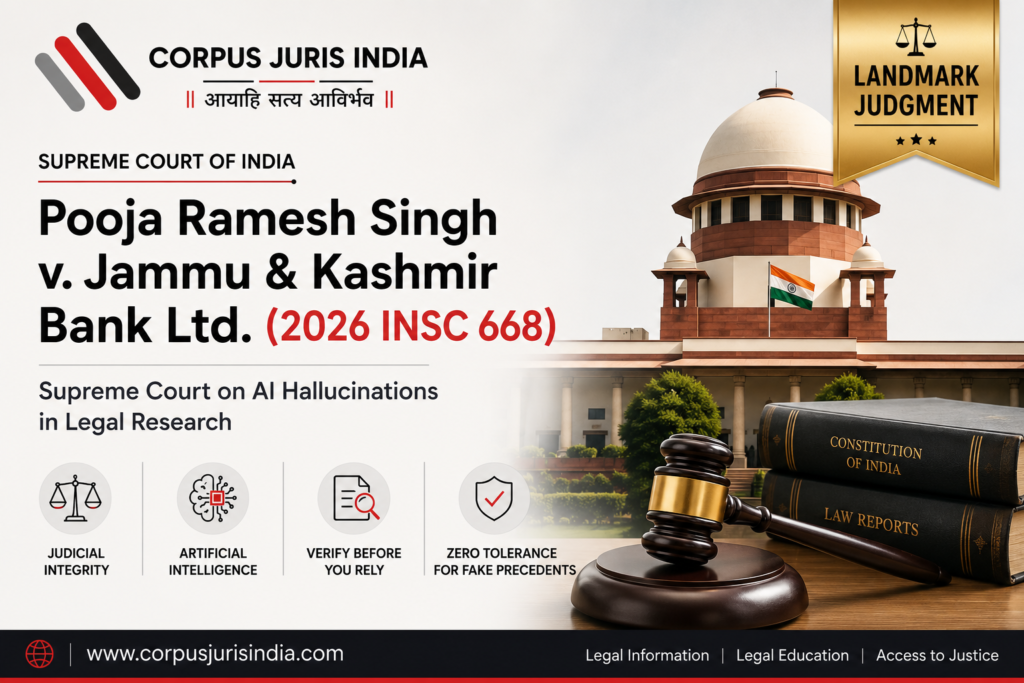
The Supreme Court of India, in Pooja Ramesh Singh v. Jammu & Kashmir Bank Ltd. (2026 INSC 668), delivered a landmark judgment addressing the responsible use of Artificial Intelligence (AI) in the legal profession. While the dispute arose from insolvency proceedings under the Insolvency and Bankruptcy Code, 2016, the Court’s observations extend far beyond insolvency law. It held that courts and advocates must exercise extreme caution when using AI-generated legal research and declared a zero-tolerance approach towards reliance on fabricated or hallucinated judicial precedents. The judgment reinforces that AI may assist legal work, but it cannot replace human judgment, verification, and accountability.
Background of the Case
The appeal arose from insolvency proceedings initiated by Jammu & Kashmir Bank Ltd. against Essel Infraprojects Ltd. (EIL) under Section 7 of the Insolvency and Bankruptcy Code, 2016.
The appellant, Pooja Ramesh Singh, was the suspended director of EIL, which had acted as a corporate guarantor for loans advanced to Pan India Utilities Distribution Company Ltd. (PIUDCL). After defaults in repayment, the bank initiated the Corporate Insolvency Resolution Process (CIRP). The NCLT admitted the application, and the NCLAT upheld that decision.
However, during the appeal before the Supreme Court, a significant issue emerged: the NCLT had relied upon judicial precedents that were either incorrectly cited, contained fabricated extracts, or did not exist at all. This shifted the focus of the appeal from the merits of insolvency law to the integrity of judicial decision-making itself.
Legal Issues Before the Supreme Court
The Supreme Court examined the following principal questions:
- Whether judicial orders relying upon non-existent or AI-generated hallucinated precedents can be sustained in law.
- Whether reliance on fabricated judicial authorities compromises the fairness and integrity of the adjudicatory process.
- What responsibilities do advocates and judges bear when using AI-assisted legal research?
- Whether institutional safeguards are required to regulate the use of Artificial Intelligence in judicial proceedings.
Supreme Court’s Analysis
The Court acknowledged that Artificial Intelligence has transformed modern legal practice and can significantly improve efficiency. It referred to developments in other jurisdictions, including the regulation of AI-assisted legal services in the United Kingdom, to illustrate that AI has a legitimate role in legal practice when used responsibly.
At the same time, the Court drew a clear distinction between using AI as an aid and allowing AI to replace independent legal reasoning. Judicial decision-making, the Court observed, requires human judgment, ethical discernment, and the ability to distinguish truth from falsehood—functions that cannot be delegated entirely to technology.
Upon independently verifying the authorities relied upon by the NCLT, the Supreme Court found multiple irregularities, including incorrect citations, fabricated paragraphs attributed to genuine judgments, and entirely non-existent reported decisions. Since these authorities formed part of the reasoning process, the Court held that the adjudicatory process itself had been tainted.
Zero-Tolerance Approach to AI Hallucinations
One of the most significant contributions of this judgment is the adoption of a zero-tolerance standard.
The Supreme Court held that:
- Advocates must verify every judicial precedent before citing it.
- Judges must ensure that authorities relied upon are authentic.
- Even minimal reliance on fabricated or hallucinated material undermines public confidence in the justice system.
- Decisions influenced by fake precedents cannot be sustained, regardless of whether the fabricated material ultimately changed the outcome.
Directions to the Bar Council of India
Recognising that technological misuse cannot be addressed through judicial declarations alone, the Court directed the Bar Council of India to constitute a committee to examine the issue of advocates submitting AI-generated fake authorities before courts. The committee has been tasked with considering appropriate guiding principles and disciplinary measures to prevent such occurrences in future.
Final Decision
The Supreme Court:
- set aside the judgments of the NCLT and NCLAT;
- restored the Section 7 application before the NCLT;
- directed the NCLT to decide the matter afresh on its own merits;
- clarified that it had expressed no opinion on the substantive insolvency dispute;
- directed expeditious disposal, preferably within two weeks; and
- ordered the parties to maintain status quo until fresh adjudication.
Why This Judgment Matters
This decision is likely to become one of India’s leading authorities on the responsible use of Artificial Intelligence in the legal system. Its significance extends beyond insolvency law because it establishes guiding principles for:
- AI-assisted legal research,
- professional responsibility of advocates,
- judicial accountability,
- verification of legal authorities,
- preservation of the integrity of adjudication.
For legal professionals, law students, researchers, tribunals, and courts, the judgment serves as an important reminder that technology can assist legal reasoning but cannot replace the responsibility to verify facts, authorities, and legal propositions.
Key Takeaways
- AI may assist legal work but cannot replace independent judicial reasoning.
- Courts should adopt a zero-tolerance approach towards fabricated AI-generated precedents.
- Advocates have a professional duty to verify authorities before citing them.
- Judges must independently ensure that precedents relied upon are genuine.
- Judicial decisions based on hallucinated legal authorities are unsustainable in law.
- The Bar Council of India has been directed to consider regulatory and disciplinary measures concerning the misuse of AI in legal practice.
Disclaimer
This article is published solely for legal information, legal education, and reporting of judicial developments. It is based on the judgment of the Supreme Court of India in Pooja Ramesh Singh v. Jammu & Kashmir Bank Ltd. (2026 INSC 668). It does not constitute legal advice, create a lawyer-client relationship, or amount to solicitation or advertisement under the Bar Council of India Rules.
Official Supreme Court Judgment PDF