
Brief Background
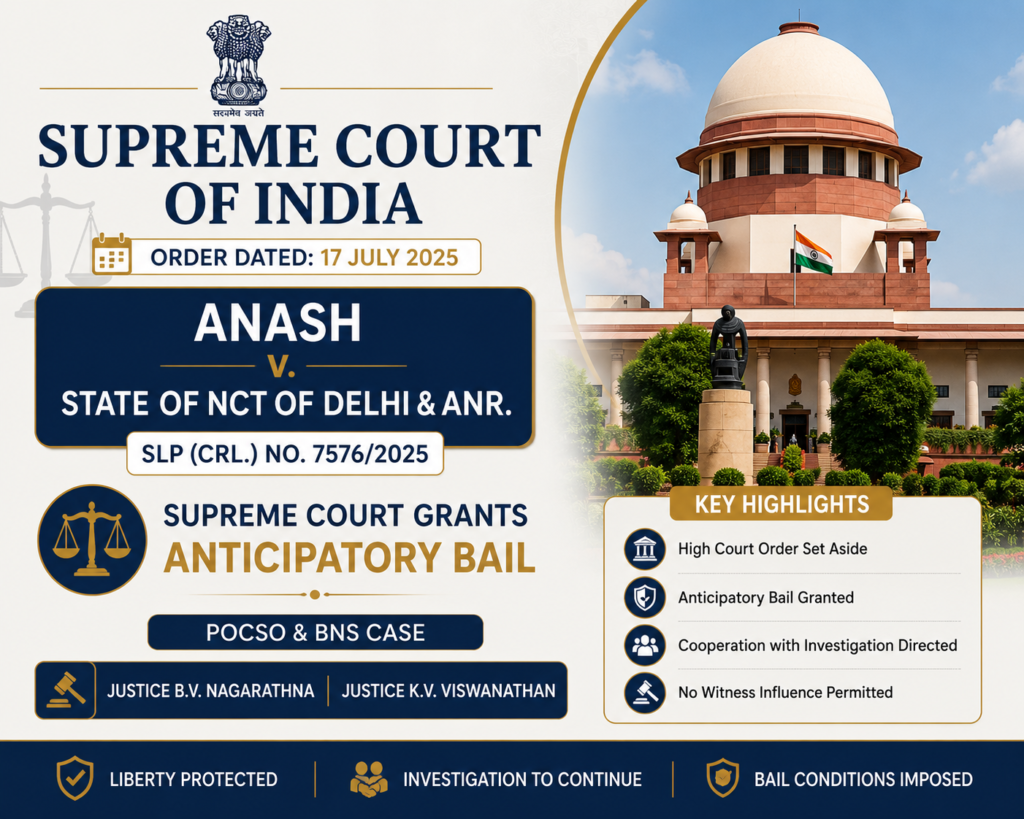
The appellant approached the Supreme Court challenging the order dated 08 May 2025 passed by the Delhi High Court whereby his application for anticipatory bail had been rejected. The case arose out of FIR No. 130/2025 registered at Police Station Wazirabad, North Delhi, alleging offences under Section 64(2)(m) of the Bharatiya Nyaya Sanhita, 2023 and Section 6 of the Protection of Children from Sexual Offences Act, 2012 (POCSO Act).
The appellant contended that the allegations against him were false and that the parties had been in a consensual relationship. He further submitted that he had cooperated with the investigation and had no criminal antecedents. Aggrieved by the refusal of anticipatory bail by the High Court, he approached the Supreme Court seeking protection from arrest.
Order Passed by the Court
The Supreme Court considered the submissions of both sides and examined the material placed on record. The Court noted that interim protection had earlier been granted to the appellant and, after considering the overall circumstances of the case, found him entitled to the relief sought under Section 482 of the Bharatiya Nagarik Suraksha Sanhita, 2023.
Accordingly, the Supreme Court allowed the appeal, set aside the order passed by the Delhi High Court, and directed that in the event of arrest, the appellant shall be released on anticipatory bail upon furnishing cash security of ₹25,000 along with two sureties of the like amount. The Court further directed the appellant to fully cooperate with the investigation and not to influence witnesses or tamper with evidence. It was clarified that any violation of these conditions would result in cancellation of the anticipatory bail granted.
Significance of the Order
This decision reiterates the Supreme Court’s approach that anticipatory bail may be granted where the facts and circumstances of the case justify protection of personal liberty while simultaneously ensuring cooperation with the investigation. The Court balanced the interests of justice by safeguarding the appellant from arrest while imposing conditions to protect the integrity of the ongoing investigation.
The ruling also underscores the principle that anticipatory bail is an important safeguard available under criminal law and may be granted when the Court is satisfied that adequate conditions can address investigative concerns without resorting to custodial arrest.