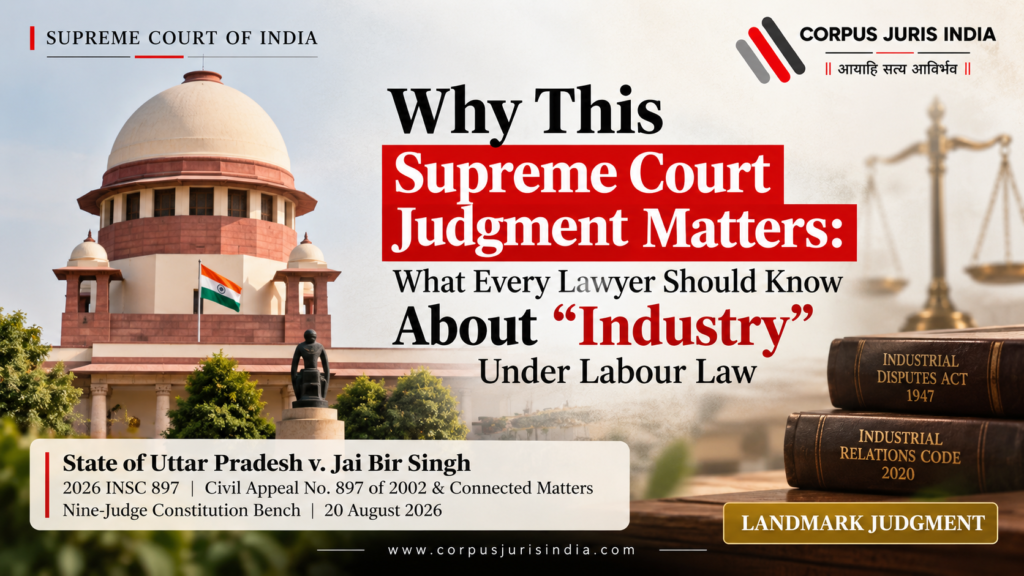
State of Uttar Pradesh v. Jai Bir Singh
2026 INSC 897 | Civil Appeal No. 897 of 2002 & Connected Matters | Supreme Court of India | Nine-Judge Constitution Bench | 20 August 2026
Why should you read this judgment?
What exactly amounts to an “industry” under Indian labour law?
For decades, this question has been closely associated with the Supreme Court’s landmark decision in Bangalore Water Supply and Sewerage Board v. A. Rajappa. The issue was again placed before a Nine-Judge Constitution Bench in State of Uttar Pradesh v. Jai Bir Singh.
The judgment is particularly important because the legal landscape has since changed: the Industrial Disputes Act, 1947 has been repealed, and the Industrial Relations Code, 2020 has come into force.
The Supreme Court therefore had to address an important transitional question: what is the position of pending disputes under the repealed Industrial Disputes Act, and should the earlier interpretation of “industry” automatically govern the new statutory framework?
The answer has significant implications for understanding the relationship between the old and new labour-law regimes.
How did the matter reach the Nine-Judge Bench?
The proceedings arose from a dispute concerning the Social Forestry Department, a welfare-oriented governmental activity.
The underlying question was whether such activity could fall within the expression “industry” under Section 2(j) of the Industrial Disputes Act, 1947.
Earlier Supreme Court decisions had taken different approaches to Social Forestry activities. In Chief Conservator of Forests v. Jagannath Maruti Kondhare, a three-Judge Bench had held that the Forest Department could fall within the definition of “industry” even while undertaking a Social Forestry welfare scheme.
A subsequent two-Judge decision in State of Gujarat v. Pratamsingh Narsinh Parmar took a different view and distinguished the earlier decision.
The resulting legal uncertainty eventually led to the reference before the larger Bench.
What questions did the Nine-Judge Bench consider?
The Bench was called upon to consider several important questions concerning the meaning and scope of “industry” under the Industrial Disputes Act.
Among the questions were:
- Whether the Triple Test formulated in Bangalore Water Supply represents the correct law for determining whether an undertaking falls within “industry”;
- Whether social-welfare activities and schemes undertaken by Government departments or their instrumentalities can constitute industrial activities;
- Which State activities can be regarded as sovereign functions and therefore fall outside Section 2(j); and
- Whether the Industrial Relations Code, 2020 has any impact on the interpretation of “industry” under the repealed Industrial Disputes Act.
What did the Supreme Court clarify?
One of the most important aspects of the judgment is the distinction drawn between the repealed Industrial Disputes Act and the Industrial Relations Code, 2020.
The Court clarified that the principles laid down in Bangalore Water Supply continue to govern pending matters arising under the Industrial Disputes Act.
The judgment specifically states that the Triple Test laid down in Bangalore Water Supply may be applied to matters that remain pending under the repealed legislation.
At the same time, the Court made it clear that the interpretation of the Industrial Relations Code, 2020 should not simply be derived from the interpretation of the repealed Section 2(j).
The Court observed that Bangalore Water Supply should not be treated as the basis for interpreting the Industrial Relations Code in future cases. The new Code must be interpreted on the basis of its own text and statutory context.
The practical distinction
The judgment can therefore be understood through a simple distinction:
Pending disputes under the old Industrial Disputes Act
The Bangalore Water Supply Triple Test continues to apply.
Future questions under the Industrial Relations Code, 2020
The Code must be interpreted independently, on its own language and context.
This distinction is particularly important for practitioners dealing with labour matters that originated under the earlier statutory regime.
What about the “Triple Test”?
The Bangalore Water Supply decision had laid down a broad framework for determining whether an undertaking could be regarded as an “industry”.
The present judgment discusses and reformulates the principles surrounding that test. However, the Court expressly clarified that the reformulated principles were not intended to displace the governing position for pending proceedings under the repealed Industrial Disputes Act.
The judgment also makes clear that proceedings which have already attained finality are not to be reopened merely because of the present decision.
Judgments, awards, settlements and determinations that are no longer subject to challenge remain undisturbed.
Government activities and sovereign functions
The judgment also examines the distinction between sovereign functions of the State and other governmental activities.
The judgment records that sovereign functions may qualify for exclusion, while welfare and economic activities undertaken by Government or statutory bodies cannot automatically be excluded merely because they are undertaken by the State.
This makes the judgment relevant beyond the particular Social Forestry dispute and useful for understanding how the expression “industry” interacts with governmental functions under the former labour-law framework.
What does this mean for pending labour disputes?
For practitioners, one of the most useful aspects of the judgment is its treatment of pending proceedings.
The Court clarified that:
- Pending matters under the repealed Industrial Disputes Act may continue to be decided using the Triple Test laid down in Bangalore Water Supply;
- Proceedings that have already attained finality are not reopened;
- Existing judgments, awards, settlements and determinations that are no longer subject to challenge remain undisturbed; and
- The present judgment is confined to disputes arising under the Industrial Disputes Act and the interpretation of Section 2(j).
The Court ultimately ordered accordingly, disposed of the pending interlocutory applications and made no order as to costs.
Key Takeaways
1. “Industry” remains an important question under the former ID Act
The judgment revisits the interpretation of Section 2(j) of the Industrial Disputes Act, 1947.
2. The Bangalore Water Supply Triple Test continues for pending ID Act matters
Pending proceedings under the repealed legislation may continue to be adjudicated according to the established Triple Test.
3. The Industrial Relations Code has to be interpreted independently
The jurisprudence under the repealed Section 2(j) should not automatically be imported into the new Code.
4. Final decisions remain undisturbed
The judgment does not reopen proceedings that have already attained finality.
5. The judgment has a defined statutory scope
The Court expressly confined its judgment to disputes under the Industrial Disputes Act and Section 2(j), without determining questions arising under a different statutory framework.
Why is this judgment important for lawyers?
This judgment is useful not merely because it comes from a Nine-Judge Constitution Bench, but because it helps explain a practical transition in Indian labour law.
For lawyers dealing with older industrial disputes, the judgment clarifies the continued relevance of the Bangalore Water Supply principles.
For lawyers dealing with the Industrial Relations Code, 2020, it provides an equally important caution: the new statutory framework cannot simply be treated as a continuation of the old Section 2(j) jurisprudence.
In that sense, State of Uttar Pradesh v. Jai Bir Singh provides an important reference point for understanding the relationship between established labour-law precedent, pending proceedings and the new statutory regime.
📄 Read the Full Judgment
State of Uttar Pradesh v. Jai Bir Singh
2026 INSC 897
Civil Appeal No. 897 of 2002 & Connected Matters
Supreme Court of India
Judgment dated: 20 August 2026
Reportable
[ 📄 READ / DOWNLOAD FULL JUDGMENT PDF ]
Legal Disclaimer
This article is intended solely for general legal information and educational purposes. It is based on the judgment of the Supreme Court of India and does not constitute legal advice. The application of legal principles may vary depending upon the facts and circumstances of each case.