
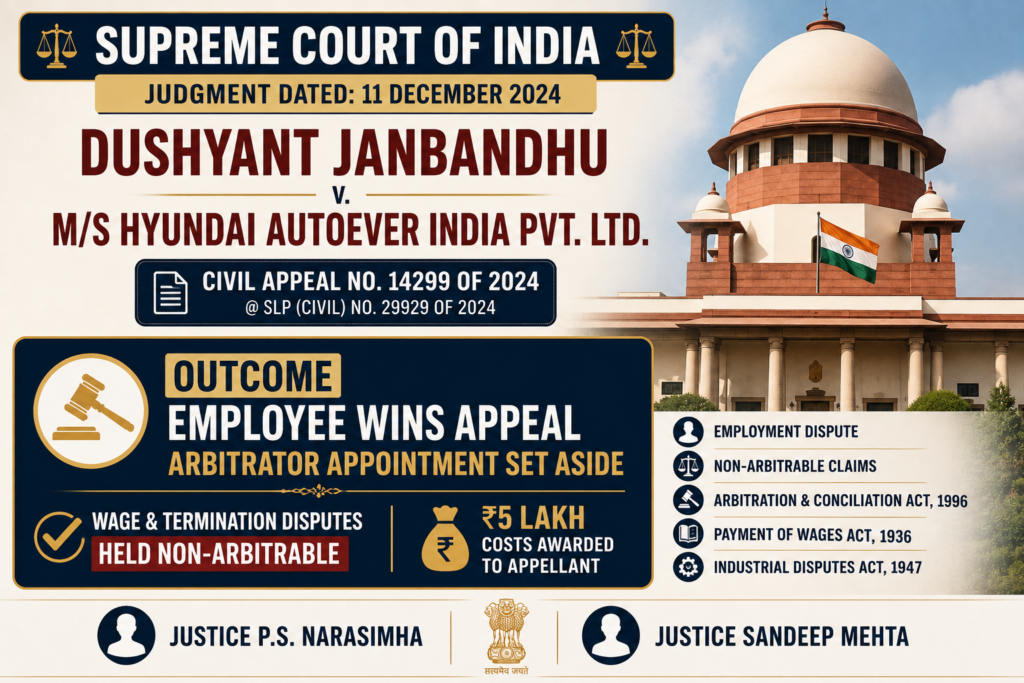
Brief Background
The appellant, Dushyant Janbandhu, challenged the order of the Madras High Court appointing an arbitrator under Section 11(6) of the Arbitration and Conciliation Act, 1996. The dispute arose following his termination from employment with Hyundai AutoEver India Pvt. Ltd. and related claims concerning unpaid wages and the legality of the termination.
Prior to the arbitration proceedings, the appellant had already initiated proceedings under the Payment of Wages Act, 1936 and the Industrial Disputes Act, 1947. The employer nevertheless sought appointment of an arbitrator on the basis of an arbitration clause contained in the employment agreement.
Order Passed by the Court
The Supreme Court held that disputes relating to non-payment of wages and the legality of termination were already pending before statutory authorities under labour laws and were therefore not capable of being referred to arbitration. The Court observed that such disputes fall within the exclusive jurisdiction of authorities constituted under the relevant statutes.
The Court further found that the employer’s allegation regarding breach of confidentiality obligations was an afterthought and had not formed part of the disciplinary proceedings or termination order. Accordingly, the Supreme Court set aside the High Court’s order appointing an arbitrator, dismissed the Section 11(6) petition, and awarded costs of ₹5 lakh to the appellant.
Significance of the Judgment
This judgment reinforces the principle that disputes concerning wages and termination of employment, where special statutory remedies exist, cannot ordinarily be referred to arbitration. The Supreme Court emphasized that arbitration cannot be used to bypass statutory forums created under labour welfare legislation.
The ruling also serves as an important precedent against the misuse of arbitration proceedings as a means of pressuring employees who have already invoked their statutory rights before competent authorities.