
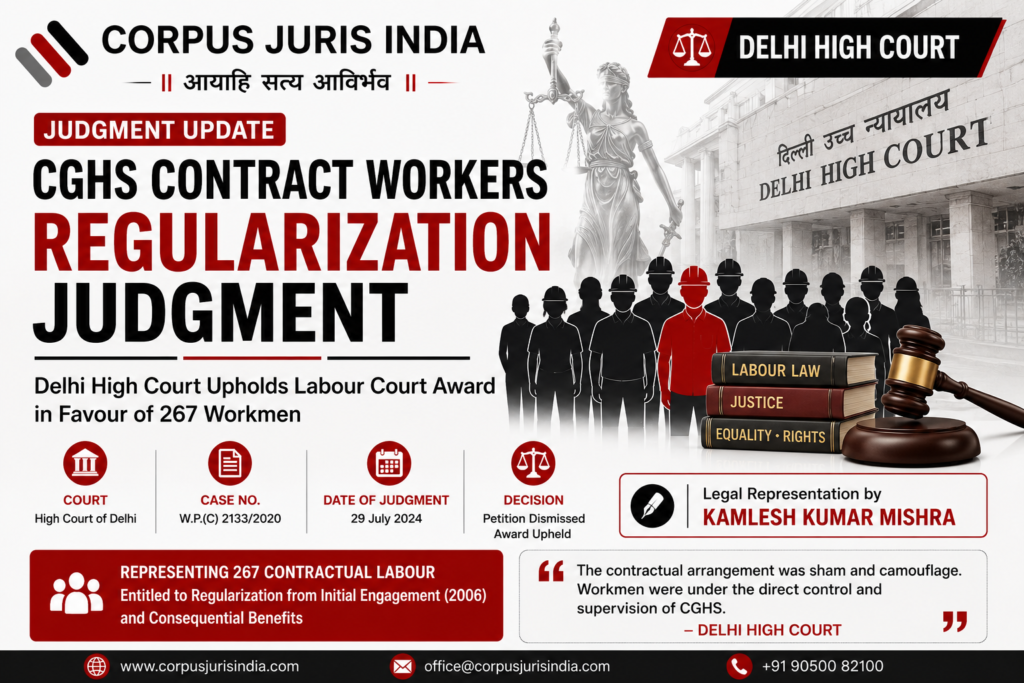
The CGHS Contract Workers Regularization Judgment delivered by the Delhi High Court is an important labour law decision concerning the regularization of 267 contract workers engaged under the Central Government Health Scheme (CGHS). The Court upheld the Labour Court Award and dismissed the writ petition filed by CGHS.
Court
High Court of Delhi
Case Title
The Director, CGHS & Ors. v. Shri Ram Chander & Ors.
Case No.
W.P.(C) 2133/2020
Date of Judgment
29 July 2024
Coram
Hon’ble Mr. Justice Chandra Dhari Singh
Practice Area
Labour & Employment Law | Service Law | Contract Labour | Regularization
Advocates for Respondents (Workmen)
- Mr. Kamlesh Kumar Mishra
- Mr. Nitin Kumar Nayak
- Mr. Deepak Raj
- Ms. Renu
- Ms. Samishti Soloman
Brief Facts
The dispute concerned 267 contract workers engaged in the computerization project of the Central Government Health Scheme (CGHS). Although they were shown as contractual employees through outsourcing agencies, the workmen contended that they had been working directly under the supervision and control of CGHS since 2006 and sought regularization of their services.
The Central Government Industrial Tribunal (CGIT) passed an award directing regularization of the workmen. Aggrieved by the award, CGHS challenged it before the Delhi High Court.
Issues Before the Court
- Whether the contract arrangement between CGHS and the outsourcing agencies was genuine or merely a sham arrangement.
- Whether an employer-employee relationship existed between CGHS and the workmen.
- Whether the workmen were entitled to regularization and consequential service benefits.
Observations of the High Court
The Delhi High Court observed that:
- The workmen had been working continuously since 2006.
- Their appointments, transfers, supervision, attendance, leave, identity cards, experience certificates and disciplinary control were all managed by CGHS.
- Contractors changed several times over the years, yet the same workmen continued to work without interruption.
- CGHS failed to produce convincing evidence to establish that the workmen were employees of the contractors.
- The contractual arrangement was merely a camouflage intended to deny the workmen their legitimate service benefits.
- The work performed by the workmen was permanent and perennial in nature.
Accordingly, the Court upheld the findings of the Labour Court.
Held
The Delhi High Court dismissed the writ petition filed by CGHS and upheld the Labour Court Award holding that:
- The workmen were employees of CGHS.
- The contractual arrangement was sham and not genuine.
- The workmen were entitled to regularization from their initial engagement.
- They were also entitled to wages, pay-scale and consequential service benefits in accordance with law.
Result
Petition Dismissed.
The Award dated 23 August 2019 passed by the Central Government Industrial Tribunal was affirmed by the Delhi High Court.
Significance of the Judgment
This judgment is a significant precedent in labour jurisprudence. It reiterates that:
- Merely engaging workers through contractors does not defeat an employer-employee relationship when the principal employer exercises complete supervision and control.
- Courts will lift the veil where contractual arrangements are used only to deprive workers of statutory rights.
- Long and continuous service coupled with direct supervision by the principal employer may justify regularization in appropriate cases.
The CGHS Contract Workers Regularization Judgment is an important precedent on sham contracts, employer-employee relationship, and regularization of contract workers under Indian labour law.
Why this Judgment Matters
The CGHS Contract Workers Regularization Judgment is a significant decision for contract labour jurisprudence in India. It reiterates that courts will examine the actual nature of employment rather than merely relying on contractual documentation. Where a contract is found to be sham or camouflage, workers may be entitled to the protections available to regular employees. This judgment will serve as an important reference for future disputes involving contract workers, public authorities, and labour law practitioners.