
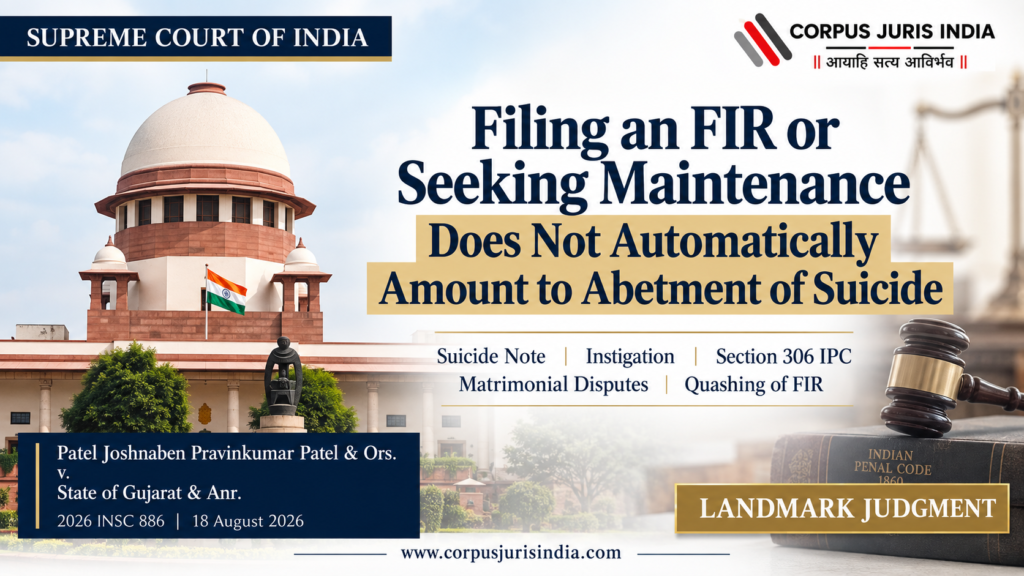
Filing FIR and Abetment of Suicide is an issue that the Supreme Court recently examined in the context of matrimonial disputes and allegations under Sections 107 and 306 of the Indian Penal Code, 1860.
The Supreme Court has clarified that filing an FIR or initiating legal proceedings does not, by itself, amount to abetment of suicide. In a reportable order dated 18 August 2026, the Court examined whether the allegations contained in an FIR, read with a suicide note and the surrounding circumstances, disclosed a prima facie case of abetment of suicide under Sections 107 and 306 of the Indian Penal Code, 1860.
In Patel Joshnaben Pravinkumar Patel & Ors. v. State of Gujarat & Anr., the Supreme Court held that the essential ingredients of abetment were absent from the material placed before it. The Court consequently set aside the order of the Gujarat High Court and quashed the FIR as well as all consequential proceedings.
Background of the Case
The appellants were the mother-in-law, father-in-law and brother-in-law of the deceased. The deceased had married Shraddhaben, who was the daughter of appellant Nos. 1 and 2 and sister of appellant No. 3, in 2009.
On 6 March 2020, Shraddhaben lodged an FIR against the deceased under Sections 498A and 323 IPC. She alleged that the deceased had abused and assaulted her. The judgment records that she subsequently left the matrimonial home and went to Ahmedabad. She was medically examined on the same day, and multiple contusions were found on her body.
Thereafter, on 21 March 2020, the brother of the deceased lodged another FIR against the present appellants under Sections 306 and 114 IPC.
The allegation in this FIR was that the appellants had harassed the deceased and had contributed to circumstances that allegedly drove him to commit suicide. The FIR also referred to the criminal proceedings initiated by the deceased’s wife and a maintenance notice served upon him.
The appellants approached the Gujarat High Court under Section 482 CrPC seeking quashing of the FIR and consequential proceedings. The High Court dismissed the petition.
The matter subsequently came before the Supreme Court.
Supreme Court Examines the Suicide Note
During the proceedings before the Supreme Court, the State placed the suicide note of the deceased on record.
The Court examined the contents of the suicide note along with the other circumstances of the case. The note was addressed to several relatives, including the deceased’s elder brother, elder sister, wife and his mother-in-law and father-in-law.
The Court observed that although the deceased expressed the view that his married life had been ruined by the appellants, the suicide note did not contain an allegation of any specific act by the appellants which could constitute instigation or harassment of such an extent that the deceased was left with no option but to end his life.
The Court therefore considered whether the allegations, taken at their highest along with the suicide note and undisputed surrounding circumstances, were sufficient to establish the necessary ingredients of abetment.
What Constitutes Abetment Under Section 107 IPC?
The Supreme Court referred to Section 107 IPC, which defines abetment of a thing.
The provision contemplates abetment through:
- instigation;
- participation in a conspiracy accompanied by an act or illegal omission; or
- intentional aid by an act or illegal omission.
The Court held that the necessary ingredients of abetment were completely lacking in both the FIR and the suicide note in the case before it.
This distinction is important because an allegation that a person’s conduct caused distress or frustration does not automatically satisfy the legal requirements of abetment. For an allegation under Section 306 IPC to proceed, there must be material indicating the commission of an act which legally amounts to abetment.
Can Filing an FIR Amount to Abetment of Suicide?
One of the significant issues considered by the Supreme Court was whether the filing of an FIR against a person could itself amount to instigation to commit suicide.
The Court answered this in the negative in the circumstances before it.
It held that lodging an FIR, even if it is alleged to be false, does not per se amount to instigating a person to commit suicide.
The Court also recognised that an individual has a right to take recourse to appropriate legal proceedings for protection of his or her rights. Therefore, merely because a person sets the criminal justice system in motion and the person against whom proceedings are initiated subsequently commits suicide, the person who initiated the proceedings cannot, on that basis alone, be held liable for abetment of suicide.
The Court’s observation is particularly relevant where criminal proceedings arise out of matrimonial disputes and allegations are subsequently made that the initiation of those proceedings itself caused the suicide.
Seeking Maintenance and Initiating Legal Proceedings
The allegations in the present case also referred to a maintenance notice served upon the deceased.
The Supreme Court considered the initiation of legal proceedings in the broader context of the matrimonial dispute. It noted that a person is entitled to pursue appropriate legal remedies for protection of his or her rights.
The mere fact that proceedings have been initiated, therefore, cannot by itself be treated as an act of instigation to suicide.
At the same time, the judgment does not lay down that every act connected with legal proceedings can never constitute abetment. The Court’s determination was based on whether the necessary ingredients of abetment were disclosed by the material available in the particular case.
A Suicide Note Is Not Conclusive by Itself
The Supreme Court further emphasised that the existence of a suicide note naming or blaming particular persons does not, by itself, establish a prima facie case of abetment.
While examining allegations of abetment to suicide, the Court must consider the suicide note together with the surrounding facts and circumstances.
The Court observed that a person may end his or her life because of frustration or distress and may attribute blame to another person in a suicide note. Such attribution alone cannot automatically lead to the conclusion that the person named in the note committed abetment.
The conduct attributed to the accused must therefore be examined in its proper factual and legal context.
Matrimonial Disputes and Allegations of Abetment
The judgment has particular significance in the context of matrimonial disputes.
The Supreme Court noted that differences between spouses may result in each side blaming the other and initiating legal proceedings. The mere initiation of such proceedings cannot, by itself, be regarded as an act of instigation to commit suicide.
Whether proceedings initiated by either spouse are bona fide or mala fide is ultimately a matter for the competent court to determine.
In the present case, the Court also considered the circumstances in which the deceased’s wife had left the matrimonial home and initiated proceedings against him. The Court noted that her allegations had prima facie support from the medical report recording injuries.
However, the Supreme Court expressly declined to speculate about the actual reason why the deceased committed suicide. The question before it was narrower: whether the FIR and material placed before the Court disclosed the legal ingredients necessary to constitute abetment of suicide.
Surrounding Circumstances Must Be Considered
The Supreme Court stressed that the assessment of a prima facie case of abetment cannot be based solely on the words contained in a suicide note.
The Court must examine the surrounding circumstances and the conduct attributed to the accused.
The relevant inquiry is whether the conduct complained of, viewed in ordinary circumstances, would have driven an ordinary person to take the drastic step of ending his or her life, rather than simply assuming that the deceased’s subjective reaction is sufficient to establish abetment.
This approach reinforces the requirement that allegations under Section 306 IPC must be examined against the statutory ingredients of abetment rather than merely on the basis of the fact that a suicide occurred.
Supreme Court Quashes the FIR
After examining the FIR, the suicide note and the surrounding circumstances, the Supreme Court concluded that the material on record did not disclose the necessary ingredients of abetment so as to make out a prima facie case against the appellants.
The Court accordingly allowed the appeal, set aside the Gujarat High Court’s order and quashed the impugned FIR and all consequential proceedings.
Legal Significance of the Judgment
The judgment provides important guidance on the relationship between legal proceedings and allegations of abetment of suicide.
The decision makes clear that the mere filing of an FIR, even where its correctness is disputed, cannot automatically be characterised as instigation to suicide. Similarly, the initiation of matrimonial or maintenance-related proceedings cannot, by itself, satisfy the ingredients of abetment.
At the same time, the judgment underscores that courts must examine the complete factual circumstances of each case. A suicide note cannot be viewed in isolation, and allegations must be tested against the statutory requirements of abetment under Section 107 IPC when an offence under Section 306 IPC is alleged.
The decision is therefore relevant not only to matrimonial disputes but also to the broader question of how allegations of abetment of suicide should be assessed when they arise from the initiation of legal proceedings.
Key Takeaways
- Filing an FIR does not, by itself, amount to abetment of suicide.
- Even an allegation that an FIR is false does not automatically establish instigation.
- A person exercising a legal right to initiate proceedings cannot ordinarily be held liable for abetment merely because the person against whom proceedings were initiated subsequently commits suicide.
- A suicide note naming or blaming an individual is not, by itself, sufficient to establish abetment.
- The suicide note must be considered along with the surrounding facts and circumstances.
- Matrimonial proceedings between spouses cannot, merely because they were initiated, be treated as an act of instigation to suicide.
- For an allegation under Section 306 IPC, the necessary ingredients of abetment under Section 107 IPC must be prima facie disclosed.
- The Supreme Court in the present case found those ingredients absent and consequently quashed the FIR and consequential proceedings.
Case Details
Case: Patel Joshnaben Pravinkumar Patel & Ors. v. State of Gujarat & Anr.
Court: Supreme Court of India
Citation: 2026 INSC 886
Case Number: SLP (Crl.) No. 18705/2025
Date of Judgment: 18 August 2026
Bench: Justice Manoj Misra and Justice Vijay Bishnoi
Subject: Abetment of Suicide; Sections 107 and 306 IPC; Matrimonial Proceedings; Quashing of FIR
Decision: Appeal allowed; impugned High Court order set aside; FIR and consequential proceedings quashed.
📄 Official Judgment
Read / Download the Judgment PDF
Disclaimer
This content is published solely for legal information, legal education, and reporting of judicial or legal developments. It does not constitute legal advice, create a lawyer-client relationship, or amount to solicitation or advertisement under the applicable Bar Council of India Rules.