
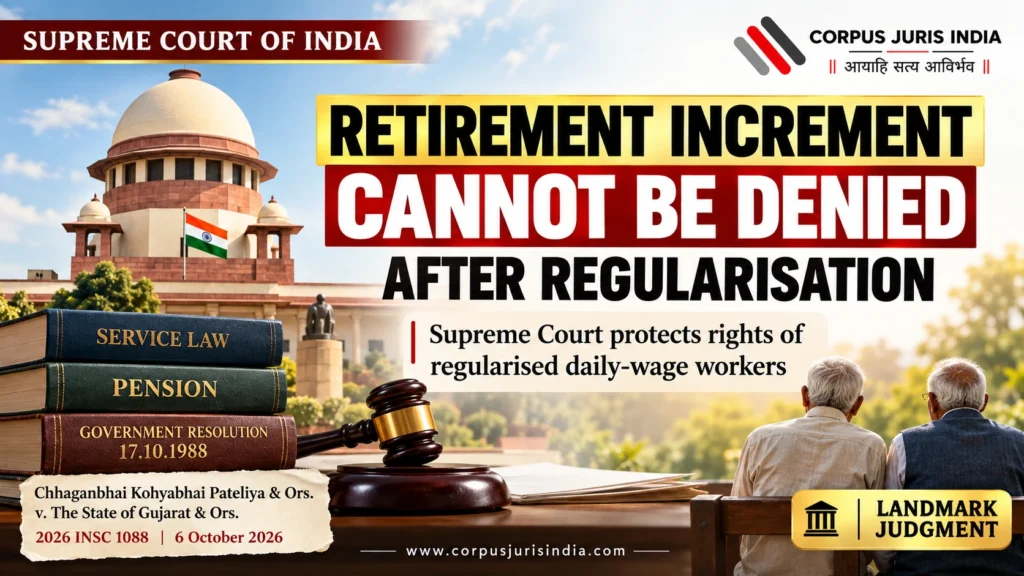
Supreme Court Holds That Permanent Status Cannot Be Ignored to Deny Annual Increment
The Supreme Court has clarified the entitlement to annual increment after regularisation in Chhaganbhai Kohyabhai Pateliya & Ors. v. The State of Gujarat & Ors., 2026 INSC 1088, decided on 6 October 2026. The judgment concerns retired workers of the Gujarat Irrigation Department who had been granted permanent status under the applicable Government Resolution and whose claim for an annual increment falling due after retirement was disputed.
The Supreme Court of India, in Chhaganbhai Kohyabhai Pateliya & Ors. v. The State of Gujarat & Ors., 2026 INSC 1088, has held that daily-wage skilled workers who were conferred permanent status under the Gujarat Government Resolution dated 17 October 1988 cannot be denied the benefit of an annual increment merely on the ground that they were originally engaged as daily-wage workers.
The judgment, delivered on 6 October 2026 by a Bench comprising Justice Sanjay Kumar and Justice Sanjeev Sachdeva, concerns employees of the Gujarat Irrigation Department who had rendered more than 30 years of service and retired on 30 June of different years. They claimed the annual increment that fell due on 1 July immediately after their retirement.
The Supreme Court allowed the appeal, set aside the Gujarat High Court Division Bench’s order, and held that the employees’ permanent status under the 1988 Government Resolution could not be ignored while considering their entitlement to the increment and consequential pension benefits.
Why This Judgment Matters
The case addresses a practical question in service and pension law:
Can an employee who was originally engaged as a daily-wage worker be denied an annual increment after retirement merely because the increment technically became due on the day after retirement?
The Supreme Court’s answer, in the circumstances of this case, is no.
The Court examined not merely the employees’ original mode of engagement, but their legal status under the Government Resolution dated 17.10.1988. That Resolution treated eligible daily-wage skilled workers as permanent employees and extended benefits relating to pay scale, allowances, pension and retiral benefits.
The judgment therefore demonstrates why the employee’s legal status at the relevant stage of service, and not merely the historical label attached to the initial appointment, can be decisive.
Case Snapshot
| Particular | Details |
|---|---|
| Case Title | Chhaganbhai Kohyabhai Pateliya & Ors. v. The State of Gujarat & Ors. |
| Citation | 2026 INSC 1088 |
| Court | Supreme Court of India |
| Bench | Justice Sanjay Kumar and Justice Sanjeev Sachdeva |
| Date of Judgment | 6 October 2026 |
| Proceeding | Civil Appeal arising out of SLP (C) No. 26129 of 2025 |
| Area of Law | Service Law / Pension / Retiral Benefits |
| Key Government Resolution | Gujarat Government Resolution dated 17.10.1988 |
| Key Precedent | Director (Administration and Human Resources), KPTCL v. C.P. Mundinamani |
| Financial Framework | Modified clause (d) of the order dated 20.02.2025 concerning M. Siddaraj |
| Final Decision | Appeal allowed; Gujarat High Court Division Bench order set aside |
| Compliance Direction | Amounts to be worked out and released within 30 days |
| Default | 6% p.a. interest for the period after expiry of the 30-day period |
The Background of the Case
The appellants had served in the Irrigation Department of the State of Gujarat for more than 30 years.
They had retired on 30 June in different years but were denied the benefit of the increment that fell due on 1 July. The dispute eventually reached the Supreme Court after the Gujarat High Court Division Bench reversed the decision of the Single Judge in favour of the employees.
The case became particularly significant because of the employees’ status under the Government Resolution dated 17 October 1988.
What Did the 1988 Gujarat Government Resolution Provide?
The Supreme Court noted that the Government Resolution applied to daily-wage skilled workers serving in different departments of the State Government.
For workers who had completed 10 years or more of service as on 1 October 1988, the Resolution provided, among other things, that they were to be considered permanent.
The Resolution also provided for:
- placement in the running pay scale of the concerned cadre;
- salary and applicable allowances;
- dearness allowance;
- house rent allowance;
- local compensatory allowance;
- retiral benefits;
- gratuity;
- employees’ provident fund;
- pensionable service; and
- superannuation at the age of 60 years.
This background became central to the Supreme Court’s reasoning.
What Happened Before the Gujarat High Court?
A Single Judge of the Gujarat High Court had accepted the employees’ claim on 26 September 2023, relying upon the Supreme Court’s judgment in Director (Administration and Human Resources), KPTCL v. C.P. Mundinamani.
The Single Judge held that the entitlement to the increment could not be denied and directed consequential action relating to pension and retiral benefits.
The State subsequently challenged the decision before a Division Bench.
Before the Division Bench, the State raised the argument that the employees were daily wagers and therefore could not claim the benefit of the increment principle applicable to regular employees.
The Division Bench accepted that argument and, by oral order dated 9 January 2025, reversed the Single Judge’s decision.
The employees then approached the Supreme Court.
The Supreme Court’s Reasoning
1. The “Daily-Wager” Objection Could Not Be Accepted
The Supreme Court noted that the State did not dispute that the employees fell within the category of daily-wage skilled workers covered by the 1988 Resolution.
The Court then focused on the fact that these workers were treated as permanent employees for purposes including pay scale, allowances, pension and retirement benefits.
Therefore, the Court held that denying the increment only because they were originally daily-wage workers could not be accepted.
This is the central point of the judgment.
The Court found that the argument before the Division Bench had ignored the Government Resolution and the benefits flowing from it.
2. The Principle in C.P. Mundinamani Applies
The Supreme Court also considered its earlier judgment in:
Director (Administration and Human Resources), KPTCL & Ors. v. C.P. Mundinamani & Ors.
The present judgment proceeds on the established principle concerning the annual increment for employees who retire on 30 June, where the increment falls due on 1 July after completion of the relevant period of service.
The important point in the present case was whether that principle could be denied because these employees had originally entered service as daily-wage workers.
The Supreme Court answered that issue against the State because the employees had subsequently been treated as permanent under the 1988 Resolution.
3. M. Siddaraj and the Financial Consequences
The Court also considered the subsequent framework arising from:
Union of India & Anr. v. M. Siddaraj
The Supreme Court referred to its orders concerning implementation of the C.P. Mundinamani judgment and the subsequent modification of the relevant clause.
Under the modified clause (d), where a retired employee had filed an intervention, impleadment application, writ petition or original application before the appropriate forum, enhanced pension including one increment could be payable for the period of three years prior to the month in which the application was filed, subject to the terms of the applicable orders.
The appellants had filed their writ petition in 2022.
The Supreme Court therefore held that they came within the modified clause (d) and were entitled to the benefit of the increment and pension calculated by taking that increment into account.
4. What About Interest on the Arrears?
This point requires careful distinction.
The Supreme Court noted that no interest was payable on the arrears themselves under the applicable framework.
However, the authorities were required to comply with the Court’s stipulated time period for disbursement.
Therefore, if the authorities failed to release the amounts within the directed period, interest at 6% per annum would become payable from the date of default until payment.
Thus, the judgment should not be inaccurately described as granting 6% interest on the entire arrears from the original date of entitlement.
Final Directions of the Supreme Court
The Supreme Court did not itself calculate the individual amounts payable to each appellant.
Instead, it directed the competent authorities to:
- examine the individual case of each appellant and proforma respondent;
- consider the relevant date of retirement;
- calculate the amount payable in accordance with the modified clause (d) of the order dated 20 February 2025; and
- release the amounts due within 30 days.
If the authorities failed to comply within that period, interest at 6% per annum would be payable for the period thereafter until payment.
The appeal was accordingly allowed.
Legal Significance of the Judgment
Permanent Status Cannot Be Ignored Selectively
The most important aspect of the judgment is the Court’s treatment of the employees’ legal status.
The employees may have originally entered service as daily-wage workers. However, the 1988 Resolution subsequently placed them within a framework of permanent employment carrying pay, pension and retiral benefits.
The State therefore could not rely selectively on the historical description of the employees as “daily wagers” to deny a benefit associated with their recognised permanent status.
The Judgment Reinforces the Practical Reach of C.P. Mundinamani
The case also demonstrates the practical application of the C.P. Mundinamani principle to employees whose service history includes an initial daily-wage phase but who subsequently acquired permanent status under the applicable Government Resolution.
Pension Consequences Matter
The judgment is not confined to the increment as an isolated salary component.
The increment has consequential relevance to the calculation of pension, and the Court expressly directed that the authorities work out the enhanced amounts under the applicable M. Siddaraj framework.
Timely Compliance Is Mandatory
The 30-day direction also has practical significance.
The authorities were not given an open-ended period to calculate and disburse the amounts. Failure to comply within the stipulated period carries a 6% per annum interest consequence from the date of default.
Who Should Read This Judgment?
Government Employees and Pensioners
The judgment is particularly relevant to employees and pensioners whose service history involves retirement on 30 June and an increment falling due on 1 July, especially where permanent status and pensionary benefits are governed by a specific Government Resolution or similar service framework.
Service-Law Practitioners
For service-law practitioners, the case provides an important illustration of how the Supreme Court applies an established increment principle to employees whose original mode of appointment was daily-wage engagement but who subsequently acquired permanent status.
Government Authorities
The judgment also highlights the importance of examining the complete service framework rather than relying solely on the original designation of an employee.
Law Students and Researchers
The case provides a useful study of the relationship between:
Government Resolution → Permanent Status → Annual Increment → Pension → Arrears Framework → Compliance Directions.
Key Takeaways
- Original daily-wage status cannot, by itself, defeat the increment claim where the employees had subsequently been treated as permanent under the applicable Government Resolution.
- The Gujarat Government Resolution dated 17.10.1988 was central because eligible daily-wage skilled workers were granted permanent status and corresponding service and retiral benefits.
- The Supreme Court applied the principle emerging from C.P. Mundinamani to the appellants.
- The financial implementation of the benefit is governed by the applicable M. Siddaraj framework and subsequent orders.
- The appellants’ 2022 writ petition brought them within the modified clause (d) framework concerning the three-year period prior to filing.
- No interest is payable on the arrears merely because they became due earlier.
- However, failure to comply with the 30-day payment direction attracts 6% p.a. interest from the date of default.
- The benefit was also extended to the relevant proforma respondents falling within the same applicable framework.
Download the Judgment
Official Supreme Court Judgment:
Chhaganbhai Kohyabhai Pateliya & Ors. v. The State of Gujarat & Ors. — 2026 INSC 1088
[📄 DOWNLOAD / VIEW JUDGMENT PDF]
The judgment is a reportable Supreme Court decision dated 6 October 2026. The uploaded judgment copy records the complete 8-page decision, including the final operative directions.
Case Details
| Particular | Details |
|---|---|
| Case Title | Chhaganbhai Kohyabhai Pateliya & Ors. v. The State of Gujarat & Ors. |
| Citation | 2026 INSC 1088 |
| Court | Supreme Court of India |
| Jurisdiction | Civil Appellate Jurisdiction |
| Proceeding | Civil Appeal arising out of SLP (C) No. 26129 of 2025 |
| Bench | Justice Sanjay Kumar and Justice Sanjeev Sachdeva |
| Date | 6 October 2026 |
| Area | Service Law / Pension / Retiral Benefits |
| Key Resolution | Gujarat Government Resolution dated 17.10.1988 |
| Key Precedent | C.P. Mundinamani |
| Financial Framework | M. Siddaraj and subsequent clarificatory orders |
| High Court Single Judge Order | 26 September 2023 |
| Gujarat High Court Division Bench Order | 9 January 2025 |
| Final Decision | Appeal allowed; Division Bench order set aside |
| Compliance Period | 30 days |
| Interest for Default | 6% p.a. after expiry of 30-day period |
Related Judgments
Director (Administration and Human Resources), KPTCL v. C.P. Mundinamani & Ors.
(2023) 14 SCC 411
The foundational Supreme Court decision concerning the annual increment payable in the context of employees retiring on 30 June.
Union of India & Anr. v. M. Siddaraj
The subsequent Supreme Court proceedings governing the financial implementation and temporal limits associated with the increment and enhanced pension.
Pravinbhai Khemabhai Patel v. State of Gujarat
A Gujarat High Court decision considered in the proceedings concerning payment of the benefit and arrears.
Conclusion
The Supreme Court’s decision in Chhaganbhai Kohyabhai Pateliya & Ors. v. The State of Gujarat & Ors. is an important service-law judgment concerning the relationship between an employee’s original mode of engagement and their subsequent legal status.
The judgment makes clear that where workers covered by the Gujarat Government’s 1988 Resolution were treated as permanent employees for pay, pension and retiral purposes, their original daily-wage status could not be selectively relied upon to deny the annual increment.
At the same time, the Court carefully applied the existing financial framework governing enhanced pension and arrears rather than treating the judgment as an unrestricted direction for payment of all historical dues.
For service-law practitioners, government employees and pensioners, the case is particularly useful for understanding how permanent status, annual increment entitlement and consequential pension benefits interact in cases involving retirement on 30 June.
Disclaimer
This content is published solely for legal information, legal education, and reporting of judicial or legal developments. It does not constitute legal advice, create a lawyer-client relationship, or amount to solicitation or advertisement under the applicable Bar Council of India Rules.