
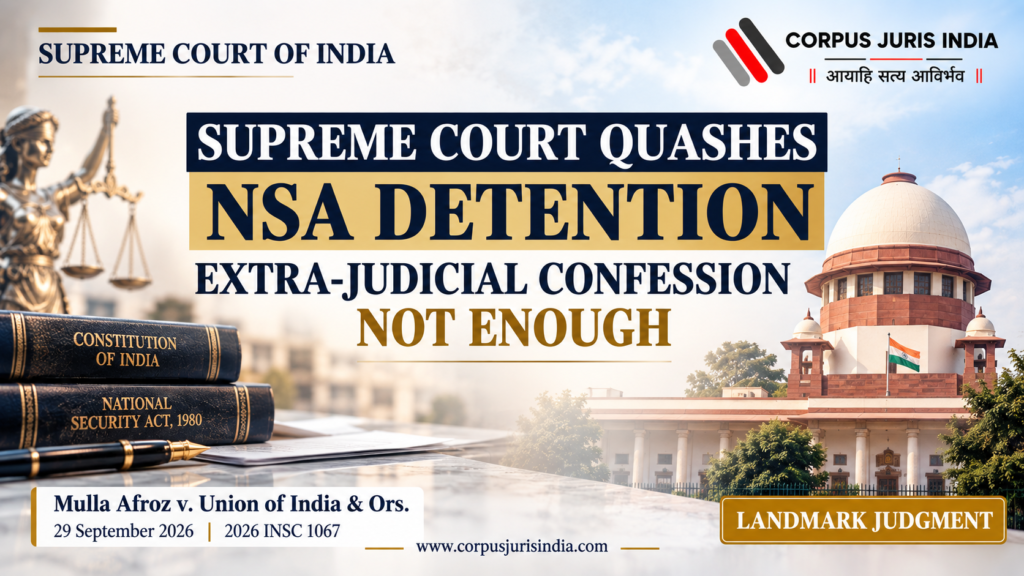
The Supreme Court of India, in Mulla Afroz v. Union of India & Ors., 2026 INSC 1067, has examined the limits of preventive detention under the National Security Act, 1980.
In its judgment dated 29 September 2026, the Court quashed the preventive detention order against Mulla Afroz and imposed ₹10 lakh costs on the State of Uttar Pradesh.
The judgment addresses important questions concerning preventive detention, constitutional safeguards, police confessions, application of mind by the detaining authority, and the relevance of a bail order while considering preventive detention.
Case Details
| Particular | Details |
|---|---|
| Case Title | Mulla Afroz v. Union of India & Ors. |
| Citation | 2026 INSC 1067 |
| Court | Supreme Court of India |
| Bench | Justice Dipankar Datta and Justice Sheel Nagu |
| Date of Judgment | 29 September 2026 |
| Case Number | Criminal Appeal No. 4310 of 2026 |
| Arising From | SLP (Crl.) No. 12534 of 2026 |
| Nature of Matter | Criminal Appeal |
| Principal Legislation | National Security Act, 1980 |
| Key Constitutional Provisions | Articles 20(3), 21 and 22(5) |
| Other Key Provision | Section 23, Bharatiya Sakshya Adhiniyam, 2023 |
| Principal Legal Issue | Whether an extra-judicial confession can form the basis of preventive detention under the NSA |
| Final Outcome | Appeal allowed; detention order and connected orders set aside |
| Costs | ₹10 lakh imposed on the State of Uttar Pradesh |
Background of the Case
The matter arose from proceedings relating to the violence that occurred in Sambhal, Uttar Pradesh, on 24 November 2024.
Mulla Afroz was arrested in January 2025 in connection with criminal cases arising from the incident. The case record concerned, among other things, an alleged confessional statement made before the police and the material relied upon by the authorities for initiating preventive detention.
The District Magistrate, Sambhal passed an order dated 13 October 2025 under Section 3(2) of the National Security Act, 1980.
The State Government subsequently confirmed the detention.
Afroz challenged the detention before the Allahabad High Court. The High Court dismissed the writ petition on 8 June 2026. He thereafter approached the Supreme Court.
Issues Before the Supreme Court
The Supreme Court examined, among other matters:
- Whether an extra-judicial confession made before a police officer could constitute the basis of preventive detention under the NSA; and
- Whether the constitutional and statutory safeguards governing preventive detention had been properly complied with.
What Did the Supreme Court Decide?
The Supreme Court allowed the appeal and set aside the Allahabad High Court judgment, the detention order and the order confirming the detention.
The Court directed that the appellant be released forthwith, unless his custody was required in any other case.
The Court also imposed ₹10 lakh costs on the State of Uttar Pradesh, directing that the amount be paid to the appellant within one month.
The Court clarified that it was not expressing any opinion on the merits of the underlying criminal proceedings, which would continue independently.
Extra-Judicial Confession and Preventive Detention
One of the important aspects of the judgment concerns the use of a confessional statement allegedly made before a police officer.
The Court held that such a confession cannot, by itself, constitute the basis for preventive detention.
The Court considered the protection against compelled self-incrimination under Article 20(3) of the Constitution and the statutory treatment of confessions made to police officers under Section 23 of the Bharatiya Sakshya Adhiniyam, 2023.
The judgment examines whether material that cannot ordinarily be used as substantive evidence against an accused in a criminal proceeding can nevertheless become the substantive basis for preventive detention.
The Court held that a police confession, standing alone, could not sustain the detention.
Independent Material Remains Relevant
The judgment does not mean that every preventive detention order involving a confession will automatically be invalid.
The Court clarified the importance of independent material.
Where other legally relevant and independent material exists apart from the confession, the validity of the detention order would have to be examined on the facts and circumstances of the particular case.
The important principle emerging from the judgment is that a police confession alone cannot sustain preventive detention.
Other Material Considered by the Court
The Supreme Court also examined the other material relied upon by the detaining authority.
CCTV Footage and Video Recordings
The detention grounds referred to CCTV footage and video recordings as important material.
The Court examined the fact that the material relied upon had not been supplied to the appellant and had not been produced before the Court in the manner required for examination.
This raised concerns regarding the effective opportunity available to the detenu to make a representation against the detention.
Mobile Phone Material
The detention grounds also referred to communications involving a person described as “Boss”.
The Court examined the manner in which this material had been relied upon and the absence of adequate supporting material explaining its source and evidentiary basis.
Chargesheet Is Not Proof of Guilt
The judgment also reiterates the distinction between an investigation and a finding of guilt.
The mere filing of a chargesheet does not establish that an accused is guilty. A chargesheet represents the investigating agency’s conclusion based on the material collected during investigation; it is not itself a judicial determination of guilt.
This distinction assumes particular importance where criminal proceedings and preventive detention operate simultaneously.
Preventive Detention and Bail
Another significant aspect of the judgment concerns the relationship between a bail order and preventive detention.
The Court considered the fact that the appellant had already been granted bail in one of the criminal cases before the preventive detention order was passed.
The judgment emphasises that preventive detention cannot be employed merely as an alternative route to continue a person’s custody after a judicial order granting bail.
Preventive detention serves a distinct legal purpose and cannot simply become a substitute for ordinary criminal custody.
Preventive Detention and Personal Liberty
Preventive detention occupies a distinctive position under the Constitution.
Although the Constitution recognises preventive detention, its exercise remains subject to constitutional safeguards.
Article 22(5), in particular, provides safeguards concerning communication of the grounds of detention and the opportunity to make a representation against the detention.
The Supreme Court’s decision reinforces the importance of examining the decision-making process, the material relied upon by the detaining authority and the safeguards available to the person detained.
Earlier Judicial Position
The Supreme Court also considered the existing judicial position concerning the use of confessional material in preventive detention.
The judgment dealt with the Full Bench decision of the Madras High Court in Suman v. State of Tamil Nadu and overruled it to the extent that it permitted a confessional statement to form the basis of detention in circumstances inconsistent with the principle laid down by the Supreme Court.
This aspect gives the judgment additional precedential significance for future cases involving preventive detention and confessional material.
Final Directions of the Supreme Court
The Supreme Court:
- Allowed the appeal.
- Set aside the Allahabad High Court judgment.
- Set aside the preventive detention order and the confirmation order.
- Directed the release of the appellant forthwith, unless his custody was required in any other case.
- Imposed costs of ₹10 lakh on the State of Uttar Pradesh, payable to the appellant within one month.
- Clarified that the judgment did not express any opinion on the merits of the underlying criminal proceedings.
Key Legal Takeaways
- A confessional statement made before a police officer cannot, by itself, sustain preventive detention under the NSA.
- Constitutional safeguards under Article 20(3) remain relevant when examining the use of confessional material.
- Section 23 of the Bharatiya Sakshya Adhiniyam, 2023 is relevant to the treatment of confessions made to police officers.
- The detaining authority must consider relevant and independent material.
- A chargesheet is not proof of guilt.
- A previous bail order is a relevant circumstance.
- Preventive detention cannot simply be used to bypass or frustrate a judicial order granting bail.
- The safeguards under Article 22(5) remain an important protection for persons subjected to preventive detention.
- The judgment also addresses the earlier position taken in Suman v. State of Tamil Nadu concerning confessional material in preventive detention.
Why This Judgment Matters
The significance of the decision lies in its examination of the boundary between ordinary criminal prosecution and preventive detention.
Preventive detention operates on a different legal basis from prosecution for an offence. However, the existence of this separate mechanism does not remove the constitutional safeguards applicable to a person whose liberty is curtailed.
By examining the material relied upon by the detaining authority, the treatment of a police confession, the relevance of a bail order and the distinction between a chargesheet and proof of guilt, the judgment provides useful guidance for understanding the limits of preventive detention under the NSA.
For advocates, law students, researchers and others studying constitutional and criminal law, the decision is particularly relevant to the intersection of personal liberty, preventive detention and procedural safeguards.
Conclusion
The Supreme Court’s judgment in Mulla Afroz v. Union of India & Ors., 2026 INSC 1067, provides an important examination of the safeguards surrounding preventive detention under the National Security Act, 1980.
The central principle is that an extra-judicial confession made before a police officer, standing alone, cannot constitute a sufficient basis for preventive detention.
The decision also emphasises the need for proper consideration of relevant material, the significance of existing judicial orders and the distinction between preventive detention and ordinary criminal proceedings.
The judgment therefore provides an important reference point for understanding the constitutional limits governing preventive detention and the protection of personal liberty.
📄 Read the Judgment
[ READ / DOWNLOAD THE OFFICIAL SUPREME COURT JUDGMENT — 2026 INSC 1067 ]
Case Details — Quick Reference
| Particular | Details |
|---|---|
| Case Title | Mulla Afroz v. Union of India & Ors. |
| Citation | 2026 INSC 1067 |
| Court | Supreme Court of India |
| Bench | Justice Dipankar Datta and Justice Sheel Nagu |
| Date of Judgment | 29 September 2026 |
| Case Number | Criminal Appeal No. 4310 of 2026 |
| SLP Number | SLP (Crl.) No. 12534 of 2026 |
| Subject | Preventive Detention / National Security Act / Personal Liberty |
| Key Constitutional Provisions | Articles 20(3), 21 and 22(5) |
| Key Statutory Provisions | Section 3(2), National Security Act, 1980; Section 23, Bharatiya Sakshya Adhiniyam, 2023 |
| Outcome | Appeal allowed; detention order and connected orders set aside |
| Release Direction | Appellant directed to be released forthwith, unless required in any other case |
| Costs | ₹10 lakh imposed on the State of Uttar Pradesh |
Disclaimer
This content is published solely for legal information, legal education and reporting of judicial or legal developments. It does not constitute legal advice, create a lawyer-client relationship, or amount to solicitation or advertisement under the applicable Bar Council of India Rules.
Readers are advised to refer to the original judgment and applicable law for the complete legal position.