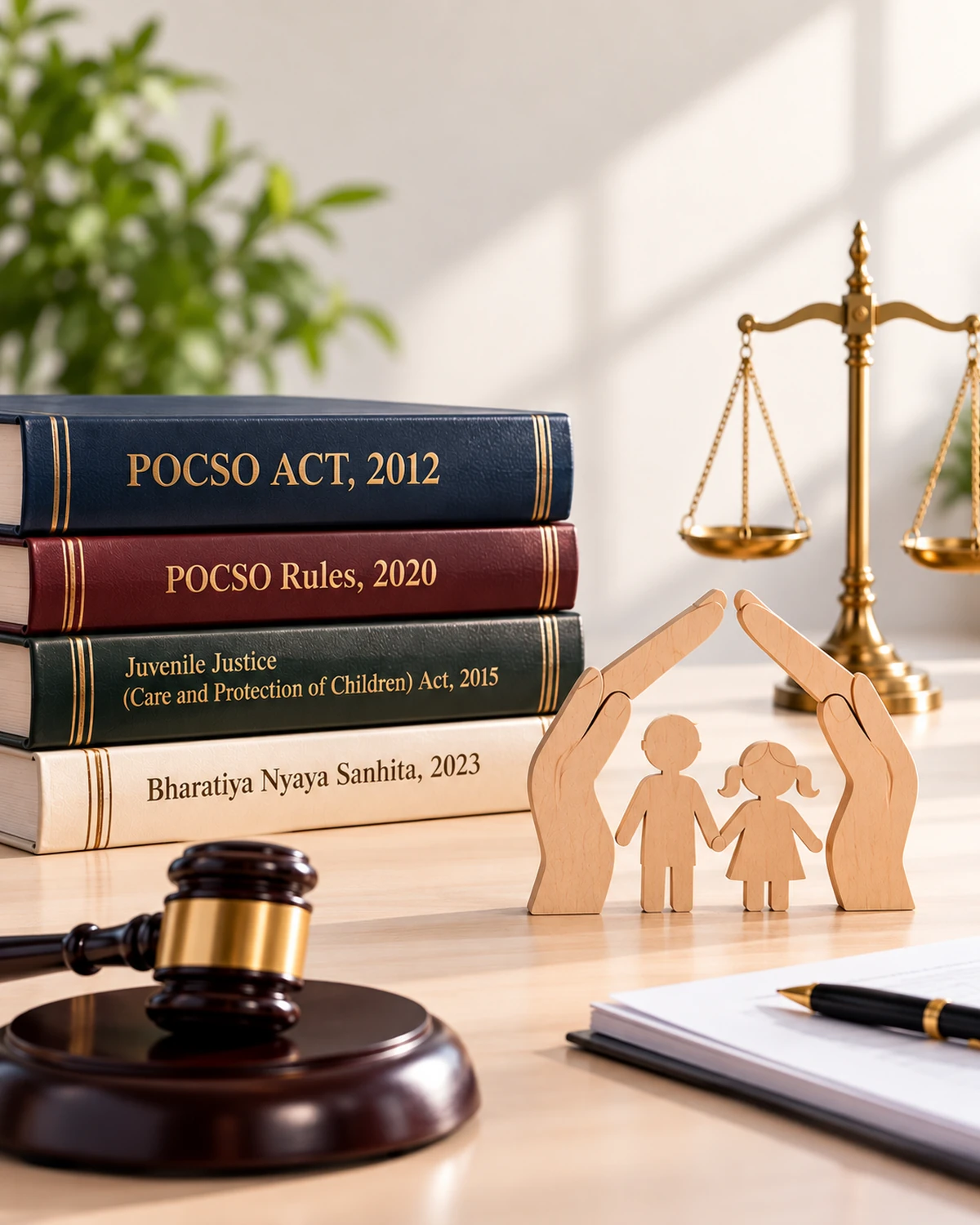
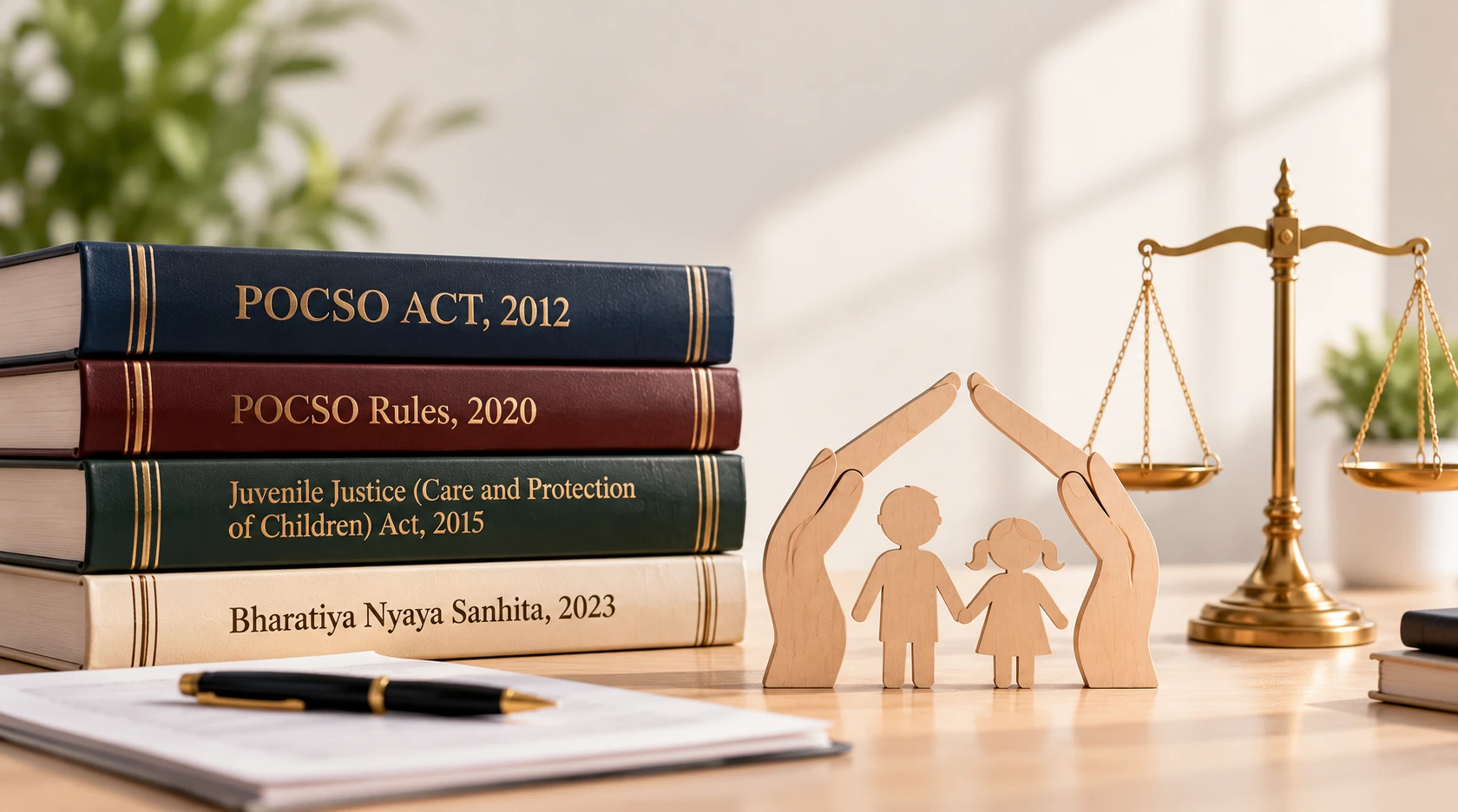
The Protection of Children from Sexual Offences Act, 2012 (POCSO Act) is a comprehensive statute enacted to protect children from offences of sexual assault, sexual harassment and pornography, and to provide for child-friendly mechanisms for the reporting, recording of evidence, investigation and trial of such offences. For the purposes of the Act, a
"child" means any person below the age of eighteen years. The Act is gender-neutral in its application and is supplemented by the
POCSO Rules, 2020, which provide for procedures and safeguards relating to reporting, investigation, support persons and other matters under the Act. Depending on the nature of the matter, other laws such as the
Bharatiya Nyaya Sanhita, 2023, the
Juvenile Justice (Care and Protection of Children) Act, 2015, the
Information Technology Act, 2000 (in relation to child sexual abuse material) and the
Bharatiya Sakshya Adhiniyam, 2023 may also be relevant.
Matters under the POCSO Act are governed by
child-friendly procedural safeguards, including the designation of
Special Courts, provisions for recording the statement of the child at the child's residence or a place of choice, in-camera proceedings, and
statutory presumptions in specified cases under the Act. The Act and the POCSO Rules, 2020 provide for support persons and child-friendly safeguards, while Child Welfare Committees may have a role in matters concerning the care and protection of the child under the applicable framework. The procedures, remedies and protections available depend on the applicable statutory framework and the nature of the matter.
Key Areas of POCSO
An overview of the principal categories of offences and procedural matters under the Protection of Children from Sexual Offences Act, 2012, and related legal issues.
01. Penetrative Sexual Assault
Matters relating to offences of penetrative sexual assault under the Act.
Common Matters: Complaints and proceedings relating to penetrative sexual assault.
Key Issues: Nature of the alleged conduct, age of the child, evidentiary considerations and applicable statutory provisions.
Legal Focus: POCSO Act, 2012 — Sections 3 and 4; and related provisions of the applicable criminal law framework.
02. Sexual Assault
Matters relating to offences of sexual assault (non-penetrative) under the Act.
Common Matters: Complaints and proceedings relating to sexual assault involving a child.
Key Issues: Nature of the alleged act, age of the child, applicable statutory provisions and evidentiary considerations.
Legal Focus: POCSO Act, 2012 — Sections 7 and 8.
03. Sexual Harassment of a Child
Matters relating to sexual harassment of a child as defined under the Act, including certain forms of conduct with sexual intent.
Common Matters: Complaints relating to sexual harassment of a child, including conduct falling within the statutory definition.
Key Issues: Nature of the alleged conduct, sexual intent, and evidentiary considerations.
Legal Focus: POCSO Act, 2012 — Sections 11 and 12.
04. Child Sexual Abuse Material
Matters relating to the use of a child for pornographic purposes and the production, distribution or possession of child sexual abuse material.
Common Matters: Complaints and proceedings relating to child pornography, including its production, distribution, transmission or possession.
Key Issues: Nature of the material, applicable provisions, and evidentiary and jurisdictional considerations.
Legal Focus: POCSO Act, 2012 — Sections 13, 14 and 15; Information Technology Act, 2000; and related provisions.
05. Aggravated Offences
Matters relating to aggravated forms of offences under the Act, where the conduct is accompanied by specified aggravating circumstances.
Common Matters: Complaints and proceedings involving aggravated sexual assault or aggravated penetrative sexual assault.
Key Issues: Nature of the aggravating circumstances, statutory classification, and applicable punishment provisions.
Matters relating to the conduct of trial of offences under the Act, including the role of designated Special Courts and child-friendly procedure.
Common Matters: Proceedings before Special Courts, in-camera trial, and related procedural matters under the Act.
Key Issues: Designation of Special Courts, procedure for recording evidence, timelines, and child-friendly safeguards.
Legal Focus: POCSO Act, 2012 — Sections 28, 31, 33 and 35 to 38; and POCSO Rules, 2020.
07. Statement Recording & Evidence
Matters relating to the recording of the statement of the child, and procedural safeguards relating to evidence in POCSO proceedings.
Common Matters: Recording of statements, examination of the child, and evidence-related procedural matters.
Key Issues: Place of recording, presence of support persons, safeguards during examination, and evidentiary considerations.
Legal Focus: POCSO Act, 2012 — Sections 24 to 27 and Section 35; POCSO Rules, 2020; Bharatiya Sakshya Adhiniyam, 2023, where applicable.
08. Support Persons & Child Welfare
Matters relating to support persons, care and protection of the child, and the role of authorities under the applicable framework.
Common Matters: Appointment of support persons, care and protection measures, and related proceedings.
Key Issues: Role of support persons and Child Welfare Committees, statutory safeguards, and procedural requirements.
Legal Focus: POCSO Act, 2012; POCSO Rules, 2020, including Rule 4; and the Juvenile Justice (Care and Protection of Children) Act, 2015, where applicable.
09. Appeals & Further Remedies
Remedies against orders or decisions in POCSO matters, including statutory appeals, bail and other proceedings.
Common Matters: Statutory appeals, bail applications, quashing petitions and further remedies available under the applicable law.
Key Issues: Availability of the remedy, limitation, jurisdiction, and grounds of challenge.
Legal Focus: POCSO Act, 2012; Bharatiya Nagarik Suraksha Sanhita, 2023; and constitutional or other statutory remedies where available.
Legal Assistance in POCSO Matters
An overview of the legal assistance that may be relevant in POCSO matters, depending on the facts, the applicable statute and the forum or authority having jurisdiction.
01
Pre-Filing Assessment & Advisory
Understanding the nature of the POCSO matter, relevant facts and documents, the applicable provisions of the POCSO Act, 2012, the POCSO Rules, 2020, the Bharatiya Nyaya Sanhita, 2023 and related statutes — and the appropriate forum or authority, where applicable, before proceedings are initiated or responded to.
02
Complaints, Notices & Responses
Assistance relating to the drafting of complaints and responses, and to the review of and response to notices, summons or other communications issued by the police, the Child Welfare Committee, the Special Court or other authorities, in accordance with the applicable statutory and procedural framework, including the safeguards under the POCSO Act and the POCSO Rules, 2020.
03
Bail, Anticipatory Bail & Interim Relief
Assistance in matters involving applications for bail, anticipatory bail or other interim relief that may be sought before the appropriate court, in accordance with the applicable law and procedural framework, including provisions of the Bharatiya Nagarik Suraksha Sanhita, 2023, and taking into account the specific considerations applicable to offences under the POCSO Act, 2012.
04
Representation & Assistance Before Special Courts and Authorities
Representation and assistance in proceedings before the Special Court, the Child Welfare Committee and other appropriate authorities, including matters relating to recording of statements, evidence, support persons and related procedural steps — in accordance with the child-friendly safeguards prescribed under the POCSO Act, 2012 and the POCSO Rules, 2020.
05
Trial, Evidence & Child-Friendly Procedure
Assistance in the conduct of trial and in the presentation of evidence, examination of witnesses where applicable, and related proceedings, in accordance with the applicable procedural and evidentiary framework, including the Bharatiya Sakshya Adhiniyam, 2023, where applicable, and the child-friendly safeguards under the POCSO Act, 2012 and the POCSO Rules, 2020.
06
Appeals & Further Remedies
Assistance concerning appeals and other remedies available under applicable laws — including statutory appeals before the appropriate appellate court, where permitted by law, and further remedies before the High Court or the Supreme Court, subject to the statutory conditions, limitation and procedural requirements prescribed under the relevant laws.
Stages in a POCSO Matter
A procedural overview of how a POCSO matter may progress, in accordance with the child-friendly safeguards prescribed under the Protection of Children from Sexual Offences Act, 2012 and the POCSO Rules, 2020.
01
Complaint / Report of Offence
A matter may commence with a complaint or report of an offence under the Act, which may be made by any person, including the child. The report may be recorded in accordance with the applicable provisions and safeguards under the Act and the POCSO Rules, 2020.
02
Recording of Statement of the Child
The statement of the child may be recorded in accordance with the applicable provisions, with safeguards such as recording at the child's residence or a place of choice, and in the presence of a support person, where applicable.
03
Investigation & Medical Examination
Investigation may be conducted in accordance with the applicable statutory framework, and medical examination, where required, may be conducted in accordance with the procedure and safeguards prescribed under the Act and the POCSO Rules, 2020.
04
Support Person & Child Welfare Measures
A support person may be provided to assist the child during the investigation and trial, and matters relating to the care and protection of the child may involve the Child Welfare Committee, in accordance with the applicable statutory framework, including the POCSO Act, the POCSO Rules, 2020 and, where applicable, the Juvenile Justice (Care and Protection of Children) Act, 2015.
05
Filing of Police Report / Complaint
Upon completion of investigation, a police report or charge sheet may be filed or presented before the appropriate court, as applicable, in accordance with the applicable statutory and procedural framework. A complaint may also be presented before the appropriate court or authority where permitted by law.
06
Trial before the Special Court
The matter may proceed to trial before the designated Special Court, in accordance with the child-friendly procedural safeguards under the Act, including in-camera proceedings, recording of the child's evidence, and related measures.
07
Judgment / Order
After considering the evidence and submissions, the Special Court may pass a judgment or order in accordance with the applicable law and the nature of the proceedings, subject to the statutory presumptions in specified cases under the Act.
08
Appeals & Further Remedies
Where the applicable law permits, an aggrieved party may pursue a statutory appeal or other available remedy against a judgment or order, subject to the statutory conditions, limitation and procedural requirements.
The sequence illustrated is indicative. Depending on the nature of the matter, the applicable provisions and the forum involved, some stages may occur in a different order, concurrently or may not arise at all. Not every matter proceeds through every stage. The information provided is a general overview and should not be treated as legal advice for any particular matter.
How a POCSO Matter May Progress
An overview of how a POCSO matter may proceed through reporting, investigation, trial and appellate forums, in accordance with the child-friendly safeguards prescribed under the Protection of Children from Sexual Offences Act, 2012 and the POCSO Rules, 2020.
01
Complaint / Report
02
Investigation & Statement
03
Trial before Special Court
04
Appeals & Further Remedies
01
Reporting of the Offence & Recording of Statements
A POCSO matter may commence with a complaint or report of an offence, which may be made by any person, including the child. The report is to be recorded in accordance with the applicable provisions and safeguards under the Act, including the requirement that the identity of the child is not disclosed, and that the report is recorded in a manner that is child-friendly. The statement of the child may be recorded at the child's residence or a place of choice, and in the presence of a support person, where applicable.
In Simple Terms
The matter begins when a complaint or report is made. The child's statement is recorded with safeguards.
02
Investigation and Support Measures
Investigation may be conducted in accordance with the applicable statutory framework. A support person may be provided to assist the child during the investigation and trial, and matters relating to the care and protection of the child may involve the Child Welfare Committee, in accordance with the applicable framework, including the POCSO Act, the POCSO Rules, 2020 and, where applicable, the Juvenile Justice (Care and Protection of Children) Act, 2015. Medical examination, where required, is conducted in accordance with the prescribed procedure and safeguards.
In Simple Terms
Investigation takes place, and a support person may assist the child. Child welfare authorities may be involved.
03
Trial before the Special Court
Upon completion of investigation, a police report or charge sheet may be filed or presented before the appropriate court, as applicable. Where permitted by law, a complaint may also be presented before the appropriate court. The matter may proceed to trial before the designated Special Court, in accordance with the child-friendly procedural safeguards under the Act, including in-camera proceedings, recording of the child's evidence, and related measures. The Act further provides for statutory presumptions in specified cases.
In Simple Terms
The case goes to trial before a Special Court, with special protections for the child.
04
Appeals & Further Remedies
Where the applicable law permits, an aggrieved party may pursue a statutory appeal before the appropriate appellate court or forum and, where permitted, further remedies before the High Court or the Supreme Court, including judicial review before the High Court or other constitutional or appellate remedies, subject to the applicable legal framework. The availability of the appellate remedy, limitation and grounds of challenge depend on the relevant statute. These remedies are not available in every matter.
In Simple Terms
In appropriate cases, an appeal or other legal remedy may be available, subject to the applicable law.
Please note: The path followed by a POCSO matter depends on the applicable provisions,
the forum involved and the nature of the matter. Every matter does not necessarily proceed through every
stage shown above, and some stages may occur in a different order or not arise at all. The information
provided is a general overview and should not be treated as legal advice for any particular matter.
Documents & Information That May Be Relevant
The documents and information relevant to a POCSO matter depend on the nature of the matter, the applicable provisions and the forum or authority involved, and are subject to the child-friendly safeguards prescribed under the Act and the POCSO Rules, 2020.
01
Identity & Age Documentation
Identity and age-related records of the child, including birth certificate, school records, or other documents relevant to establishing the age of the child, where applicable to the matter.
02
Complaint / Report & Statements
Complaint or report of the offence, and records of the statement of the child recorded in accordance with the applicable provisions, including any statement recorded by the Magistrate, where applicable.
03
Medical Examination Records
Medical examination reports and related records, where applicable, prepared in accordance with the procedure and safeguards prescribed under the Act and the POCSO Rules, 2020.
04
Support Person & Child Welfare Committee Records
Records relating to the support person assisting the child, including relevant communications or records concerning such assistance, and records of the Child Welfare Committee or other authorities involved in matters concerning the care and protection of the child, where applicable.
05
Court / Special Court Records
Records of proceedings before the Special Court, including orders, applications, and other records relevant to the trial, in accordance with the applicable procedural framework and the child-friendly safeguards under the Act.
06
Evidence & Supporting Material
Documents, records, electronic evidence or other material relevant to the facts of the matter, subject to the applicable evidentiary framework and safeguards relating to the child, including the Bharatiya Sakshya Adhiniyam, 2023, where applicable.
Please Note: The documents relevant to a POCSO matter vary according to the nature of the matter, the applicable provisions and the forum or authority involved. Not every document listed above will be relevant to every matter. The information provided is a general overview and should not be treated as legal advice for any particular matter.
Frequently Asked Questions
Common questions about the Protection of Children from Sexual Offences Act, 2012, child-friendly safeguards, procedural protections and related legal remedies.
The Protection of Children from Sexual Offences Act, 2012 (POCSO Act) is a comprehensive statute enacted to protect children from offences of sexual assault, sexual harassment and pornography, and to provide for child-friendly mechanisms for reporting, recording of evidence, investigation and trial of such offences. The Act is supplemented by the POCSO Rules, 2020, which provide for procedures and safeguards relating to reporting, investigation, support persons and other matters. It operates alongside other statutes such as the Bharatiya Nyaya Sanhita, 2023, the Juvenile Justice (Care and Protection of Children) Act, 2015 and the Information Technology Act, 2000, depending on the nature of the matter.
For the purposes of the POCSO Act, a "child" means any person below the age of eighteen years. The determination of age may be relevant in proceedings under the Act, and the Special Court may consider the question of age where it arises in the matter, in accordance with the applicable law and procedure. The Act is gender-neutral in its application and protects children of all genders.
The POCSO Act covers offences such as penetrative sexual assault (Sections 3 and 4), aggravated penetrative sexual assault (Sections 5 and 6), sexual assault (Sections 7 and 8), aggravated sexual assault (Sections 9 and 10), sexual harassment of a child (Sections 11 and 12), and offences relating to the use of a child for pornographic purposes and child sexual abuse material (Sections 13 to 15). The Act also provides for punishment for these offences and for related matters such as abetment. The specific classification of an act depends on the facts and the applicable statutory provisions.
An offence under the POCSO Act may be reported to the Special Juvenile Police Unit or the local police, and the report is to be recorded in accordance with the applicable provisions and safeguards under the Act. The Act also provides for mandatory reporting in specified circumstances, and failure to report may attract consequences under the applicable law. The statement of the child is to be recorded in accordance with the child-friendly safeguards prescribed under the Act, including recording at the child's residence or a place of choice and, where applicable, in the presence of a support person. The identity of the child is protected under the applicable provisions of the Act.
The POCSO Act provides for several child-friendly procedural safeguards, including the designation of Special Courts, in-camera proceedings, provisions relating to recording the statement and evidence of the child, and safeguards to prevent the child from being exposed to the accused during trial. The POCSO Rules, 2020 further provide for support persons and related assistance to the child, while the Child Welfare Committee may have a role in matters concerning the care and protection of the child under the applicable framework. The specific safeguards applicable to a matter depend on the applicable provisions and the nature of the proceedings.
A support person may be provided to assist the child through the investigation and trial under the POCSO framework. The role of the support person is to provide assistance and support to the child during the proceedings, and the framework for such assistance is set out under the POCSO Rules, 2020. The Child Welfare Committee may have a role in matters concerning the care and protection of the child under the applicable framework. The specific role and functions of a support person depend on the applicable provisions and the nature of the matter.
Yes. The POCSO Act provides safeguards for protecting the identity of the child. Section 23 restricts disclosure of information that may identify the child in media reports, subject to the statutory exception provided by the Act. The Special Court is also required to ensure that the identity of the child is not disclosed in proceedings, subject to the applicable provisions. The specific requirements and exceptions depend on the applicable statutory framework.
The POCSO Act contains statutory presumptions in specified cases. Sections 29 and 30 of the Act provide for presumptions relating to certain offences and culpable mental state, subject to the conditions and requirements set out in the Act. The applicability and scope of these presumptions depend on the specific provisions, the nature of the offence and the facts of the matter. The court may consider the applicable statutory presumptions in accordance with the law.
Offences under the POCSO Act are not compoundable under the Act. A settlement between parties does not, by itself, amount to compounding of a POCSO offence or bring criminal proceedings to an end. Any application seeking quashing or other relief in an appropriate case is a separate matter governed by the applicable law and judicial principles, and its availability depends on the nature of the proceedings and the facts of the case.
Remedies available in a POCSO matter depend on the applicable provisions and the nature of the proceedings. Where the applicable law permits, an aggrieved party may pursue a statutory appeal before the appropriate appellate court or forum and, where permitted, further remedies before the High Court or the Supreme Court. Judicial review may be available before the High Court under its constitutional jurisdiction, while the Supreme Court may exercise its constitutional or appellate jurisdiction where the applicable requirements are satisfied. The availability of a particular remedy, limitation and grounds of challenge depend on the applicable law and the nature of the order.
Further Reading
Related Legal Areas
Explore related legal information and resources relevant to POCSO matters and related legal issues.
Please read the following information before accessing this website.
The Rules of the Bar Council of India prohibit advocates and law firms from soliciting work or advertising in any manner. By clicking on "Proceed to Website", you acknowledge and confirm that:
You wish to obtain information about Corpus Juris India (CJI), its practice areas, advocates, and legal services for your own information and use.
The information available is provided solely upon your specific request. Your access does not create an advocate-client relationship.
The content is for legal awareness only. Nothing herein is legal advice, opinion, solicitation, or advertisement.
CJI shall not be liable for reliance on this information. Users are advised to seek independent legal counsel before acting.
By continuing, you consent to cookies per our Privacy Policy.