Child Law

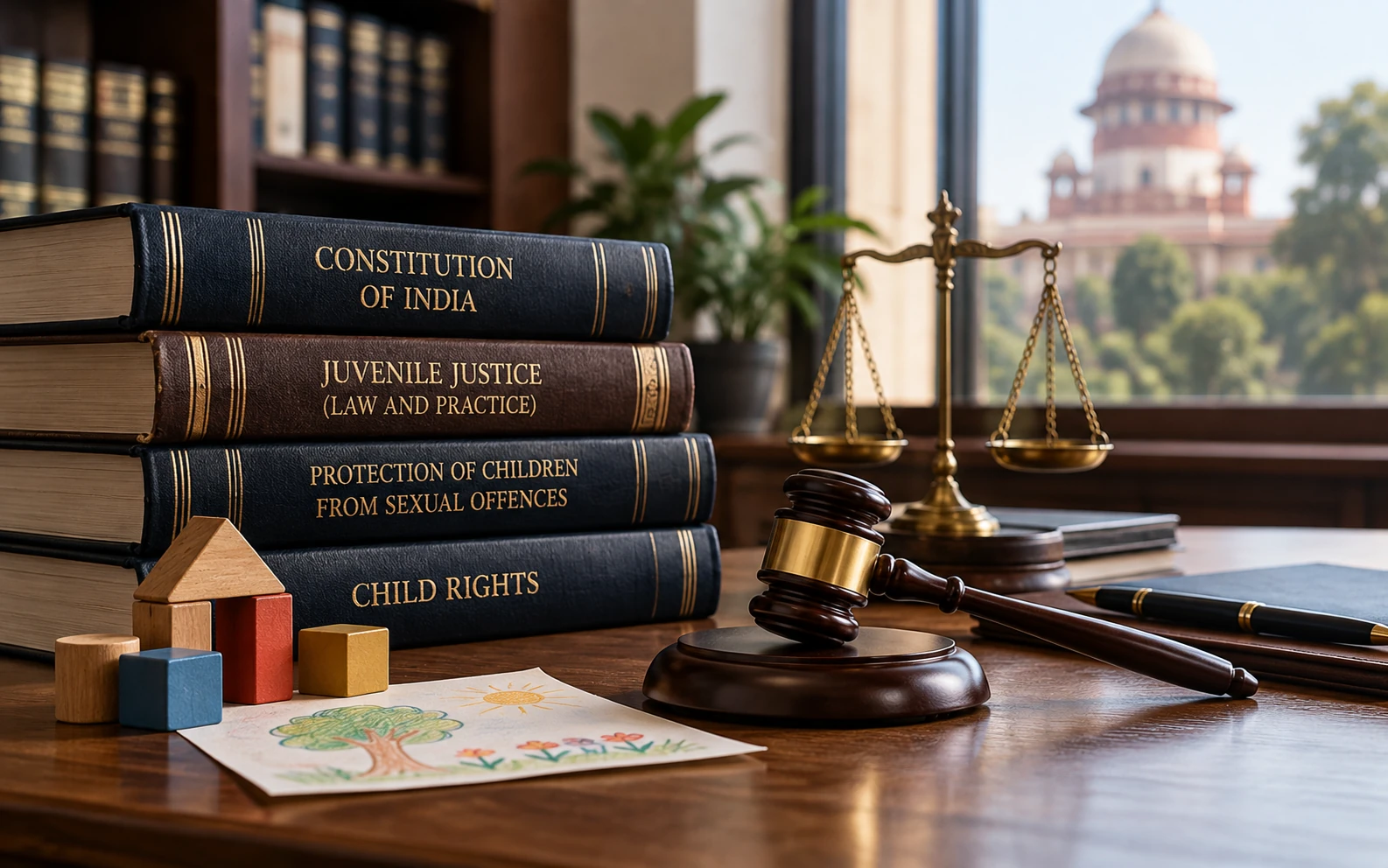
Child Law legal books and legal materials relating to child protection and welfare

Child Law

Child law concerns legal issues relating to the protection, welfare, rights and legal interests of children. It includes proceedings under the Juvenile Justice (Care and Protection of Children) Act, 2015, matters under the Protection of Children from Sexual Offences Act, 2012, and issues relating to custody, guardianship, adoption, education and child welfare.

The nature and procedure of a child-related matter depend on the facts of the case, the applicable statute and the court or authority having jurisdiction over the matter. Proceedings may involve the Child Welfare Committee, Juvenile Justice Board, Family Court or other competent authorities, and may include inquiries, interim orders, counselling and rehabilitative measures before final determination.

Key Areas of Child Law

An overview of the principal categories of child-related legal matters.

01. Juvenile Justice

Proceedings concerning children in conflict with law and children in need of care and protection.

  • Common Matters: Juvenile Justice Board proceedings, Child Welfare Committee proceedings and care and protection orders.
  • Key Issues: Age determination, bail, inquiry procedure and rehabilitative measures.
  • Legal Focus: Juvenile Justice (Care and Protection of Children) Act, 2015 — rehabilitation, reintegration and welfare of the child.

02. Child Protection & POCSO Matters

Matters concerning the protection of children from sexual offences and related protective proceedings.

  • Common Matters: POCSO complaints, victim support proceedings and related protective matters.
  • Key Issues: Reporting, investigation, victim protection and support mechanisms.
  • Legal Focus: Protection of Children from Sexual Offences Act, 2012 — child-friendly procedures and protective measures.

03. Custody & Guardianship

Child-centric proceedings concerning custody, guardianship, access and welfare of a minor.

  • Common Matters: Custody, guardianship, visitation and child welfare determinations.
  • Key Issues: Best interests of the child, welfare principle and guardianship certificates.
  • Legal Focus: Guardians and Wards Act, 1890 and Hindu Minority and Guardianship Act, 1956, where applicable — welfare of the child as paramount consideration.

04. Adoption

Legal proceedings concerning adoption of children under applicable personal and statutory laws.

  • Common Matters: In-country adoption, relative adoption and adoption under personal law.
  • Key Issues: Eligibility, consent, court procedures and adoption regulations.
  • Legal Focus: Juvenile Justice (Care and Protection of Children) Act, 2015 and applicable adoption regulations, with the Hindu Adoptions and Maintenance Act, 1956, where applicable.

05. Child Marriage Prohibition

Matters concerning the prevention and prohibition of child marriage under applicable law.

  • Common Matters: Prevention petitions, nullity of child marriage and protection of the child.
  • Key Issues: Age verification, consent and protection of the child.
  • Legal Focus: Prohibition of Child Marriage Act, 2006 — prevention, protection and welfare of the child.

06. Child Labour & Education

Matters concerning the prohibition of child labour and the right to education of children.

  • Common Matters: Complaints relating to child labour, RTE enforcement and school admission issues.
  • Key Issues: Age-based employment, hazardous work and access to compulsory education.
  • Legal Focus: Child and Adolescent Labour (Prohibition and Regulation) Act, 1986 and Right of Children to Free and Compulsory Education Act, 2009.

07. Child Maintenance & Welfare

Matters concerning the right of a child to maintenance and welfare-related provisions.

  • Common Matters: Child maintenance claims, welfare arrangements and custody-linked maintenance.
  • Key Issues: Quantum, enforcement and continuing welfare of the child.
  • Legal Focus: Maintenance provisions under applicable personal laws and Section 144 of the BNSS, 2023, where applicable — welfare of the child.

08. Child Rights & Statutory Commissions

Matters concerning the protection of child rights before statutory commissions and authorities.

  • Common Matters: Complaints before NCPCR / DCPCR, child rights violations and related matters.
  • Key Issues: Enforcement of child rights, statutory recommendations and remedial measures.
  • Legal Focus: Commissions for Protection of Child Rights Act, 2005 and related statutory mechanisms.

09. Child Trafficking & Exploitation

Matters concerning trafficking, exploitation and rescue of children under applicable law.

  • Common Matters: Trafficking complaints, rescue and rehabilitation and victim compensation.
  • Key Issues: Identification, rescue, protection and long-term rehabilitation.
  • Legal Focus: Juvenile Justice (Care and Protection of Children) Act, 2015, the Bharatiya Nyaya Sanhita, 2023 and other applicable laws, where relevant — protection, rescue and rehabilitation.
Children reading in a library with legal volumes and scales of justice representing child law and education

Stages in a Child Matter

A procedural overview of how a child-related matter may progress before the competent authority.

Pre-Filing Assessment & Forum

The nature of the child-related matter, applicable statute and the appropriate forum — Child Welfare Committee, Juvenile Justice Board, Family Court, Special Court designated under the POCSO Act or other competent authority — are considered before proceedings are initiated, as applicable.

Filing / Registration

Depending on the nature of the matter, proceedings may begin through a petition, application, complaint, reference or other prescribed process before the competent court or authority, or through registration of an FIR where the matter concerns a cognizable offence.

Preliminary Stage & Initial Consideration

The competent court or authority considers the matter at the preliminary stage and takes such procedural steps as may be required, depending on the nature of the proceeding and the applicable legal framework.

Notice & Response

Notice may be issued to the concerned parties or authorities, who may file their response, reply or objections, as applicable, before the competent authority in the matter.

Interim Orders & Protection

Interim orders relating to custody, maintenance, protection or other interim directions may be sought during the pendency of proceedings, depending on the circumstances and the nature of the matter.

Inquiry / Proceedings

The inquiry or proceedings are conducted in accordance with the applicable statutory framework and child-friendly procedural safeguards, including consideration of relevant records, reports, statements and other material, as required by the nature of the matter.

Final Hearing & Order

After consideration of the material on record and submissions, the competent authority passes its final order or judgment in accordance with the applicable law and the facts of the matter.

Order, Rehabilitation & Remedies

Where applicable, the competent court or authority may pass appropriate orders concerning care, custody, protection, rehabilitation or other reliefs, depending on the nature of the matter. Available remedies against an order may include appeal, revision or other statutory remedies, where provided by law.

The sequence illustrated is indicative. Depending on the nature of the matter, some stages may occur in a different order, concurrently or may not arise at all. Interim relief or protection may be sought at an appropriate stage during proceedings.

How a Child Matter May Progress

An overview of where a child-related matter may be instituted and how it may proceed through appellate, revisional or other legal remedies, depending on the applicable statute.

Competent Forum
or Authority
Inquiry / Hearing /
Initial Order
Statutory Appeal /
Revision / Remedy
High Court /
Supreme Court

Competent Forum or Authority

Child-related matters may begin before the appropriate forum or authority, such as the Child Welfare Committee, Juvenile Justice Board, Special Court, Family Court or another competent authority, depending on the nature of the matter and the applicable statute.

In Simple Terms The right forum depends on the nature of the child-related matter — protection, custody, offence or welfare — and the law that applies to it.

Inquiry, Hearing or Initial Order

The competent forum or authority considers the matter in accordance with the applicable statute and may conduct an inquiry, hearing or other prescribed proceeding before passing an appropriate order or direction.

In Simple Terms The competent authority examines the matter as required by law and then passes its first order or direction.

Appeal, Revision or Other Statutory Remedy

Depending on the applicable law, an order may be subject to an appeal, revision, review or other statutory remedy, subject to the jurisdictional and procedural requirements governing the matter. The availability and route of such remedies depends on the statute under which the original proceeding was conducted.

In Simple Terms Where the law allows, a party may challenge the order before a higher forum — but the available remedy depends on the statute that applies.

High Court / Supreme Court Proceedings

Where permitted by the applicable law, further proceedings may lie before the High Court or Supreme Court, including appellate, revisional, writ or other jurisdiction, as applicable to the matter. The High Court may exercise its jurisdiction under Articles 226 and 227 of the Constitution, while the Supreme Court may exercise its jurisdiction under Article 32 and its discretionary power under Article 136, where maintainable.

In Simple Terms Where legally maintainable, a matter may reach the High Court or the Supreme Court — but not every case follows this path.
Please note: The path followed by a child-related matter depends on the applicable statute and the forum or authority having jurisdiction. Every child-related matter does not necessarily proceed through every stage shown above, and not all forums share the same appellate or revisional route. The information provided is a general overview and should not be treated as legal advice for any particular matter.

Documents & Information That May Be Relevant

The documents and information relevant to a child-related matter depend on the nature of the proceeding, the applicable statute and the forum or authority having jurisdiction.

Identity & Age Documentation

Birth certificate, age proof documents and identity details of the child and the concerned parties, along with relevant contact information — age documentation is often significant in child-related matters.

Custody, Guardianship & Adoption Documents

Custody orders, guardianship certificates, adoption-related records and documents under applicable personal laws or statutory provisions, where relevant to the matter.

Medical, Educational & Welfare Records

Medical records, school and educational documents, counselling or welfare reports and other records relevant to the child's care, welfare or circumstances, as applicable.

Child Welfare & Juvenile Justice Records

Records, reports, orders or communications relating to proceedings before the Child Welfare Committee, Juvenile Justice Board, Special Court or other competent authority, where applicable to the matter.

Notices, Complaints & Correspondence

Legal notices, complaints, replies, letters, emails and other communications with the concerned parties or authorities relevant to the matter and the positions taken.

Court Orders & Legal Records

Petitions, applications, orders, judgments, case records and other legal documents connected with the matter, where applicable.

Please Note: The documents relevant to a child-related matter vary according to its nature, the applicable statute and the forum or authority involved. Not every document listed above will be relevant to every matter. The information provided is a general overview and should not be treated as legal advice for any particular matter.

Frequently Asked Questions

Common questions about child law, statutory authorities, procedures and available legal remedies.

Child law concerns legal issues relating to the protection, welfare, rights and legal interests of children. It includes proceedings under statutes such as the Juvenile Justice (Care and Protection of Children) Act, 2015, the Protection of Children from Sexual Offences Act, 2012, and other laws relating to children, depending on the nature of the matter.

The applicable law depends on the nature of the matter. Key statutes include the Juvenile Justice (Care and Protection of Children) Act, 2015; the Protection of Children from Sexual Offences Act, 2012; the Prohibition of Child Marriage Act, 2006; the Child and Adolescent Labour (Prohibition and Regulation) Act, 1986; the Right of Children to Free and Compulsory Education Act, 2009; and the Commissions for Protection of Child Rights Act, 2005. Where applicable, the Guardians and Wards Act, 1890, the Hindu Minority and Guardianship Act, 1956, the Hindu Adoptions and Maintenance Act, 1956, and the Adoption Regulations, 2022 may also be relevant.

The Child Welfare Committee (CWC) is a statutory body constituted under the Juvenile Justice (Care and Protection of Children) Act, 2015. It deals with matters concerning children in need of care and protection, conducts inquiries and may pass orders relating to the care, protection, rehabilitation and welfare of such children, in accordance with the Act.

The Juvenile Justice Board (JJB) is constituted under the Juvenile Justice (Care and Protection of Children) Act, 2015, to deal with matters concerning children in conflict with law. It conducts an inquiry into the alleged matter and may pass orders relating to rehabilitation, counselling, or other measures as provided under the Act.

The "best interests of the child" is a guiding principle recognised under the Juvenile Justice (Care and Protection of Children) Act, 2015 and other child-related laws. It requires that decisions concerning a child prioritise the child's safety, well-being, and developmental needs. It also informs determinations relating to custody, guardianship and welfare of a minor, where applicable.

Matters under the Protection of Children from Sexual Offences Act, 2012 generally involve the registration of a complaint, investigation by the designated authorities and proceedings before a Special Court designated under the Act. The Act provides for child-friendly procedures and protective measures. The specific steps and timelines depend on the facts and the applicable provisions.

Custody generally relates to the physical care and day-to-day control of a child, while guardianship relates to the legal authority over the child's person and property. Both may be determined under the applicable personal laws and the Guardians and Wards Act, 1890, where applicable. In all such matters, the welfare of the child is treated as a paramount consideration.

Adoption of children in India may be governed by the Juvenile Justice (Care and Protection of Children) Act, 2015 read with the Adoption Regulations, 2022, and, in certain cases, by personal laws such as the Hindu Adoptions and Maintenance Act, 1956. The procedure generally involves eligibility requirements, consent, and approval by the competent court or authority, depending on the applicable framework.

Depending on the nature of the matter, a petition or complaint may be filed by a parent, guardian, relative, concerned person or statutory authority, as permitted under the applicable statute. Certain child-related laws also allow action to be initiated on the basis of information received from any source, or by the authority concerned, where provided by law.

There is no fixed period applicable to every child-related matter. The duration may depend on the nature of the proceeding, the applicable statute, the forum or authority concerned, the complexity of the matter and other procedural circumstances. Some matters may be resolved relatively quickly, while others may take longer.

Discuss Your Legal Matter

For information regarding a child-related legal matter or our areas of practice, you may contact Corpus Juris India through the available contact channels.

Contact Us
Scroll to Top

Legal Disclaimer

Please read the following information before accessing this website.

The Rules of the Bar Council of India prohibit advocates and law firms from soliciting work or advertising in any manner. By clicking on "Proceed to Website", you acknowledge and confirm that:

  • You wish to obtain information about Corpus Juris India (CJI), its practice areas, advocates, and legal services for your own information and use.
  • The information available is provided solely upon your specific request. Your access does not create an advocate-client relationship.
  • The content is for legal awareness only. Nothing herein is legal advice, opinion, solicitation, or advertisement.

CJI shall not be liable for reliance on this information. Users are advised to seek independent legal counsel before acting.

By continuing, you consent to cookies per our Privacy Policy.